



500 Million Stake Behind Solid-State Battery Positioning War: Fospower Technology Joins Hands with Zijin Mining to Layout Core Materials for Next-Generation Batteries
A traditional polymer materials company, with only a 5% stake, is participating in a battery-grade lithium sulfide project, reflecting the fierce competition in the Chinese battery industry for the strategic high ground of solid-state batteries.
A well-established listed company with a registered capital of nearly 1 billion yuan has invested 5 million yuan in a new project, which may not seem noteworthy at first. However, when this project involves core materials for next-generation power batteries, the partner is mining giant Zijin Mining, and the project is located in the Shanghang Industrial Zone of Longyan City, Fujian Province, this investment move becomes worth examining in detail.

Source of image: Foshan Plastics Group Co., Ltd.
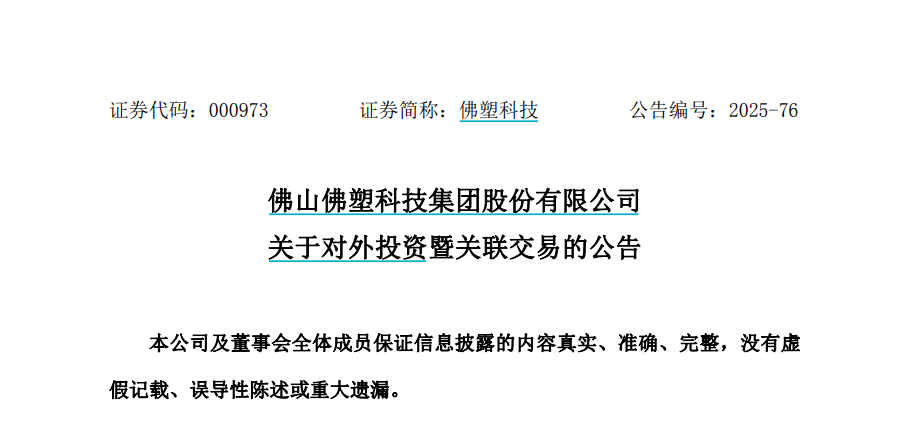
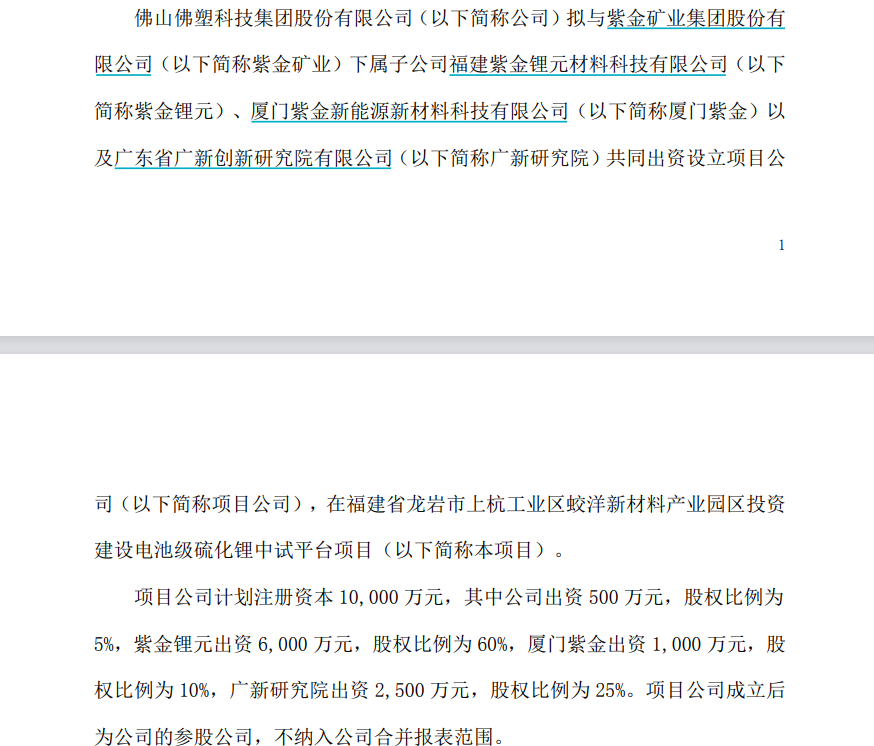
On November 13, Fospower Technology announced in a statement that it will jointly invest 100 million yuan with a subsidiary of Zijin Mining Group and the Guangdong Guangxin Innovation Research Institute to establish a pilot project for battery-grade lithium sulfide. Fospower Technology will invest 5 million yuan, holding only a 5% stake.
Source: Foshan Plastics Group Co., Ltd.
01 Key points of the project: Small investment, large layout
Foshan Plastics Group's investment project this time is not large in scale but includes all essential elements.
The total planned investment is 113 million yuan, and a 100 tons/year lithium sulfide production line will be constructed, mainly focusing on the research and development, production, and operation of high-purity battery-grade lithium sulfide products.
From the perspective of the equity structure, Zijin Mining's wholly-owned subsidiary, Fujian Zijin Lithium Materials Technology Co., Ltd., invested 60 million yuan to hold a 60% stake, thus holding a controlling position; Guangxin Research Institute invested 25 million yuan to hold a 25% stake; Xiamen Zijin New Energy Materials Technology Co., Ltd. contributed patent technology to hold a 10% stake; and FOSU Technology contributed 5 million yuan in cash to hold a 5% stake.
This equity arrangement is quite meaningful: Zijin Mining, as a leading domestic mining company, provides funding and resource advantages; Xiamen Zijin contributes core technology; Guangxin Research Institute represents state-owned assets; and Fospower Technology, as a traditional high polymer materials enterprise, gains entry with a relatively small investment. The project is planned to have a construction period of 10 months and is located in the Jiaoyang New Materials Industrial Park in Shanghang Industrial Zone, Longyan City, Fujian Province. It is worth noting that Shanghang County in Longyan City is the birthplace and development base of Zijin Mining, with the actual controller being the Shanghang County Finance Bureau. This site selection clearly takes into account the local industrial synergy effects.
02 Lithium Sulfide: Key Material for Solid-State Batteries
Lithium sulfide plays a key role in this project.
It is one of the main raw materials for sulfide solid-state electrolytes and is regarded by the industry as a core material for the key technological path of the next generation of power batteries. Traditional lithium-ion batteries use liquid electrolytes, which pose safety risks and energy density bottlenecks. Solid batteries replace liquid electrolytes with solid-state electrolytes, offering higher safety and energy density, making it one of the mainstream directions for the future development of power batteries. Among the three major technological paths of solid-state batteries (polymer, oxide, sulfide),Sulfide solid electrolytes have the highest lithium-ion conductivity.This is considered the most promising technological direction, approaching or even surpassing existing liquid electrolytes.

Image source: Doubao AI
However, the industrialization of sulfide solid-state batteries still faces many challenges. Lithium sulfide itself is highly reactive and extremely sensitive to moisture and oxygen, requiring very high production process standards. Additionally, the interfacial stability issues between the sulfide solid electrolyte and the cathode and anode materials also need to be addressed.
The pilot project's annual production capacity of 100 tons is moderate on a global scale, indicating that the project is still in the early stages of industrialization. The core task of the pilot platform will be to overcome the stable mass production technology of high-purity battery-grade lithium sulfide, laying the foundation for subsequent large-scale industrialization.
03 Acceleration of Solid-State Battery Industrialization
Foshan Plastics Group's investment proportion may not be large this time, but the strategic intent behind it is clear.
Founded in 1988, Foshan Plastics Group Co., Ltd. is an established company in the polymer materials industry, with the actual controller being the Guangdong Provincial People's Government. Its main business involves the production and sales of various advanced polymer new materials. In recent years, the company has been continuously expanding its layout into the field of new energy materials.
Participating in the lithium sulfide project can be regarded as a further deepening of its new energy strategy. Investing 5 million yuan to gain access to cutting-edge battery materials is a controllable risk for Fosu Technology, which has an annual revenue exceeding 2 billion yuan, but the potential returns could be significant.
The global power battery industry is on the eve of a technological transformation. The energy density of the current mainstream liquid lithium-ion batteries is gradually approaching its theoretical limit, and safety issues have not yet been completely resolved.
Solid-state batteries are widely regarded as the mainstream direction for the next generation of power batteries. Japanese car manufacturers started early in the field of sulfide solid-state batteries, with Toyota holding over 1,000 related patents and planning to achieve mass production around 2025. Domestic battery companies, including CATL and BYD, are also accelerating their solid-state battery research and development.
According to industry forecasts, 2025 may become the year for mass production of semi-solid-state batteries, and by around 2030, all-solid-state batteries are expected to achieve large-scale application. This timeline basically aligns with the 10-month construction period of this pilot project and the subsequent industrialization process.
05 Foshan Plastics Group's Current Situation: Transformation Attempts in Steady Operations
From the perspective of Fosun Technology's own performance, the company's operating conditions are relatively stable. The operating revenues from 2022 to 2024 were 2.635 billion yuan, 2.215 billion yuan, and 2.228 billion yuan, respectively, while the first three quarters of 2025 recorded 1.662 billion yuan. In terms of net profit, the net profit attributable to the parent company from 2022 to 2024 was 136 million yuan, 214 million yuan, and 120 million yuan, respectively, with 83.919 million yuan for the first three quarters of 2025.
Although there have been fluctuations in performance, the company has maintained an overall profitable status. In terms of asset-liability ratio, the company's financial structure is relatively stable, maintaining a ratio between 25% and 30% from 2022 to the third quarter of 2025. Regarding risks, information from Tianyancha indicates that the company has multiple risk alerts, but as a long-established listed company with over 30 years of history, the overall risk is controllable. The investment of 5 million yuan in the lithium sulfide project has a limited impact on Foshan Plastics Group's financial status. Once the project company is established, it will be considered an affiliate and will not be included in the consolidated financial statements, aligning with the company's strategic position of seeking innovative breakthroughs while maintaining stable operations.
06 Prospects: Opportunities and Challenges Coexist
Lithium sulfide for battery applications is an emerging field with broad prospects but numerous challenges. On one hand, as the industrialization process of solid-state batteries accelerates, the demand for core upstream materials will continue to grow. On the other hand, the technical route has not yet been fully established, and the industrial chain still needs to be improved.
As the global power battery industry evolves towards solid-state technology, the upstream materials sector is bound to undergo a new round of reshuffling. Although Fosun Technology has only invested 5 million, it has secured a ticket to enter the race. Whether it can leverage this layout to occupy a place in the new energy materials field in the future will depend not only on the progress of the project itself but also on the maturity of the entire solid-state battery industry.
Editor: Lily
Source: Caizhong Society, Fosun Technology, Securities Star, Polaris Energy Storage Network, etc.
【Copyright and Disclaimer】This article is the property of PlastMatch. For business cooperation, media interviews, article reprints, or suggestions, please call the PlastMatch customer service hotline at +86-18030158354 or via email at service@zhuansushijie.com. The information and data provided by PlastMatch are for reference only and do not constitute direct advice for client decision-making. Any decisions made by clients based on such information and data, and all resulting direct or indirect losses and legal consequences, shall be borne by the clients themselves and are unrelated to PlastMatch. Unauthorized reprinting is strictly prohibited.
Most Popular
-
U.S. Appeals Court Officially Rules: Trump Tariff Unlawful and Void!
-
[Today's Plastics Market] General Materials Weakly Fluctuate, Engineering Materials Steadily Rise
-

At Least 44 Dead in Century-Old Fire! Questioning Hong Kong's Hong Fu Garden: Why Has the Path to Fire Resistance Taken 15 Years Without Progress?
-
Avatr Files for IPO on HKEX, Plans to Complete Listing in Q2 2026
-
Satellite chemical's profits surge! can the 26.6 billion yuan high-end new materials project meet expectations? a review of progress on four major projects