



Ideal Auto Releases AI Glasses Livis, Why Are Car Companies Collectively Betting on AI Terminals
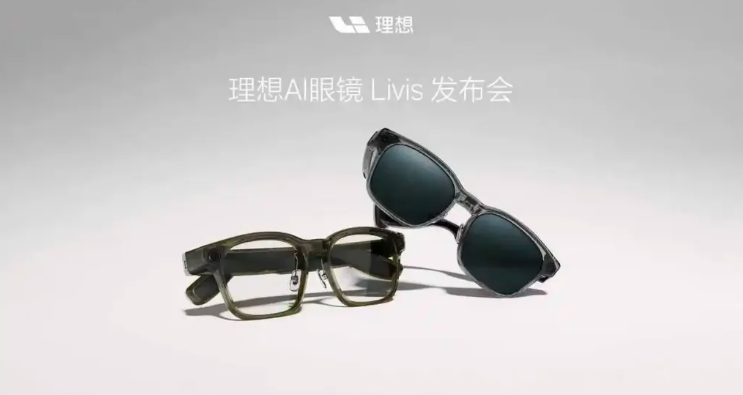
Currently, as electrification technology in the automotive industry gradually converges, intelligent deployment has become the key arena for car manufacturers to differentiate themselves. At the same time, cars are no longer isolated transportation tools but are beginning to become nodes in a cross-terminal ecosystem.
On December 3rd, Li Auto officially launched the Li Xiang AI Glasses Livis and announced a global strategic partnership with Zeiss. This product is the first tangible result of their collaboration, priced starting at 1999 yuan, which drops to 1699 yuan after national subsidies.
This smart accessory further connects its intelligent cockpit experience with users' mobile scenarios, representing another practice of automakers' cross-industry layout of AI terminals.
Wang Peng, an associate researcher at the Beijing Academy of Social Sciences, mentioned in an interview with a reporter from The Paper that this phenomenon reflects the comprehensive upgrade of the automobile industry from "electric competition" to "AI ecological competition," with the dimension of competition extending from product performance to life service capabilities.
Li Xiang AI Strategy Takes Another Step: Intelligent Cockpit Extension and Data Closed Loop
In the view of Li Xiang, CEO of Ideal Auto, artificial intelligence is "everything in the future." He has repeatedly emphasized his hope that the outside world will regard Ideal as an AI company. During the earnings call, Li Xiang mentioned that the company's total R&D spending for the year will reach 12 billion yuan, with more than 6 billion yuan invested specifically in artificial intelligence.
Li Auto's Senior Vice President Fan Haoyu introduced in an interview with The Paper that in Li Auto's strategic landscape, robots can be divided into two categories: embodied robots and humanoid robots. Among them, embodied robots are given "eyes," "brains," and "hearts" to the most commonly used tools, further intelligentizing them on their original forms, ultimately evolving into robots.
Based on the concept of embodied intelligence, AI terminals are clearly divided into four forms: L4-level autonomous driving cars are car robots running on the road; the upgraded smart cockpit is a thinking spatial intelligent entity; smart evolved charging stations are automated service charging robots; and AI glasses are wearable robots worn on the head.
Why start with glasses? Fan Haoyu explained, "Ideal has been exploring intelligent device forms that can naturally and continuously accompany users. Glasses, due to their long daily wear time, proximity to the eyes, ears, and mouth, and no need to change user habits, are currently the most natural interaction entry point."
From a technical perspective, the AI interaction module of the ideal AI glasses Livis is sourced from the self-developed VLA driver model, allowing for quick responses to voice commands. It can also perceive physical scenes through a 12-megapixel ultra-wide-angle lens, enabling more accurate contextual services. This technology reuse not only reduces R&D costs but also ensures consistency with the in-vehicle system experience.
From an ecological perspective, Fan Haoyu emphasized that Livis is not only the "third screen" of the ideal intelligent cockpit but also a natural extension of Li Auto's AI terminal. The relationship between glasses, mobile phones, and car machines is very clear: one is for long-term wear, one is for long-term pocketing, and one is for touch recording. When these three elements come together, it can create a natural experience that meets user expectations.
Li Auto's vast user base and massive voice interaction data provide data support for enhancing the algorithm performance of AI glasses. The visual interaction data collected by the glasses will further improve the AI glasses and feed back into the optimization of intelligent driving algorithms, forming a "hardware-data-algorithm" closed loop.
AI glasses are the starting point for Li Auto to build a cross-terminal AI ecosystem. Fan Haoyu revealed that Li Auto established a wearable robotics department in January this year, which will be dedicated to the long-term development of AI terminal products.
He also mentioned that the company aims to create products that truly revolve around AI, rather than simply adding features to consumer electronics. "We are in a vortex of competition, but we want to step out of this vortex. What we are doing is creating things that users truly need."
Automakers collectively enter the AI terminal market: the growth space of technology "transforming into multiple forms".
The move by Ideal to release AI glasses is backed by a collective consensus within the entire automotive industry on the deployment of AI terminals. The boundaries of cross-industry ventures by car companies are continuously expanding, from mobile phones and AI glasses to humanoid robots. NIO has launched the NIO Phone, Geely has built a car-machine same-screen ecosystem through Xingji Meizu's mobile phones and launched AR glasses, BYD has collaborated with DJI to introduce the "Lingyuan" in-vehicle drone system, while Changan and Xiaopeng have released humanoid robots, among others.
Wang Peng analyzed that the core driving force for car companies to AI glasses, humanoid robots, and other smart terminals lies in the demand for technology transfer and ecological positioning strategy.
On one hand, autonomous driving, smart cockpits, and humanoid robots share a high degree of commonality in technology modules such as environmental perception and decision control, allowing car manufacturers to leverage existing technological expertise to reduce research and development costs. On the other hand, AI intelligent terminals are key entry points for "space intelligence" in the future, requiring car manufacturers to proactively position themselves to seize the dominant role in the "mobile living environment" ecosystem, transitioning from single transportation tool producers to "intelligent space operators."
He believes that car companies venturing into AI intelligent terminals have three fundamental advantages: hardware reuse capability, accumulation of sensing technology, and advantages in data and scenarios. These advantages can support car companies in forming differentiated competitiveness: reducing R&D costs through technology reuse, accelerating iteration by relying on ecosystem collaboration, and building a "hardware + algorithm + scenario" moat, thereby forming a coordinated ecosystem from the car end to the terminal.
In the view of Zhang Yongwei, Vice President and Secretary General of the China Electric Vehicle 100 Association, components such as batteries and sensors in the automotive industry can almost seamlessly integrate into new fields like embodied intelligence. Amidst the intense competition within the automotive industry, this has provided a new track for automotive companies, making them realize that they can seek greater growth opportunities through the "one-to-many" transformation of technology.
Car manufacturers venturing into AI terminal layouts cannot achieve success overnight.
Wang Peng pointed out that car companies face challenges in cross-domain adaptation, such as differences in data requirements and interaction logic between the vehicle end and the terminal end, which require targeted optimization. Additionally, there are commercialization bottlenecks due to the insufficient maturity of current smart terminal technologies; breakthroughs in computing power, energy consumption, and cost are needed for large-scale commercial use. Moreover, there are ecological collaboration risks as companies need to manage dual supply chains for automobiles and terminals simultaneously, relying on the progress of partner technology iterations.
"Despite significant challenges, the long-term value looks promising: the integration of AI technology is irreversible, and car manufacturers can seize strategic high ground by planning ahead; under the dual drive of policy and market, the demand for smart terminals will continue to be released. If car manufacturers can reduce costs through technology reuse and ecosystem collaboration, relying on sales networks to quickly reach users, they may replicate the leap from 'product competition to platform competition' in the future, building an AI ecosystem covering mobility, home, and industry." He added.
【Copyright and Disclaimer】The above information is collected and organized by PlastMatch. The copyright belongs to the original author. This article is reprinted for the purpose of providing more information, and it does not imply that PlastMatch endorses the views expressed in the article or guarantees its accuracy. If there are any errors in the source attribution or if your legitimate rights have been infringed, please contact us, and we will promptly correct or remove the content. If other media, websites, or individuals use the aforementioned content, they must clearly indicate the original source and origin of the work and assume legal responsibility on their own.
Most Popular
-

Clariant Unveils Cost-Cutting Plan Details, Plans to Shut Down Multiple Plants
-
Dow, Wanhua, Huntsman Intensively Raise Prices! Who Controls the Global MDI Prices?
-

[Today's Plastics Market] General Materials Weakly Fluctuate, Engineering Materials Steadily Rise
-

U.S. Appeals Court Officially Rules: Trump Tariff Unlawful and Void!
-

Daily Review: Polyethylene Prices Under Weak Consolidation, Sellers Face Significant Pressure to Move Inventory