



Who will still be at the poker table in five years?
"The Chinese market, no matter how big, cannot accommodate so many players!" "There are simply too many car companies in China"... As some fringe brands gradually fade out and some joint venture car companies narrow their focus, similar views seem to be becoming a reality.
There is a silent anxiety permeating the industry, whether it's the currently flourishing companies or the booming sectors, none can predict if they will face a sudden impact in the next moment. No one can guarantee that their industry or position will not suddenly "lose its appeal."
Negative emotions always spread faster than good news.
In such an atmosphere, Wang Xianbin, partner and vice president of the research institute at Gasgoo Auto, offered a completely different prediction: the future competitive landscape will be richer in layers and more diverse. "The automotive market is vast and won't be reduced to just a few oligopolies. Instead, it may accommodate a large number of different types of players coexisting."
Let me first ask a question: Do you know how many automotive groups and brands are currently in the Chinese passenger car market?
Gais Automotive Research InstituteFrom January to October 2025, a total of 36 passenger car enterprise groups achieved sales, with the number of active brands under them reaching as high as 124.
At this year's Munich Auto Show, BYD Executive Vice President Li Ke bluntly stated that with China's rectification...New energy vehiclesThe irrational competition in the industry will lead to a major reshuffling of the Chinese automobile market, with about 100 car companies possibly being eliminated in this fierce competition!
In fact, the "elimination round" has long begun. Just like in the past six years, people have continually tallied the number of surviving new forces attempting to validate the logic of "the great wave sweeping away sand." However, the reality is that some have completely exited, some are hovering on the edge, and others are defying the odds to return and repeatedly reach the top—yet the market has never provided a "final answer." This is precisely a reflection of the entire Chinese automobile market.
As everyone can feel, China itself is a huge market with annual sales exceeding 30 million vehicles, possessing unparalleled inclusiveness and diversity of demand. In this market, some choose a 20,000 yuan mini electric car to meet commuting needs, while others spend lavishly on a million-yuan supercar.
The strong demand segmentation ensures that the market cannot be monopolized by a single type of car company. The market has already seen the emergence of numerous niche segments, such as family commuting, hardcore off-road, and personalized modifications. What used to be a niche market struggling to sell a thousand units a month is now becoming the "new blue ocean" that car companies are vying to enter.
As the scale dividend reaches its peak, profits must come from a granular exploration of demand. The Chinese automotive industry is at a turning point from a "mass market" to a "segmented market." After all, when the tide recedes, whoever finds the next blue ocean first will be the first to reach the shore.
Professor Zhao Fuquan from Tsinghua University, who is also the director of the Automotive Industry and Technology Strategy Research Institute, has pointed out that in the future, automobiles will become "mobile spaces, data carriers, interconnected nodes, computing units, intelligent terminals, and energy storage devices," becoming the largest parent ecosystem in the era of the Internet of Everything.
The underlying cause of market differentiation is the flourishing of diverse technological paths.
The year 2030Electric vehicleAccording to the recent report "Global Electric Vehicle Outlook" released by the International Energy Agency (IEA), the global market share is expected to exceed 40%, with China's electric vehicle market share possibly reaching 80%, Europe's approaching 60%, and the United States at 20%.
The industry is undergoing an arms race in the field of smart driving. Tech giants such as Baidu are deeply collaborating with car manufacturers to promote the expansion of smart driving features into models priced around 100,000 yuan.
It is undeniable that technological advancement, capital support, and policy promotion are driving the industry forward at high speed. At the same time, brands, The channels are also continuously being reshuffled. Elimination has become an inevitable part of industry evolution.
The competition in the automotive industry is not like sports competitions; China will not follow the path of the markets in Europe, America, and Japan where only a few monopolies remain. The future landscape will be led by several leading companies, while a large number of "small and beautiful" brands will cultivate their respective niche areas, forming a diverse and symbiotic ecosystem.
According to data from Gasgoo Automotive Research Institute, the advantages of leading companies are being fully consolidated. From January to October 2025, the top ten corporate groups have occupied 84.23% of the market share.
According to market forecasts, Wang Xianbin believes that the future Chinese passenger car market will exhibit a structure of 80% domestic brands and 20% foreign brands. Among the domestic brands, a "1+2+3+10" competitive structure may emerge: one company, BYD, with annual sales of 5 million units; two companies, Geely and Chery, each with sales of 4 million units; three companies, Chang'an, SAIC, and Hongmeng Zhixing, each with sales of 2 million units; and approximately 10 mid-sized companies with annual sales ranging from 500,000 to 1 million units.
Five years later, the number of Chinese companies in the top 100 list will double.
As the penetration rate of new energy vehicles surpasses the critical threshold of 50%, the competitive logic of the market has fundamentally changed. The industry is bidding farewell to the singular focus on "range anxiety" and ushering in a collective charge towards smart features and extreme cost control, with comprehensive strength becoming the new "touchstone." It can be said that behind the market, a gradual "value reshaping" centered around automotive parts suppliers is unfolding.
In this context, Chinese component companies are no longer followers and have become mainstream players in several core sectors globally.
The most representative comeback in the ADAS field.
Once upon a time, key components such as millimeter-wave radar and front-facing cameras were almost monopolized by foreign companies. Nowadays, millimeter-wave radars from SenseTime and Huawei Technologies have achieved large-scale integration, and Freetech's advanced intelligent driving solutions have been implemented in multiple vehicle models. The upstream supply chain has also made breakthroughs, with Chinese companies establishing a foothold in critical areas such as CMOS chips and millimeter-wave radar MMC chips.
According to data from Gasgoo Auto Research Institute, the lidar sector increasingly shows a "China-dominated" pattern. From January to September this year, Huawei Technologies, Hesai Technology, RoboSense, and Tudatong together accounted for over 99% of the lidar market share.
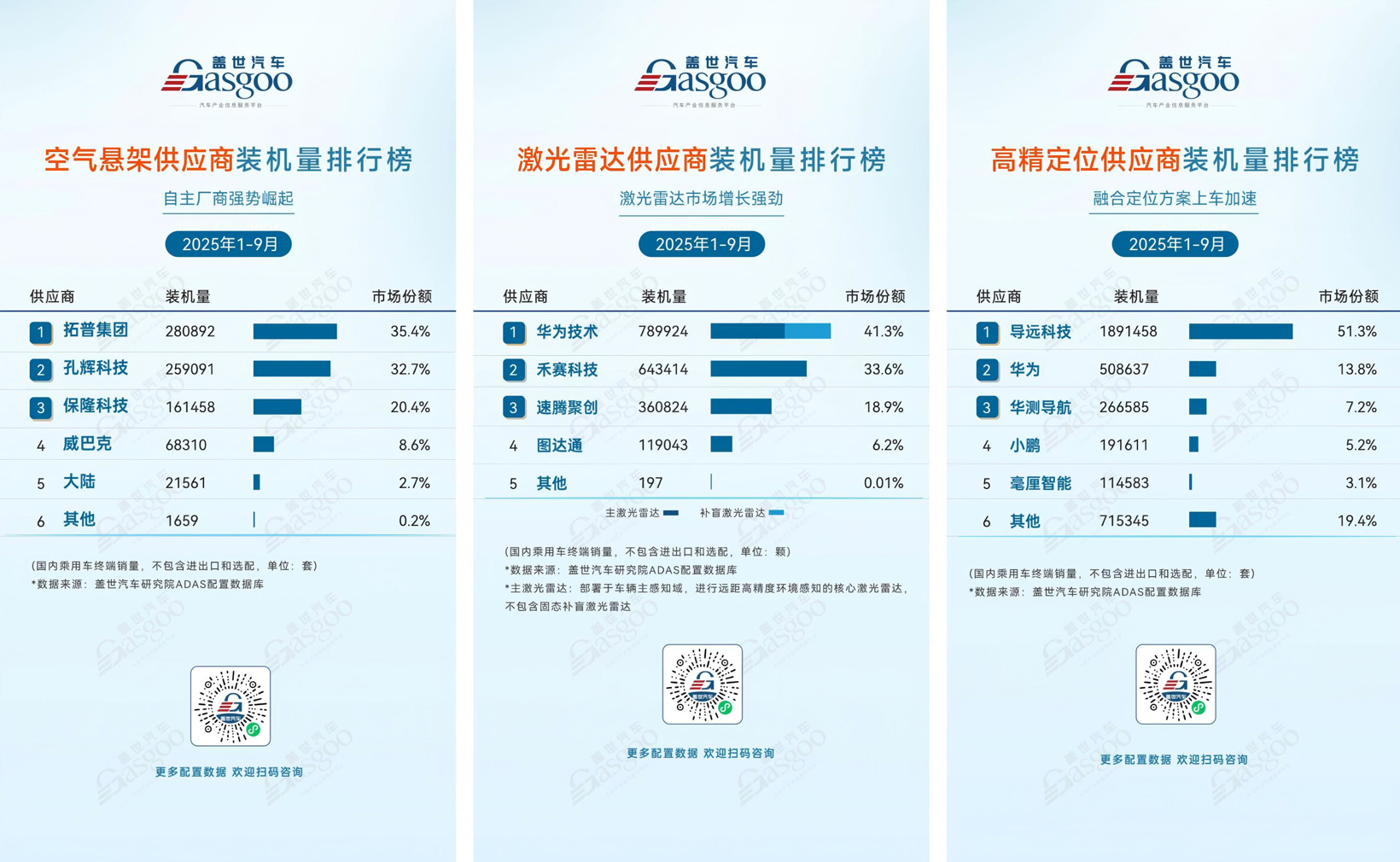
Furthermore, China's intelligent driving solutions are rapidly advancing into the global market. Taking the 2025 Munich Motor Show as an example, China’s smart automotive industry chain is treating Europe as a technological stronghold, launching a "siege exercise" against the German fortresses. Momenta has reached a global strategic partnership with Valeo, while companies like Horizon Robotics, ZVision Technologies, and QCraft have announced their European strategies, significantly accelerating their overseas expansion.
The competition in the smart cockpit field is equally intense. There are over 200 players in the central control and LCD instrument cluster tracks, and Chinese companies have already captured the mainstream share in emerging fields such as HUD and DMS. Although Qualcomm still holds 80% of the domain controller chip market, domestic companies like Huawei, Xinqing, and Xinchip have achieved mass production and installation in vehicles, with their market share steadily increasing. According to data from Gasgoo Auto Research Institute, from January to October 2025, the penetration rate of vehicles with cockpit domain control functions in China has reached 25%, and it is expected to become standard equipment by 2030.
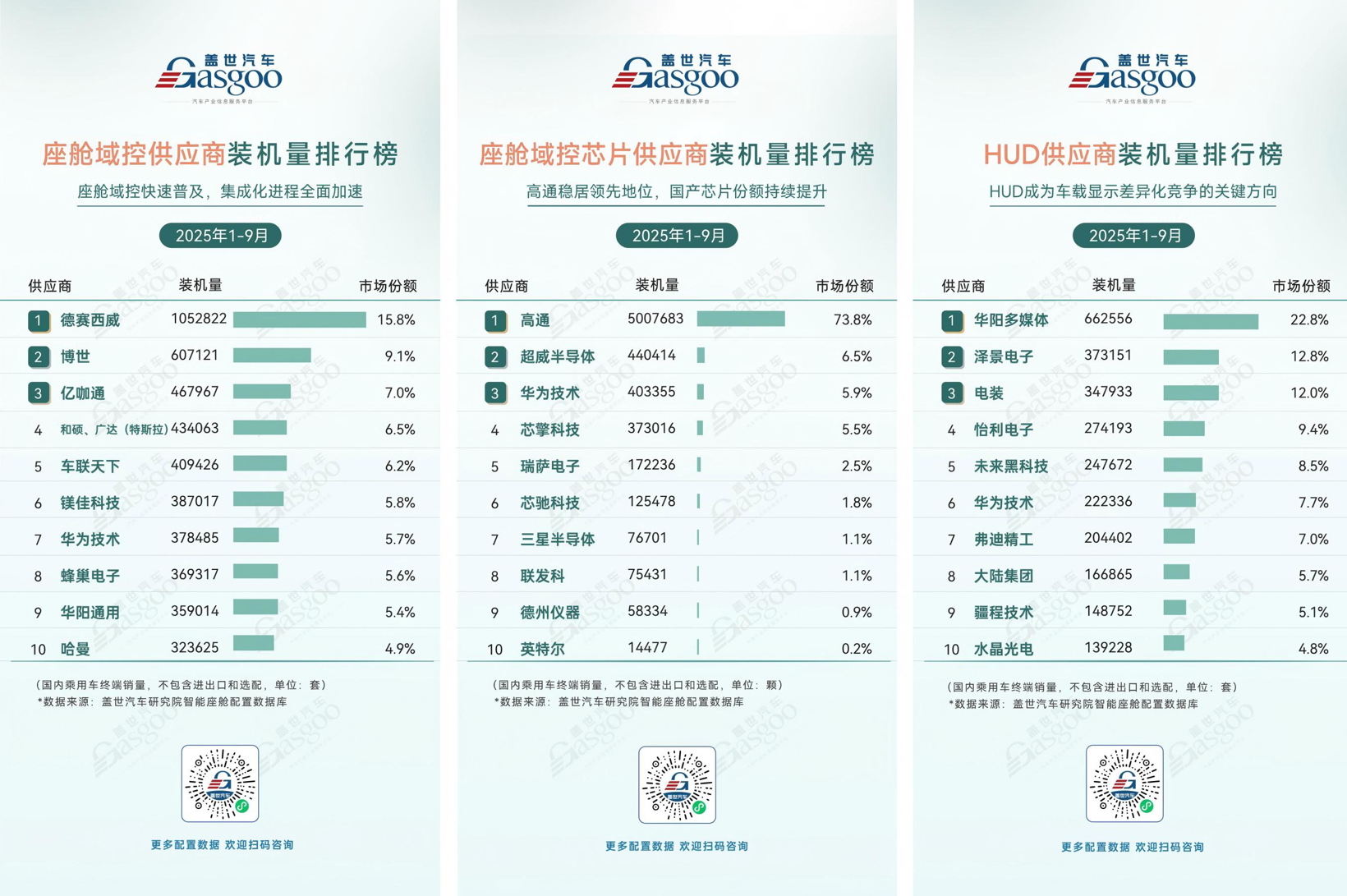
Innovation in the battery and electric drive fields continues to lead the way. Structural innovations such as CTC and CTB have significantly increased energy density, with semi-solid-state batteries entering the pilot stage and achieving an energy density of 400Wh/kg. According to the plans of major battery companies, fully solid-state batteries are expected to achieve small-scale vehicle integration between 2027 and 2028. The electric drive system is evolving from a three-in-one to a multi-in-one integration, and in the future, combined with EMB brake-by-wire and steer-by-wire technologies, it will achieve more precise single-wheel control.
The rise of component companies has surpassed the boundaries of the Chinese market, with the trend of going abroad alongside complete vehicle enterprises. Facing challenges such as factor costs and logistics radius, Chinese companies are exploring win-win cooperation models with local enterprises, aiming to meet regional regulations and market demands through deep localization operations. Companies like Weichai and Sailun have made it into the global top 100 supply chains, proving the global competitiveness of Chinese components.
Market data intuitively shows this rising trend. The "2025 Global Top 100 Auto Parts Suppliers" list published by Automotive News (click on [link]).2025 Global Top 100 Auto Parts List: New Breakthroughs for the Chinese GroupThis year, 15 Chinese companies made it to the list, whereas in 2020, the number was only 7. In the future, driven by technological innovation, scalable growth, and global expansion, this number is expected to exceed 30 by 2030, achieving a five-year doubling.
The path of Chinese component enterprises' rise is clearly visible, from breaking through with a single component to achieving full industry chain collaboration, and from local support to global competition. The leap in the number of companies on the top 100 list in five years will be an important testament to the transformation of China's automotive industry from large to strong.
Let's just get through 2026 first.
"Wanting to cross the Yellow River but blocked by ice, intending to climb Taihang Mountain but covered in snow," the current automobile industry is similarly challenging. For many mid-level and lower enterprises, rather than looking forward to a vision five years ahead, a more realistic goal is: can they survive through 2026.
In particular, according to the forecast by the Gasgoo Auto Research Institute, "the car market will show a downturn next year." This means that the era of effortless growth has ended, replaced by intense competition for existing market share. The market pie is difficult to expand, yet more competitors continue to enter. Every transaction order may directly come from a competitor's share.
After multiple rounds of policy stimulation and market education, consumers are becoming more rational and discerning. In the face of solid product strength and sincere pricing, the premium effect of brand aura is rapidly diminishing.
To survive is to have the right to talk about the future.
Especially, the impact of the decline in policy dividends will become evident in 2026. The preferential treatment for new energy vehicle purchase taxes will be halved, coupled with stricter technical constraints—significant increases in energy consumption and range thresholds. Additionally, the stimulus effect of the previous "trade-in" policy, which boosted sales, will inevitably weaken. The days of easy growth driven by policy incentives are gone forever.
Cost pressures are making it increasingly difficult for companies to breathe easily. As the "heart" of new energy vehicles, the price of lithium iron phosphate materials for power batteries has been continuously rising since the third quarter of this year. Recently, it has been reported that two leading lithium iron phosphate manufacturers plan to uniformly increase the processing fee for all series of lithium iron products by 3,000 yuan per ton starting in 2026. This is bound to drive up the cost of batteries per vehicle, further eroding the gross profit margin of the entire vehicle.
On the other hand, the upgrading of mandatory safety standards is also forcing companies to increase their investments. After the implementation of new regulations such as battery thermal runaway protection and autonomous driving data recording systems, the additional costs of safety testing and compliance alone are enough to continuously squeeze the already thin profits of small and medium-sized car companies.
The "double squeeze" between rising costs and the difficulty of passing them on to end prices has led many car companies into a dilemma of "losing money if prices don't rise, losing orders if they do."
More importantly, the traditional approach of relying on channel expansion and low-price promotions to gain market share has become ineffective. Consumers are increasingly "demanding" in terms of the smooth experience of intelligent cockpits and the scenario coverage capability of autonomous driving. In the arena of stock competition, intelligence is no longer a "bonus" but a "ticket" for survival. Companies that lag behind in chip computing power and data iteration are being quickly eliminated by the market.
Further forward-looking policy variables have already sounded the alarm. The industry generally anticipates that the "strictest in history" National VII emission standards will be implemented around 2029. Just the upgrade of the after-treatment system for fuel vehicles could increase the cost per vehicle by several thousand yuan; energy consumption indicators for new energy vehicles will also be significantly tightened.
Although formal implementation is still several years away, the preparation for technical research and production line transformation is urgent. This undoubtedly adds pressure to the already tight funding chain and drives the entire industry to shift from "scale expansion" to "quality improvement."
Every fluctuation affects not only the profit margins of the complete vehicle companies but also the survival of hundreds of upstream enterprises.
The so-called market "correction" is essentially a brutal selection process. Does the company have the core strength to overcome technological barriers? Can it achieve extreme cost control? Can the intelligent experience truly impact users? Is there any foresight and planning for future regulatory changes? These questions pose a severe test for players with shallow foundations.
From a certain perspective, the adjustment period in 2026 is the crucial reshuffling stage for the industry to "eliminate the false and retain the true." Only those enterprises that focus on developing core technologies, meticulously refining supply chains, and accurately understanding the real needs of users will not only be able to weather the cycles but also gain a competitive edge in the future.
For China's automotive industry, this "winter" may not be short-lived, but only through the forging of extreme competition can it solidly move towards a new stage of high-quality development.
Five years from now, when we look back on today, we may find that the golden age of China's automotive industry is just beginning.
【Copyright and Disclaimer】The above information is collected and organized by PlastMatch. The copyright belongs to the original author. This article is reprinted for the purpose of providing more information, and it does not imply that PlastMatch endorses the views expressed in the article or guarantees its accuracy. If there are any errors in the source attribution or if your legitimate rights have been infringed, please contact us, and we will promptly correct or remove the content. If other media, websites, or individuals use the aforementioned content, they must clearly indicate the original source and origin of the work and assume legal responsibility on their own.
Most Popular
-
Clariant Unveils Cost-Cutting Plan Details, Plans to Shut Down Multiple Plants
-
Dow, Wanhua, Huntsman Intensively Raise Prices! Who Controls the Global MDI Prices?
-
[Today's Plastics Market] General Materials Weakly Fluctuate, Engineering Materials Steadily Rise
-
U.S. Appeals Court Officially Rules: Trump Tariff Unlawful and Void!
-

Daily Review: Polyethylene Prices Under Weak Consolidation, Sellers Face Significant Pressure to Move Inventory