



1% Stake, 100% Strategy: How Big a Game Is Toyota Playing?
On June 9, Gaishi Automotive learned that Toyota, through its fund operated by Toyota Invention Partners, invested 1 billion yen in Tier IV, a developer and service provider of autonomous driving systems, acquiring a stake of only 1%.
A 1% stake and 1 billion yen would almost qualify as a “symbolic investment” in the autonomous driving sector, where deals worth billions of dollars are commonplace.
However, if you understand the industrial logic behind this 1%, you will find that Toyota is laying the most critical wedge for the future landscape of autonomous driving over the next decade.
From Closed to Open Source: Why Toyota is Eyeing Tier IV?
To understand the strategic significance of this investment, one must first understand who Tier IV is and what it has.
Founded in 2015, Tier IV is a world-class player in the field of open-source software for autonomous driving, and its core asset is Autoware, the world’s first Linux-based open-source autonomous driving operating system.
At present, the Autoware Foundation has more than one hundred members, forming a complete ecosystem spanning academia to industry.
Over the past year, Tier IV’s technological leap has been particularly noteworthy.
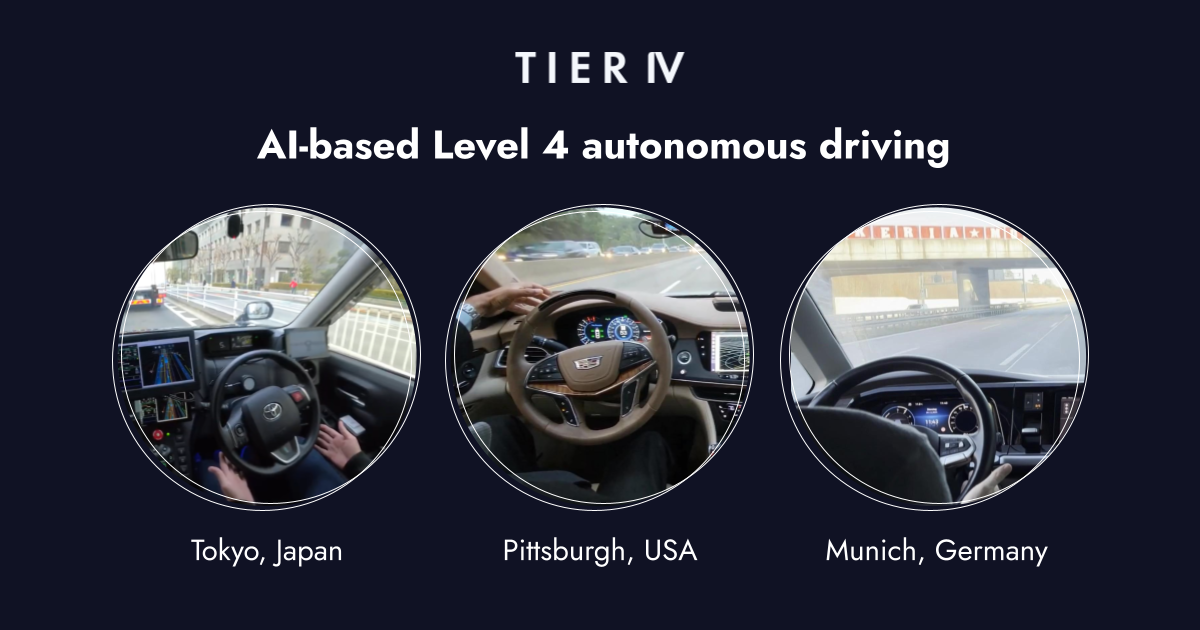
Image source: Tier IV
In July 2025, Tier IV released an end-to-end AI architecture supporting Level 4+ autonomous driving, marking a key step in its shift from the traditional modular perception-planning-control pipeline toward a data-driven, neural-network-based holistic decision-making framework. In March 2026, Tier IV further released an L4 autonomous driving software stack based on data-driven AI. Featuring a hardware-agnostic design, it is compatible with a variety of automotive-grade SoCs and sensor configurations, and is made available free of charge to developers worldwide through the open-source platform Autoware.
Notably, Tier IV announced in March 2026 the integration of NVIDIA's Alpamayo vision-language-action model and the Cosmos world foundation model platform to tackle the most challenging "long-tail edge cases" in autonomous driving.
For Toyota, the value of Tier IV lies not only in the technology itself, but also in the ecosystem it has built.
In the field of autonomous driving, the deciding factor has never been a single technology, but rather who possesses a more powerful data loop and developer community. The combination of Autoware’s open-source ecosystem and Toyota’s vast vehicle data could give rise to a whole new path of technological evolution. Automakers no longer need to build autonomous driving systems from scratch but can customize development based on a mature open-source foundation. This is precisely the ecological advantage that traditional closed development cannot reach.
A Tripolar Balance Among Japan, the United States, and China: Toyota’s Global Autonomous Driving Strategy
If we take a broader perspective, this investment in Tier IV is a key piece of Toyota's global autonomous driving strategy.
Analyzing Toyota's recent strategies reveals a very clear approach: in each core market, it partners with the strongest local players to advance the commercialization of Robotaxi and autonomous driving technologies with regionally optimized strategies.
In mainland Japan, Tier IV is the central move on this chessboard.
Toyota plans to equip its e-Palette electric buses with Level 4 fully autonomous driving technology by 2027, with Tier IV serving as a key technology partner in this initiative. Meanwhile, other Japanese industrial giants such as Suzuki and Sony have also invested in Tier IV, and an “All Japan” autonomous driving ecosystem is rapidly taking shape.
Turning our attention to the United States, Toyota reached a basic cooperation consensus with Waymo as early as 2025 to jointly develop an autonomous ride-hailing service. Since April 2025, Waymo has been testing about 25 self-driving taxis in core areas of Tokyo, such as Shinjuku and Shibuya, to collect high-precision map data under Japan's narrow streets and left-hand driving rules.
In China, Toyota’s partnership with Pony.ai has already borne fruit: the first mass-produced bZ4X Robotaxi officially rolled off the production line in February 2026, with plans to launch commercial operations in cities including Guangzhou, Shenzhen, and Beijing.
The fact that Toyota has established a foothold in one city each in Japan, the U.S., and China reflects its core judgment in the autonomous driving field: no single company can independently solve all the challenges of autonomous driving across different regions.
Road conditions, regulations, and driving culture vary greatly from country to country; the most effective strategy is to work in deep collaboration in each market with local technical partners who understand the local context best. This so-called “multi-path” approach is strikingly similar to Toyota’s strategy in the powertrain field of pursuing hybrid and pure electric powertrains in parallel.
Of course, Toyota’s path was not a smooth one.
In March 2026, Nissan reached a partnership with Uber and the UK-based company Wayve, planning to launch a robotaxi pilot program in Tokyo by the end of the year. Tesla is also actively advancing plans to roll out FSD in Japan. As global tech giants and traditional competitors accelerate their race to capture market share, whether Toyota can outperform them with this hybrid strategy of “global collaboration + deep regional engagement” remains to be seen.
But one thing is already certain: the 1% stake is only the beginning. When Tier IV’s open-source ecosystem truly integrates with Toyota’s global manufacturing network, people may come to realize that this news flash on June 9, 2026, marked a major turning point in the history of autonomous driving in Japan.
【Copyright and Disclaimer】The above information is collected and organized by PlastMatch. The copyright belongs to the original author. This article is reprinted for the purpose of providing more information, and it does not imply that PlastMatch endorses the views expressed in the article or guarantees its accuracy. If there are any errors in the source attribution or if your legitimate rights have been infringed, please contact us, and we will promptly correct or remove the content. If other media, websites, or individuals use the aforementioned content, they must clearly indicate the original source and origin of the work and assume legal responsibility on their own.
Most Popular
-
Layoffs, Divestments, Plant Closures While Pouring Billions: BASF Undergoes Major Transformation!
-
Ascend Adipic Acid Hit By Force Majeure, Market Expects Supply Resumption In Mid-September
-

Raw Material Supply Shortage! INEOS Phenol Declares Force Majeure on Phenol and Acetone Businesses
-
South Korea initiates anti-dumping investigation against Chinese PVC suspension resin! The target is Tianjin Bohua and Wanhua Chemical. How to break through?
-

Sixth national procurement set to be implemented: A “Reshuffling” Moment for the $10-Billion Medical Device Market