



160% Surge In Half A Year! Behind Sulfur’s Break Above 10,000, Is The Titanium Dioxide Industry Landscape About To Be Rewritten?
Image source: Doubao AI
On June 7, 2026, the auction reserve price for solid sulfur at a local refining enterprise in Shandong surged to RMB 9,800 per ton, with the transaction price quickly breaking the RMB 10,000 mark. At the beginning of 2026, the price was still at RMB 3,850 per ton. An increase of more than 160%, nearly quadrupling within half a year—this is not short-term speculation in the futures market, but a structural shift that is profoundly reshaping the competitive landscape of the titanium dioxide industry. For the plastics industry, where titanium dioxide is an important raw material, this “sulfur storm” brings not only cost pressure, but also a window for reassessing supply chain risks.
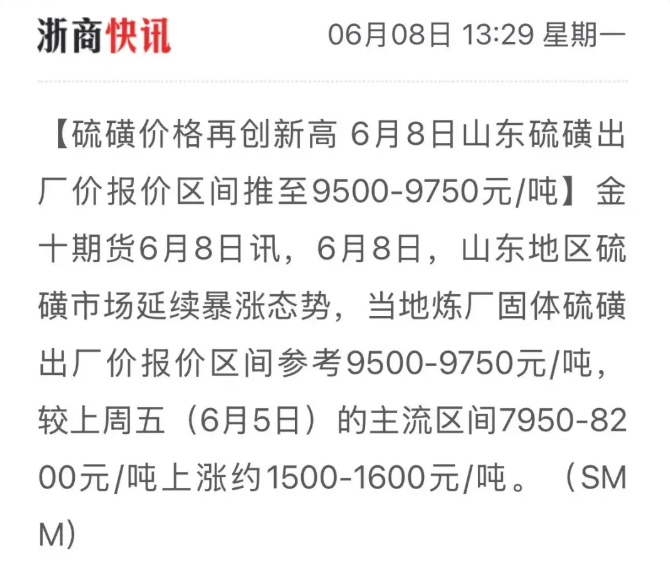
Image source: Zheshang Express
I. How Can a Grain of Sulfur Ignite a Trillion-Yuan Industrial Chain?
To understand the transmission mechanism of this wave of price increases, we must first clarify a basic question:What is the relationship between sulfur and titanium dioxide?
Titanium dioxide (TiO₂) is the most widely used white pigment in the world and is extensively applied in coatings, plastics, rubber, papermaking, and other industries. In the plastics industry, titanium dioxide is an indispensable core functional filler for opacity and coloration, whether in white masterbatch, engineering plastics modification, or the covering and coloring of films and pipes.
Currently, there are two main production processes for titanium dioxide (TiO2) in China: the sulfate process and the chloride process. Among these, the sulfate process still accounts for over 75% of the total domestic production capacity. One of the core raw materials for the sulfate process is sulfuric acid, and the mainstream preparation route for industrial sulfuric acid is derived from the oxidation of sulfur. This means that if the price of sulfur rises, the cost of sulfuric acid will also increase, putting direct pressure on the production costs of titanium dioxide produced by the sulfate process.
The data validates the power of this logical chain: sulfuric acid was about RMB 1,089 per ton in early March, RMB 1,633 per ton on April 2, and RMB 2,125 per ton on April 13. Since producing one ton of titanium dioxide by the sulfate process consumes 3–4 tons of sulfuric acid, and sulfuric acid accounts for more than 40% of its total production cost, this surge in raw material prices directly pushed up the cost of titanium dioxide by about RMB 3,000–5,000 per ton.
II. Supply Disruption Crisis: Why This Time Is Different
Historically, sulfur prices have also fluctuated sharply many times, but the current rise is distinctive—it is a structural contraction on the supply side, rather than mere short-term speculation.
From a global perspective, China’s sulfur import dependence in 2025 was about 49%, with the Middle East as the most important source of imports, accounting for more than 50% of total imports in previous years. In early 2026, geopolitical conflict in the Middle East suddenly escalated: Iranian refineries shut down, shipping through the Strait of Hormuz was disrupted, and the unresolved Red Sea crisis, combined with Russia’s shift to a net importer, caused multiple breakdowns in the global sulfur supply chain. At the same time, domestic sulfur production capacity remained limited, and port inventories fell sharply from 2 million tons a year earlier to nearly 900,000 tons, approaching historic lows.
This multi-pronged contraction on the supply side has turned price increases from “having a ceiling” to “having no visible ceiling.” In early June, some independent refineries in Shandong were already facing a situation of “one pound of sulfur being hard to find.” Even with prices topping RMB 10,000 per ton, some companies still could not secure supplies. Sulfur, once dismissed as a “byproduct” and considered the “scrap” of petrochemical processing, has overnight become the scarcest hard currency in the supply chain.
More noteworthy is the divergence in downstream response strategies. Leading phosphate fertilizer companies such as Yuntianhua and Hubei Yihua have maintained normal operations by virtue of long-term supply guarantee agreements. Sulfuric acid-process titanium dioxide producers such as Huiyun Titanium and CNNC Titanium Dioxide (now renamed Titan Chemical) have adopted multiple measures—building up low-cost sulfur reserves, seeking parity-priced resources from upstream suppliers, and exploring alternative solutions such as producing sulfuric acid from pyrite—but the effectiveness and sustainability of these measures remain highly uncertain. Meanwhile, in the wet-process nickel smelting sector, Huafei Nickel-Cobalt announced on May 1 that some production lines would be temporarily shut down, with an expected impact on 50% of output, becoming another clear victim of this round of sulfur shock.
III. Two Processes, Two Fates
In this crisis, the most pronounced industry divergence occurred between the sulfate process and the chloride process.
The core raw material for titanium dioxide production using the chlorination method is chlorine gas, not sulfuric acid. In the production process, chlorine gas is recycled and reused, resulting in almost zero dependence on sulfur. This means that when the price of sulfur soars from 3,850 yuan/ton to over 10,000 yuan, the production costs for chlorination method enterprises remain virtually unchanged, while sulfuric acid method enterprises are being engulfed by the surge in costs.
More importantly, the “double tailwind” logic is at play: after sulfate-process prices were forced to follow suit and rise, customers began proactively switching suppliers to avoid cost risk, and some downstream customers that had originally used sulfate-process products shifted to chloride-process products. At the same time, the price increase of sulfate-process products directly lifted the overall market price benchmark, effectively creating greater room for chloride-process products to command a premium at the high end.
Longbai Group is the best reference point for understanding this structural shift. As the world’s third-largest titanium dioxide producer, Longbai has 660,000 tonnes per year of chloride-process capacity, ranking first in China and accounting for about 44% of the company’s total capacity. According to estimates by analysts, its full cost is around RMB 9,000 per tonne, roughly RMB 1,500 per tonne lower than that of its peers. In the first quarter of 2026, amid pressure across the industry—Longbai’s net profit attributable to shareholders of the parent company fell 72.74% year on year—the pressure mainly came from sulfate-process production lines and overall industry oversupply, rather than the chloride process. Its chloride-process lines have reached a utilization rate of 92%, with orders backed up.
By contrast, Huiyun Titanium, which primarily uses the sulfuric acid process, explicitly acknowledged in its latest investor interactions: “The rise in sulfur prices has indeed put certain pressure on the company’s production costs.” The company stated that it is studying follow-up sulfuric acid recovery projects and exploring ways forward—behind this remark lies an industry-wide acceleration in capacity differentiation.
▼ Sulfuric Acid Method vs Chlorination Method: A Comprehensive Comparison of Costs and Competitiveness in 2026
|
Comparison Dimensions |
Sulfuric acid process |
Chlorination method |
|
Core Ingredients |
Sulfuric acid (prepared from sulfur) |
Chlorine gas (recycled) |
|
Sulfur dependency |
Extremely high (accounting for more than 40% of production costs) |
Almost zero |
|
Cost changes in the first half of 2026 |
rise sharply |
Basically stable |
|
Product Positioning |
Mid- to low-end coatings and plastic filler grade |
High-end automobiles, engineering plastics, high-end coatings |
|
Environmental pressure |
The cost of waste acid treatment is high. |
Relatively clean, recycling. |
|
Representative enterprises |
Huayun Titanium Industry, Titanium Energy Chemical, etc. |
Longbai Group (660,000 tons of capacity) |
4. How Should the Plastics Industry Respond?
For procurement and formulation professionals in the plastics industry, this round of titanium dioxide market trends is far more than a simple price fluctuation; it is reshaping supply chain logic, and at least three dimensions need to be reassessed.
1. The supplier structure urgently needs to be optimized.
If the current titanium dioxide supplier mainly uses the sulfate process, it is recommended to assess the feasibility of introducing chloride-process products into the mid- to high-end product lines. Chloride-process products offer more uniform particle size, better dispersibility, and stronger hiding power, making them especially suitable for applications with stringent requirements on appearance and performance, such as high-gloss injection-molded parts, engineering plastic modification, and automotive interior and exterior components. Although the price gap between sulfate-process and chloride-process products has been narrowing, the advantage of chloride-process products in supply stability has become increasingly evident.
2. The cost pass-through cycle needs to be incorporated into the pricing model.
As of May 2026, the national average price of titanium dioxide has risen from RMB 13,300/ton at the beginning of the year to RMB 16,733/ton, an increase of about 26%. If sulfur prices remain above RMB 10,000/ton in June, there is a very high probability that titanium dioxide prices will rise by another RMB 1,000–2,000/ton in the second quarter. For downstream enterprises with high titanium dioxide consumption, such as white masterbatch and modified plastics producers, it is recommended to incorporate raw material price linkage clauses into quotation models or appropriately extend the safety inventory cycle.
3. The marginal value of technology substitution pathways is increasing.
Some companies in the market have already begun promoting “titanium dioxide replacement” solutions (such as nano-scale specialty fillers) to partially reduce the use of titanium dioxide while maintaining whiteness and hiding power. The cost-effectiveness of such solutions is becoming more apparent during periods of high costs, but they need to be validated for specific formulations and assessed for their impact on mechanical properties and processing flowability.
V. The Battle Between the Two Process Routes Enters the Decisive Stage
The sulfur crisis in 2026, in a sense, serves as a "stress test" for the twenty-year process of technological transformation in China's titanium dioxide industry.
Domestic sulfate-process capacity has long relied on low-cost sulfur to sustain its cost advantage and has maintained market share through scale expansion. However, the premise underlying this logic—the sustainable supply of cheap imported sulfur—is being steadily eroded by geopolitical uncertainty. In an April 2026 research report, Tianfeng Securities’ chemical research team explicitly stated that rising sulfur and sulfuric acid prices are “reshaping the cost curves of the chloride process and the sulfate process,” with the cost advantage of the chloride process moving from technical theory into industrial reality.
The longer-term trend is that, as environmental regulations become increasingly stringent (the sulfuric acid process generates large amounts of by-product waste acid, and disposal costs continue to rise), downstream demand for higher-end products increases, and chlorination-process capacity continues to expand, the process of chlorination-based production replacing part of the market share of the sulfuric acid process and becoming the mainstream is accelerating.
For the plastics industry, this trend has a dual implication: on the one hand, the supply of high-end chloride-process titanium dioxide will continue to expand, and its long-term price trend is relatively predictable; on the other hand, sulfate-process capacity will face mounting pressure from both costs and environmental requirements, and small and medium-sized enterprises will be forced to exit the market at an accelerated pace. Supply-side consolidation over the medium term will drive a moderate upward shift in the overall price floor of titanium dioxide.
Editor: Lily
Source materials: Zhuochuang Information, Global Textile Network, Shengyi Society, CaiLian Press, Tianfeng Securities Chemical Research, East Money, LB Group announcements, Snowball, etc.
【Copyright and Disclaimer】This article is the property of PlastMatch. For business cooperation, media interviews, article reprints, or suggestions, please call the PlastMatch customer service hotline at +86-18030158354 or via email at service@zhuansushijie.com. The information and data provided by PlastMatch are for reference only and do not constitute direct advice for client decision-making. Any decisions made by clients based on such information and data, and all resulting direct or indirect losses and legal consequences, shall be borne by the clients themselves and are unrelated to PlastMatch. Unauthorized reprinting is strictly prohibited.
Most Popular
-

A Look at the Material Suppliers Behind SpaceX
-

Government's Triple Action, Enterprises' Three Arrows in Five Days, Semiconductor Reshuffle! What Signal Does Japan's Chemical Industry Release?
-
Name change without tax change: POM Anti-Dumping Duty Rate Inheritance Implemented
-
Fire breaks out at jiangsu meiside!
-
Ethylene: Production Capacity Accelerates Expansion, Global Industry Landscape Is Being Reshaped