



Automotive new materials double, who is the next hundred-billion track?
On May 27, at the 2026 Automotive New Materials Conference, Hou Fushen, Vice President and Secretary-General of the China Society of Automotive Engineers, disclosed a set of data: traditional fuel vehicles require over 200 types of materials for vehicle manufacturing, while intelligent...New energy vehiclesThe variety of required materials has increased to over 400 types.
From 200 to 400, this is not merely a doubling of numbers, but also reflects the profound restructuring of material systems as automobiles transform from “mechanical drive” to “intelligent electric drive.”
According to the "Energy Conservation andNew EnergyAccording to the Technology Roadmap for Energy-Saving and New Energy Vehicles 3.0, the penetration rate of new energy passenger vehicles in China is projected to exceed 70% by 2030, signaling the start of a major industrial transformation centered on new automotive materials.
What additional materials does a smart electric vehicle have?
The most intuitive way to understand this doubling of material categories is to compare smart electric vehicles with traditional fuel vehicles.
The core of a gasoline vehicle is its engine and transmission, around which materials such as cast-iron cylinder blocks, aluminum alloy pistons, and steel crankshafts are used, with a stable range of categories. Smart electric vehicles have eliminated this “heart” and replaced it with battery packs, drive motors, and electronic control systems, while adding features such as LiDAR, large center control screens, and 800V high-voltage platforms. Each new function adds an entirely new chain of material demand.
Take power batteries as an example. Traditional fuel vehicles do not have battery packs, but smart electric vehicles are often equipped with batteries ranging from 60 to 100 kWh, with highly complex internal materials. The four major components of a battery—cathode, anode, separator, and electrolyte—each represent an independent materials supply chain. The cathode has evolved from lithium iron phosphate to ternary materials and lithium manganese iron phosphate, and will further develop towards solid-state electrolytes in the future. The anode is shifting from graphite to silicon-carbon composite materials to pursue higher energy density. For the separator, an alumina ceramic coating is added to the polymer film to enhance heat resistance. Auxiliary materials such as copper foil, aluminum foil, and carbon nanotube conductive agents are all new faces that have never appeared in fuel vehicles.
The changes brought by intelligentization are equally significant. An L2-level assisted driving vehicle is typically equipped with multiple millimeter-wave radars and cameras, while high-end models also feature LiDAR. Millimeter-wave radar housings must use thermoplastic wave-absorbing materials, with PBT or PPS as the base resin compounded with magnetic loss absorbers, so as to ensure signal transmission while preventing electromagnetic interference. LiDAR lenses, on the other hand, require infrared-grade optical materials with extremely high standards for transmittance and weather resistance. In-cabin large displays and head-up displays (HUDs) have also driven demand for optical films and flexible cover materials.

Image source: Xiaomi Auto
LightweightThermal management has also become a new challenge for materials. In models equipped with a 100 kWh battery, the battery pack alone weighs more than half a ton, forcing automakers to “reduce weight” elsewhere—aluminum alloy extrusions are widely replacing steel in body-in-white structures, magnesium alloys are appearing in instrument panel frames, and carbon-fiber composites are gradually trickling down from supercars to high-end passenger vehicles. High-power fast charging generates a large amount of heat while the battery pack is charging, making new thermal management materials such as thermally conductive gel, graphene thermal conductive films, and aerogel insulation pads standard equipment as a result.
When the penetration rate approaches 70%, how large will the market for these materials become?
The introduction of new materials is only the first half; the second half is: how will demand change when these materials move down from high-end models into the mainstream market at a scale of tens of millions of vehicles?
"Roadmap 3.0" By 2030, the penetration rate of new energy vehicles is expected to exceed 70%, with more than 15 million new cars sold each year being new energy vehicles. In 2025, installed power battery capacity has already exceeded 600 GWh, and by 2030 it is expected to reach 1,500 GWh. Just for cathode materials alone, demand will reach 3 to 3.75 million tons, directly driving demand for lithium, nickel, cobalt, manganese, phosphorus, and other mineral and chemical raw materials. If solid-state batteries achieve large-scale mass production between 2028 and 2030, materials such as lithium sulfide and sulfide electrolytes, which are still confined to the laboratory today, will grow into a market worth tens of billions of yuan.
Silicon carbide is another typical example. Silicon carbide power modules have been widely adopted in mainstream 800V platforms. Compared with silicon-based IGBTs, they can improve overall efficiency by 3% to 5%, but substrate costs remain high, limiting their use in economy models. As 800V platforms move down into mainstream price segments, shipments are expected to grow severalfold. Economies of scale will in turn drive down costs, creating a positive feedback loop. The widespread adoption of L2 driver assistance and the commercialization of L3 autonomous driving will also provide sustained incremental demand for lidar optical materials, microwave-absorbing materials for millimeter-wave radar, and chip packaging substrates.
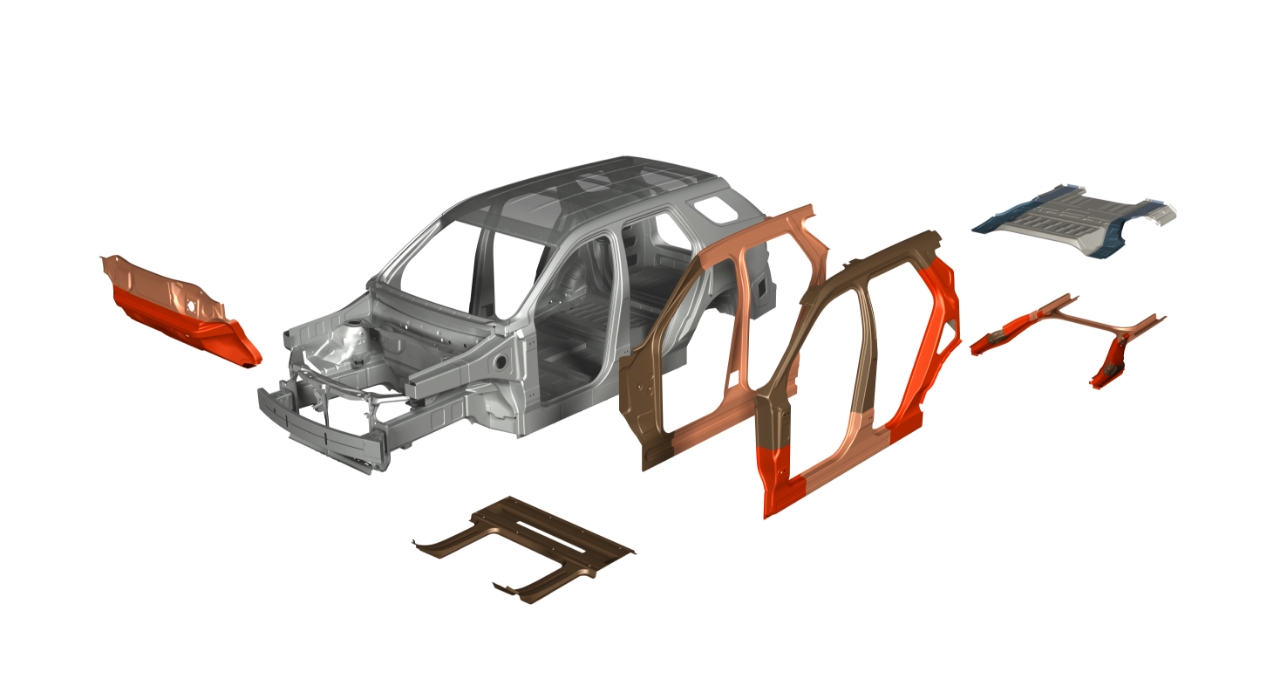
Image source: VAMA
Lightweight materials are likewise on the verge of large-scale adoption. At present, carbon fiber is mainly limited to vehicles priced above RMB 500,000, while aluminum alloys are mostly used in models priced between RMB 200,000 and RMB 300,000; mainstream vehicles in the RMB 100,000 to RMB 200,000 range still primarily use steel. However, as battery energy density is already approaching its physical limit, lightweighting has become the only viable path to extending driving range. New energy vehicles are 200 to 300 kilograms heavier than fuel-powered vehicles due to the added weight of batteries, making it necessary to offset this through lightweight vehicle bodies. The inflection point for aluminum and magnesium alloys to penetrate mainstream models is fast approaching.
The doubling of material categories and the increase in penetration rates are reshaping the upstream supply chain. The traditional system, primarily based on steel, rubber, and glass, is transforming into a new pattern that equally emphasizes battery materials, semiconductor materials, and high-performance polymers. Key areas such as silicon carbide substrates, high-end separators, and solid-state electrolytes still face "bottleneck" issues, making domestic substitution a long and challenging journey.
From 200 to 400 types, the upheaval in automotive materials is far from over. When the penetration rate of new-energy vehicles surpasses 70% by 2030, the automotive new materials industry will usher in a true boom. Whether companies can secure a position ahead of time will determine their standing over the next decade; breakthroughs in materials innovation will also directly determine the advancement of intelligent vehicles.Electric vehicleCan it comprehensively surpass in performance, safety, and cost?
【Copyright and Disclaimer】The above information is collected and organized by PlastMatch. The copyright belongs to the original author. This article is reprinted for the purpose of providing more information, and it does not imply that PlastMatch endorses the views expressed in the article or guarantees its accuracy. If there are any errors in the source attribution or if your legitimate rights have been infringed, please contact us, and we will promptly correct or remove the content. If other media, websites, or individuals use the aforementioned content, they must clearly indicate the original source and origin of the work and assume legal responsibility on their own.
Most Popular
-

A Look at the Material Suppliers Behind SpaceX
-

Government's Triple Action, Enterprises' Three Arrows in Five Days, Semiconductor Reshuffle! What Signal Does Japan's Chemical Industry Release?
-
Name change without tax change: POM Anti-Dumping Duty Rate Inheritance Implemented
-
Fire breaks out at jiangsu meiside!
-
Ethylene: Production Capacity Accelerates Expansion, Global Industry Landscape Is Being Reshaped