



Crude Oil: How Long Can the Exhausted Calm Last?
The current crude oil market is showing a startling sense of “suffocation.” The situation in the Middle East is at a critical, hair-trigger stage, yet the prices on the board remain unnervingly calm, as if pinned down and suppressed. This calm does not stem from any fundamental stability, but rather from a fragile balance maintained by offsetting spare forces in a strategic game.
From a trading perspective, trading volume in international crude oil has contracted to extremely low levels in recent years. Current market participation and turnover have fallen back to levels close to those seen in late 2025, when Brent was trading in the $60 range.
Brent crude oil main contract continues to see declining trading volume.
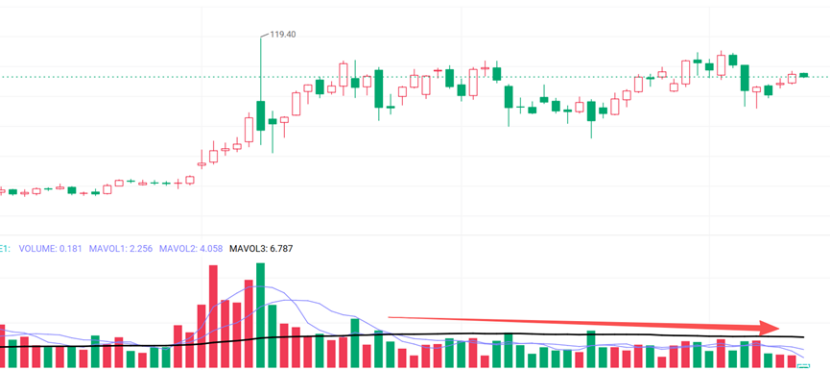
The absence of trading volume reflects the extreme dilemma facing professional investors: on the one hand, there is a visible supply gap; on the other, there is an invisible policy suppression. Before a clear directional signal emerges, the market has chosen to step aside and wait. This “vacuum of sentiment” obscures the underlying distortion in asset pricing, causing prices to gradually lose sensitivity to risk amid the fluctuations.
Extreme Suppression: Why Are Prices Unable to Rise?
In the past two months, oil prices have shown a trend of high fluctuations and a decline. Many people do not understand why prices are falling despite a significant supply gap. This is actually because the market has utilized nearly all available means to "fill the gap."
This suppression is comprehensive:
Inventory release: Both the United States and China are releasing strategic reserves, which has greatly impacted supply anxiety in the short term.
Substitution and supplementation: coal and coal chemical industries are playing a role, while U.S. natural gas and oil production have both seen slight increases to help fill the gap.
Downstream consumption: Refineries are drawing down inventories, while global demand is indeed weakening due to economic pressure.
Financial intervention: Trump used his authority and credibility as U.S. president to repeatedly signal U.S.-Iran negotiations, driving down oil prices.
The current market is maintaining an extremely fragile tight balance between supply and demand. It may appear calm on the surface, but the undercurrents beneath have already grown turbulent to the point that they can no longer be ignored.
Danger Signals of Inventory Curve
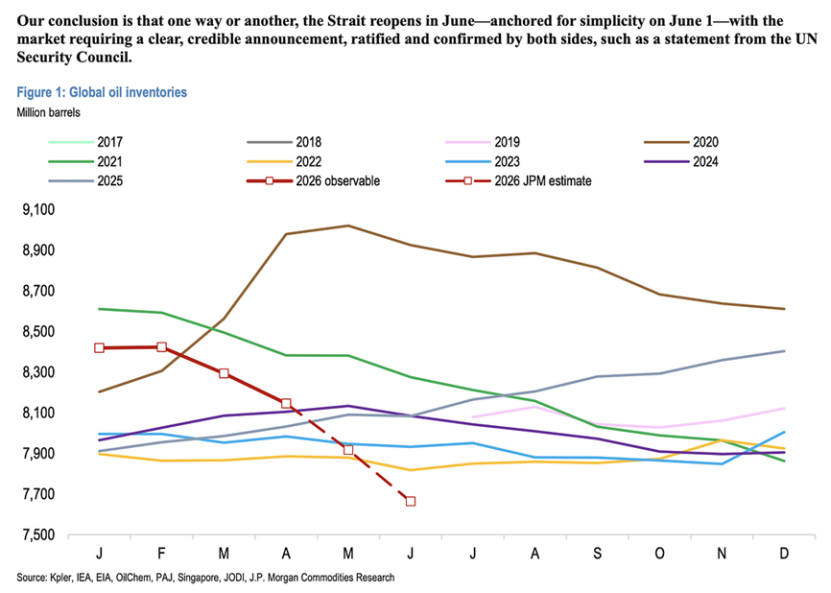
According to the latest global crude oil inventory data, the current inventory level is no longer "below average," but is on the brink of historic depletion.
From the monitoring chart, it is clear that the inventory curve in 2026, including both the observable data and JPMorgan’s estimates, shows a cliff-like decline. After the ups and downs of previous years, the inventory estimate for June 2026 has already approached an extremely low level of about 7.6 billion barrels. This means that the global crude oil “buffer” is nearly worn away.
The Truth Behind the Gap: The Persian Gulf’s “Massive Bloodletting”
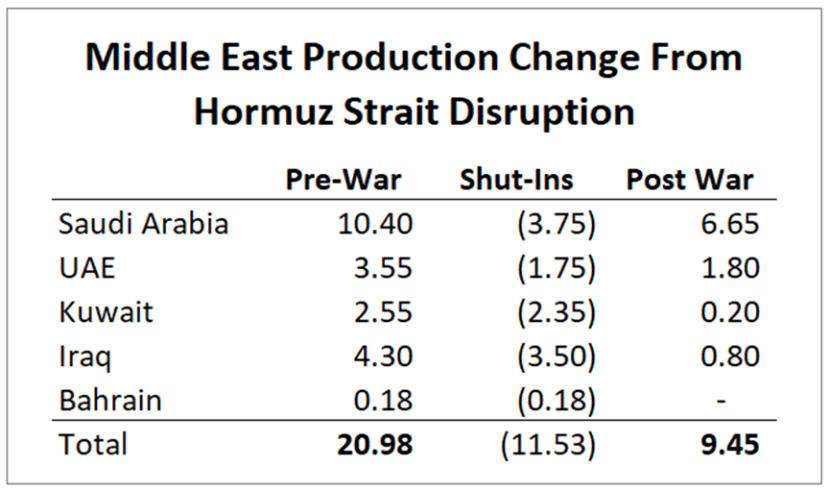
The most disturbing data comes from the Middle East. The current suppression of oil prices is, in fact, concealing a production shortfall on the scale of tens of millions of barrels.
Affected by factors such as the disruption of the Strait of Hormuz, major oil-producing countries in the Middle East are experiencing severe forced production cuts. The world is losing more than 10 million barrels of output per day, a scale sufficient to trigger an energy crisis at any time. The only reason the market can still maintain this “stalemate” is that it is being forcibly sustained by the release of strategic reserves and the depletion of existing inventories.
This suppressed calmness is essentially unsustainable. We are in a game of "overdrafting the future." When global inventories drop to a critical point where physical delivery cannot be maintained, or when the release of strategic reserves by various countries comes to an end, the truth hidden behind the low trading volume will surface. The current sluggish trading resembles a collective breath-holding in the market before the storm arrives.

【Copyright and Disclaimer】This article is the property of PlastMatch. For business cooperation, media interviews, article reprints, or suggestions, please call the PlastMatch customer service hotline at +86-18030158354 or via email at service@zhuansushijie.com. The information and data provided by PlastMatch are for reference only and do not constitute direct advice for client decision-making. Any decisions made by clients based on such information and data, and all resulting direct or indirect losses and legal consequences, shall be borne by the clients themselves and are unrelated to PlastMatch. Unauthorized reprinting is strictly prohibited.
Most Popular
-

A Look at the Material Suppliers Behind SpaceX
-

Government's Triple Action, Enterprises' Three Arrows in Five Days, Semiconductor Reshuffle! What Signal Does Japan's Chemical Industry Release?
-
Name change without tax change: POM Anti-Dumping Duty Rate Inheritance Implemented
-
Fire breaks out at jiangsu meiside!
-
Ethylene: Production Capacity Accelerates Expansion, Global Industry Landscape Is Being Reshaped