



Dongfeng's All-New Solid-State Battery Set to Begin Mass Production and Installation This Fall!
In the second half of this year, Dongfeng’s all-new next-generation solid-state battery will enter mass production and be installed in vehicles. This battery has an energy density of up to 350 Wh/kg and is the first high-energy-density solid-state battery in China to achieve large-scale application. The product is resistant to crushing and can withstand temperatures as high as 170°C. New energy vehicles equipped with this battery are expected to achieve a pure electric driving range of over 1,000 kilometers.
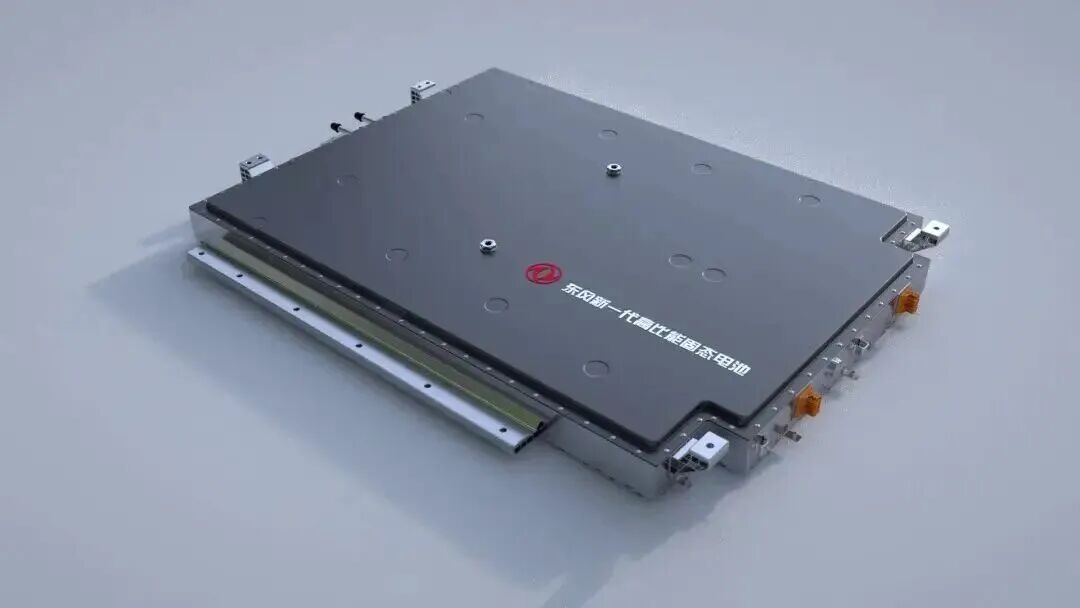
New-generation high-energy-density solid-state
Currently, the solid-state battery technologies in the industry mainly follow three routes: polymer, sulfide, and oxide. Among them, the oxide-polymer composite route is widely recognized as the solution most likely to achieve mass production and commercial deployment the fastest. This route benefits from mature raw material production, lower costs, and a very high degree of compatibility between its manufacturing equipment and existing automaker production lines, allowing for large-scale popularization within the next two years. In contrast, the sulfide route faces greater technical challenges, higher costs, and more demanding requirements for production equipment, environmental control, and battery impact resistance design. It is relatively farther from industrialization and is regarded as one of the next-generation technology directions.
As early as 2018, Dongfeng Motor established a solid-state battery project team, aiming to develop highly safe, automotive-grade, high-specific-energy solid-state batteries.
“Dongfeng is taking a gradual, step-by-step approach: first developing semi-solid-state batteries, then tackling all-solid-state batteries. Its main focus is the oxide-polymer composite route, combining oxide solid electrolytes with polymer electrolytes and continuously fine-tuning the formulation to make progress step by step,” said Zhang Wei, head of the Solid-State Battery Office at the Advanced Technology Research Institute (preparatory), Dongfeng Motor R&D Institute.
Producing a small sample in the lab is not difficult; the hardest hurdle is mass-producing it for installation in vehicles.
Solid-state electrolytes are rigid solids and cannot fill the gaps inside the battery cell like liquid electrolytes do. When there are voids between the electrodes and the solid material, the resistance to current flow increases. A higher internal resistance leads to a chain of problems, including slower charging, more heat generation, and greater energy consumption, and the vehicle’s thermal management and electronic control systems all have to be redesigned.
Based on the requirements of vehicle-level implementation, the Dongfeng R&D team tailored targeted solutions by optimizing the contact interface between the cells and the electrolyte, minimizing internal resistance to the greatest extent and ensuring smoother current transmission. At the same time, they incorporated multiple technologies such as directional pressure relief and venting, thermal-electric separation, and new thermal insulation materials to address one production bottleneck after another.
In 2019, Dongfeng completed the development of its first-generation solid-state battery system. In December 2021, it obtained China’s first passenger vehicle approval for a solid-state battery, and subsequently deployed 50 demonstration vehicles, which have since accumulated over 3.2 million kilometers of safe driving.
In June 2025, Dongfeng’s solid-state battery laboratory was completed and put into operation, and its 0.2 GWh solid-state battery pilot production line was also completed and commenced production. With this, Dongfeng has established a solid-state battery R&D and production base integrating a laboratory, trial production line, and pilot production line, completing the full pathway from technology development to mass production.
"From electrodes and solid-state electrolytes to full battery pack integration, all key technologies have been independently developed by us, with a 100% self-developed rate. Our 350 Wh/kg solid-state batteries are already in stable mass production," Zhang Wei said.
At the beginning of the year, the Dongfeng Yipai test vehicle equipped with a 350Wh/kg solid-state battery went to Mohe to face extreme cold tests, completing over 70 rigorous evaluations.
Zhang Wei introduced that the Dongfeng solid-state battery's low-temperature performance has improved by over 10%. In extremely cold environments of minus 30°C, it can still retain more than 74% of its remaining power; with a full charge, its range exceeds 1000 kilometers, which means that a trip from Beijing to Shanghai only requires one charging stop along the way.
In terms of safety performance, this battery can withstand baking at temperatures of up to 170°C, far exceeding the national standard test requirement of 130°C. The entire battery pack is 30% lighter than traditional lithium batteries, truly delivering a significant increase in driving range with more power but no added weight.
At present, domestic automakers and major battery manufacturers are all concentrating on the development of solid-state batteries.
GAC has built the country’s first pilot production line for large-capacity all-solid-state batteries and plans to install them in Hyptec models in 2026; CATL is focusing on the sulfide route, with a 500 Wh/kg battery achieving a laboratory breakthrough and expected to enter small-scale production in 2027; FAW Hongqi is joining forces with central state-owned enterprises to tackle the technology, having completed prototype trial production of an all-solid-state battery pack, with mass-production vehicle installation targeted for the end of 2027.
To accelerate the industrialization of this technology, on May 8 this year, Dongfeng Motor took the lead in establishing the Hubei Solid-State Battery Industry Technology Innovation Consortium together with a total of 18 universities and enterprises, including Wuhan University and Huazhong University of Science and Technology, providing comprehensive support for the technological iteration, mass production, and ecosystem development of Dongfeng’s solid-state batteries.
Currently, the R&D team has set new goals and is fully focused on developing fast-charging solid-state batteries and new vehicle-grade battery technologies with higher energy density. According to the plan, Dongfeng's next-generation high-specific-energy batteries will be installed in vehicles by 2027, continuously pushing the limits of range and safety for new energy vehicles.
【Copyright and Disclaimer】The above information is collected and organized by PlastMatch. The copyright belongs to the original author. This article is reprinted for the purpose of providing more information, and it does not imply that PlastMatch endorses the views expressed in the article or guarantees its accuracy. If there are any errors in the source attribution or if your legitimate rights have been infringed, please contact us, and we will promptly correct or remove the content. If other media, websites, or individuals use the aforementioned content, they must clearly indicate the original source and origin of the work and assume legal responsibility on their own.
Most Popular
-

Layoffs, Divestments, Plant Closures While Pouring Billions: BASF Undergoes Major Transformation!
-
Ascend Adipic Acid Hit By Force Majeure, Market Expects Supply Resumption In Mid-September
-

Raw Material Supply Shortage! INEOS Phenol Declares Force Majeure on Phenol and Acetone Businesses
-
South Korea initiates anti-dumping investigation against Chinese PVC suspension resin! The target is Tianjin Bohua and Wanhua Chemical. How to break through?
-

Sixth national procurement set to be implemented: A “Reshuffling” Moment for the $10-Billion Medical Device Market