



Following BASF, Covestro Reaches Second Settlement Agreement in MDI/TDI Price Manipulation Case!

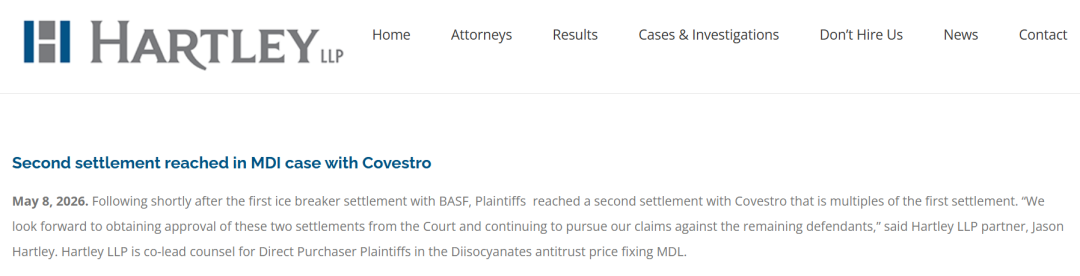
Recently, according to reports from the U.S. law firm Hartley LLP, following BASF’s earlier settlement of the first agreement in a case accusing several companies of conspiring to manipulate the prices of chemicals used in polyurethane production for $3 million, the plaintiffs subsequently reached a second settlement agreement with Covestro. Although the specific amount of the settlement was not disclosed, it is said to be several times the amount of the first settlement.
Hartley LLP is co-lead counsel for the direct purchaser plaintiffs in this diisocyanates antitrust litigation (multidistrict litigation). Jason Hartley, a partner at Hartley LLP, said, “We look forward to obtaining the Court’s approval of these two settlement agreements and to continuing to pursue our claims against the remaining defendants.”
As previously disclosed, buyers of methylene diphenyl diisocyanate (MDI) and toluene diisocyanate (TDI) filed a motion on May 4, 2026, seeking court approval of a settlement agreement with BASF. They said the agreement includes a provision for certification documents to be used in litigation against other manufacturers.
BASF agreed to pay $3 million and cooperate with the plaintiffs in exchange for immunity in the antitrust lawsuit. At the same time, BASF denies all allegations of liability, and the settlement remains subject to final court approval.
The motion points out that in class actions and other complex cases, settlements are particularly favored because avoiding formal litigation can save judicial resources.
The motion also stated: “The Court also values such ‘icebreaker’ settlements—the first settlement in this litigation—because early settlements have the potential to bring other defendants to the negotiating table. This settlement served as an icebreaker and may prompt defendants who have not yet settled to come to the negotiating table.”
According to reports, the plaintiff reached a second settlement agreement with Covestro shortly after the first agreement with BASF was reached, on May 8, 2026.
Covestro had previously moved to dismiss the case on the grounds of lack of jurisdiction, and the U.S. District Court granted that motion in January 2026. At that time, the U.S. District Court stated that it could not exercise jurisdiction over the German company and emphasized that the company’s separate legal personality must be respected; a mere parent-subsidiary relationship is not sufficient grounds to hale a foreign company into a U.S. court. However, it is worth noting that Covestro LLC, Covestro’s U.S. subsidiary, remains a defendant in the case and is not affected by this ruling.
Therefore, the settlement agreement reached this time involves the plaintiffs and Covestro LLC, Covestro’s U.S. subsidiary.

These buyers initially filed the lawsuit in June 2018, alleging that several chemical manufacturers, including BASF, Dow Chemical, and Huntsman, artificially inflated the prices of MDI and TDI by restricting production. The complaint stated that these companies colluded and took advantage of their control over most of the supply, as well as a market environment lacking alternatives.
These companies have denied the allegations, stating that they were made following reports of a U.S. Department of Justice investigation, which ultimately brought no charges.
In March 2020, U.S. District Judge Donetta Ambrose denied the request to dismiss the case, finding that the allegations were sufficiently supported by evidence for the case to proceed. The judge noted evidence of synchronized price increases, plant shutdowns, and supply disruptions, as well as communications and industry meetings that took place before price announcements. At the time, Judge Ambrose also denied the motion filed by BASF, Covestro, Mitsui Chemicals, MCNS Co., and Wanhua Chemical to dismiss the case for lack of jurisdiction.
The case was reassigned in 2022, and after conducting a jurisdictional factual investigation, Covestro and Wanhua Chemical once again filed motions to dismiss. U.S. District Judge W. Scott Hardy granted these motions in January 2026, on the grounds that the court could not exercise jurisdiction over these two German companies and the Chinese company. The dismissal opinion emphasized the need to respect the independent corporate status of companies, stating that a typical parent-subsidiary relationship is not sufficient to justify bringing foreign companies to U.S. courts. This means that the claims against these two parent company entities by the plaintiffs are legally terminated. It is worth noting that Covestro LLC (the U.S. subsidiary of Covestro) remains a defendant in the case, unaffected by this ruling.
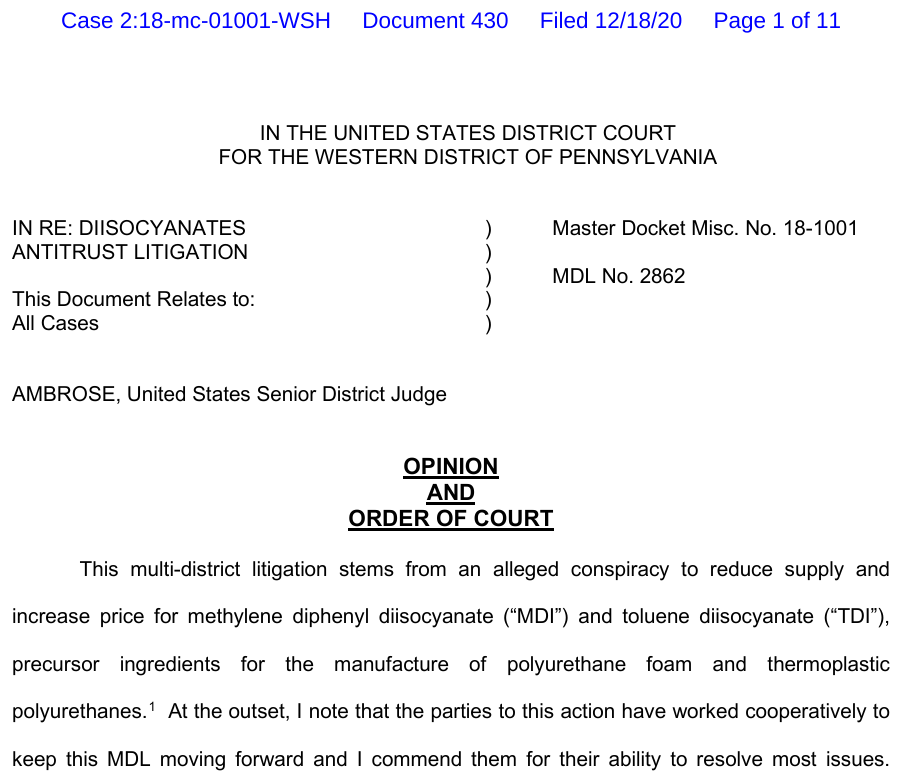
The case is In re: Diisocyanates Antitrust Litigation, Case No. 2:18-mc-01001, before the United States District Court for the Western District of Pennsylvania.
In a motion filed on May 4, 2026, seeking approval of a settlement with BASF, the purchasers stated that since the lawsuit was filed in 2018, the parties had engaged in vigorous litigation at every stage of the case, and they expected similar disputes in the subsequent stages. The motion stated that, in weighing the various factors for approving the settlement, the court needed to balance the value of the deal against the risks of continued litigation.
The motion states: “After years of protracted litigation, this groundbreaking settlement agreement provides substantial monetary compensation to the class members while also affording meaningful and effective cooperation to the plaintiffs. The value of the settlement far exceeds the risks of continued litigation and trial.”
【Copyright and Disclaimer】The above information is collected and organized by PlastMatch. The copyright belongs to the original author. This article is reprinted for the purpose of providing more information, and it does not imply that PlastMatch endorses the views expressed in the article or guarantees its accuracy. If there are any errors in the source attribution or if your legitimate rights have been infringed, please contact us, and we will promptly correct or remove the content. If other media, websites, or individuals use the aforementioned content, they must clearly indicate the original source and origin of the work and assume legal responsibility on their own.
Most Popular
-

A Look at the Material Suppliers Behind SpaceX
-

Government's Triple Action, Enterprises' Three Arrows in Five Days, Semiconductor Reshuffle! What Signal Does Japan's Chemical Industry Release?
-
Name change without tax change: POM Anti-Dumping Duty Rate Inheritance Implemented
-
Fire breaks out at jiangsu meiside!
-
Ethylene: Production Capacity Accelerates Expansion, Global Industry Landscape Is Being Reshaped