



In-Mold Coating Becomes Highlight Of 2026 CHINAPLAS Plastics And Rubber Exhibition, Automotive Manufacturing Embraces Integrated Molding
At the 2026 CHINAPLAS International Rubber and Plastics Exhibition, In-Mold Coating (IMC) became the most popular technology direction in the equipment exhibition area. At the exhibition, ENGEL showcased an integrated automotive B-pillar with self-repairing coating, KraussMaffei held a special technical seminar focusing on the implementation of the IMC system, and domestic companies such as Yizumi and Haitian also launched complete solution sets. A month before the opening of the exhibition, Li Auto completed the first large-size IMC exterior part in Jiaxing, Zhejiang, marking the transition of this process from small interior parts to large-scale production of exterior parts for automobiles. A mature process that has been around for many years welcomed a concentrated breakthrough in 2026, driven by the upgrading of the automotive industry, tightening environmental policies, and breakthroughs in supply chain collaboration.
Internal Mold Coating: One-step Molding Replaces Traditional Multi-step Painting Process
In-mold coating, also known as in-mold painting, is centered on integrating the traditional multi-stage process of "injection molding - transportation - spray painting - drying and curing" for plastic parts into a one-time completion within the mold.
The standard process sequence is as follows: first, injection-mold a thermoplastic substrate within the mold cavity; then, slightly open and reclose the mold to inject liquid polyurethane (PUR) coating into the gap between the plastic part surface and the mold cavity. The coating evenly flows and levels within the mold and rapidly cures, yielding a finished part with a high-quality surface coating upon mold opening.
Compared with traditional post-painting processes, the advantages of in-mold painting cover three dimensions: quality, efficiency, and cost. In terms of quality, high-precision formulation and sealed in-mold spraying ensure uniform coating thickness, effectively avoiding appearance defects such as color differences, scratches, sagging, and particles, significantly improving product consistency and pass rate. In terms of efficiency, it eliminates post-process steps such as painting, baking, and transportation, shortening the overall production cycle and improving raw material utilization. In terms of cost, it reduces labor, painting equipment, site occupancy, and environmental protection investment, achieving a reduction in total lifecycle costs.
This technology is not a new concept, but has long been limited by engineering challenges, making large-scale promotion difficult. Controlling the uniformity of polyurethane coatings, designing large-size mold sealing, and achieving strong adhesion between plastic substrates and coatings are all key bottlenecks restricting its application. Therefore, for a long time, in-mold spraying was limited to small-sized, simple-structured automotive interior parts. Once applied to large-sized, complex-structured exterior parts, the yield could not meet mass production requirements. With simultaneous breakthroughs in equipment control, mold design, and material formulation, this technical barrier was finally overcome in 2026.
II. Technology Implementation Acceleration: Achieving Mass Production Breakthroughs from Interior Components to Large-Sized Exterior Parts
In 2026, the most iconic advancement in in-mold painting was the successful breakthrough in mass production of large-size, complex-structure automotive exterior parts; domestic and international equipment manufacturers simultaneously launched mature solutions, propelling the process from laboratory to production line.
In the overseas technology camp, ENGEL and KraussMaffei have become the core forces driving implementation. ENGELAt the exhibition, the Duo 700 two-plate injection molding machine is used in conjunction with the ClearMelt in-mold painting process to produce automotive B-pillar trim parts, using PC+ABS as the base material with a polyurethane coating. The cycle time per piece is only 90 seconds, and the coating has self-healing properties, automatically restoring minor scratches at a certain temperature, significantly enhancing the durability of automotive interior and exterior trims. The entire system achieves integrated injection molding and painting, replacing multiple processes such as traditional injection molding lines, transportation, painting lines, and baking lines.
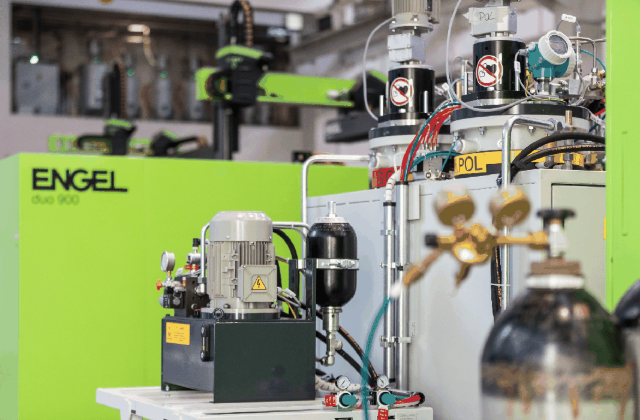
Image source: ENGEL
KraussMaffeiColorForm is a mature technology solution in the field of in-mold coating. A dedicated seminar was held concurrently with the exhibition, attracting over 200 industry experts from OEMs, component suppliers, material companies, and mold makers, covering comprehensive topics including technical principles, CAE simulation, mold sealing, cleanroom automation, and process integration. Its most significant milestone is the successful collaboration with Li Auto, Faway Dongyang, and Wanlong Mold to launch China’s first large-scale in-mold coating exterior component project in Jiaxing. The produced part measures 1.4 meters by 1.2 meters and features complex geometries such as continuous stepped surfaces, openings, and undercuts—making it the largest and most structurally complex in-mold coated exterior component currently known in China. The supporting equipment has a clamping force of 5,500 tons, capable of producing core exterior components such as fenders, bumpers, and door outer panels.
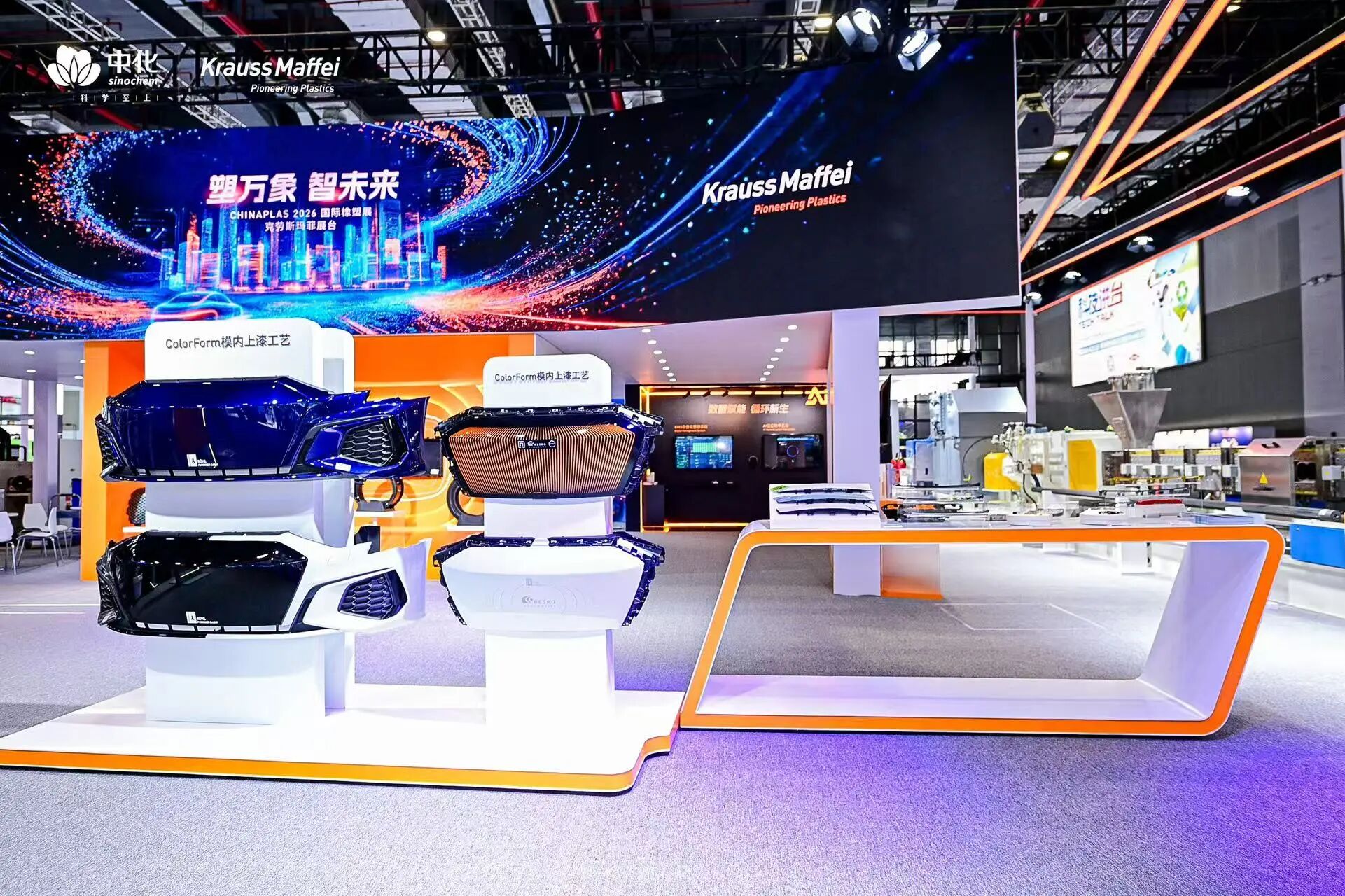
Image source: KraussMaffei
This project successfully addressed the challenge of deformation control for large-sized components: shrinkage-induced deformation during cooling of the injection-molded substrate can reach millimeter-level, whereas the polyurethane coating requires dimensional accuracy of ±0.1 mm. The R&D team achieved dimensional stability through four iterations of mold design, validation of six sealing structures, and CAE-simulation-optimized gate design. Furthermore, 5,400 experimental prototypes and 21 categories of tests were completed, establishing multi-substrate systems—including PP, PC, and PC/ABS—as well as diverse color schemes such as transparent, high-gloss black, and metallic silver. Mass production data indicate a cycle time of approximately 120 seconds per part, a 30% reduction in overall cost compared with conventional painting, a 90% reduction in VOC emissions, and a scrap rate below 3%, thereby validating the feasibility of large-scale production for large-sized exterior components.
Domestic equipment manufacturers are accelerating their efforts in parallel, establishing independently controllable technological pathways. YizumiLaunched its proprietary ReactPro in-mold coating technology, which integrates injection molding and polyurethane spraying into a single machine, aligning with international technical approaches while better suiting local supply chains. In March 2025, Yizumi entered into a strategic partnership with Wanhua Chemical, combining Wanhua’s Surface-form Pro material system—featuring high transparency, scratch resistance, and recyclability—to build an integrated “equipment + materials” ecosystem.
Leveraging nearly a decade of technological accumulation, the in-mold spraying process has been expanded from interior parts to exterior parts, with a focus on new exterior products for electric vehicles such as illuminated grilles. This is achieved through the integration of injection molding equipment and PUR equipment, enabling a fully integrated control process for raw material delivery, precise measurement, in-mold spraying, and injection molding. Additionally, multiple rounds of process validation have been completed on high-end interior materials such as real wood and carbon fiber, laying the foundation for the large-scale application of exterior parts.
III. Full-Chain Collaboration Matures: Materials, Molds, and Vehicles Jointly Drive Industrial Breakthrough
The rapid implementation of in-mold spraying is not merely an upgrade of a single equipment technology, but rather the result of the maturity of the entire industrial chain—including materials, molds, coatings, and vehicle manufacturers.
In the first half of 2026, upstream and downstream enterprises will closely collaborate, driving this process into a large-scale production cycle.
The becomes the core driving force for technology implementation.Li Auto was the first to complete the production of ultra-large exterior components, while Geely Automobile, in collaboration with SABIC and Minth Group, has launched the world’s first large-size IMC exterior component project, clearly defining mass-production and delivery targets and driving upgrades across the supply chain.
Materials and coating suppliers provide critical support.SABIC has developed customized substrates for in-mold painting. Covestro launched Makrolon® IMC2477, a dedicated PC substrate and polyurethane raw materials. Wanhua Chemical has independently developed material systems compatible with domestic equipment. Companies such as Nippon Paint, RuiPu Polyurethane, and Japanese Kansai Paint have developed new coating systems targeting specific applications. Kansai Paint has achieved mass production of coating systems for large luggage trim panels, reducing carbon emissions by approximately 60%.
Mold enterprises overcome core engineering challenges.Wanlong Molding has completed multiple scheme iterations to address the pain points of deformation and sealing for large-sized parts, breaking through the application limitations of in-mold painting on complex exterior parts, becoming a key link connecting equipment and the whole vehicle.
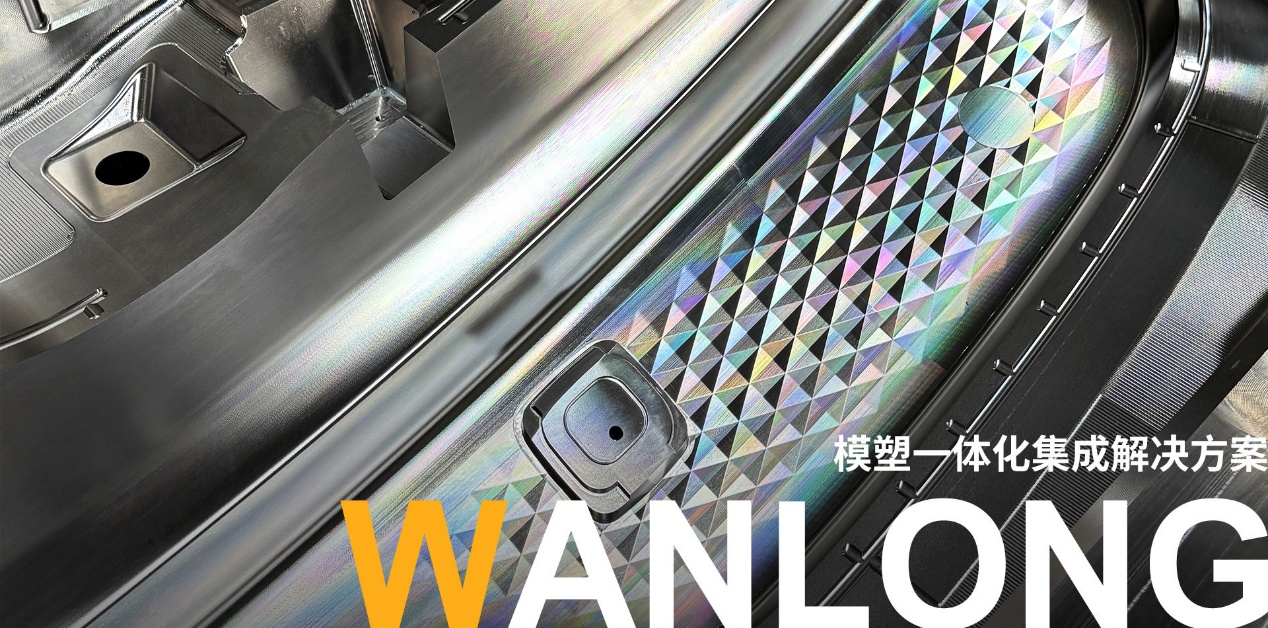
Image source: Wenglong Mould
From interior trim components to exterior large parts, and from single equipment to full-chain supporting solutions, in-mold painting is no longer an isolated process but a mature green manufacturing solution with a solid industrial foundation for rapid promotion.
IV. Logic of Three Major Industries: In-Mold Coating Becomes an Inevitable Choice in Automotive Manufacturing
In-mold spraying has evolved from a marginal process to a focal point in the industry, which is essentially an inevitable outcome of the development of the automotive industry, driven by three irreversible core logics.
First, new energy vehicles promote the flexible upgrading of surface manufacturing.The iteration speed of new energy vehicle models is accelerating, and consumers’ demands for personalized appearances, rich color options, and superior surface texture are continuously increasing. Traditional painting production lines lack flexibility; changing colors requires cleaning the entire production line, which is time-consuming, labor-intensive, and costly. In-mold painting enables rapid switching of colors and surface effects through mold and material changes, supporting flexible production with small batches and diverse variants—perfectly aligning with the rapid pace of exterior design innovation in new energy vehicles.
Second, environmental protection policies compel green transformation of manufacturing processes.Traditional painting workshops are a major source of VOC emissions in automotive component manufacturing. Environmental regulations in the EU and China are continuously tightening, imposing increasingly stringent limits on emissions and requirements for pollution control. In-mold painting completes coating curing within a sealed mold cavity, eliminating exhaust gas leakage and reducing VOC emissions by 90%. This technology addresses pollution at the process origin, eliminating the need for large-scale environmental protection equipment, and has become a baseline technology for future factories.
Third, China's supply chain has shifted from catching up to defining standards independently.In the past, high-end forming processes were mostly dominated by overseas companies, but during this round of in-mold coating boom, local companies such as Yizumi, Haitian, Wanlong Mould, and Wanhua Chemical have collaborated on innovation, forming their own technology routes and supporting ecosystems. Car manufacturers like Li Auto and Geely have led the implementation of large-scale projects, pushing China to the forefront globally in the field of in-mold coating, achieving a transformation from technology follower to industry leader.
Standing at the node of CHINAPLAS 2026, the rise of in-mold painting is not only an upgrade in plastic processing technology, but also a concentrated reflection of the trend in manufacturing toward "reducing processes, enhancing integration, and lowering emissions." It "condenses" the independent painting workshop into a single mold, integrating the costs, risks, and logistics consumption that were previously scattered across multiple processes, locations, and stages into one device and a single molding process, achieving higher quality, lower costs, and a more environmentally friendly production with a simpler process.
The emergence of this technology is no coincidence, but an inevitable choice driven by three factors: cost pressure, environmental constraints, and market competition in the automotive industry. With the production bottlenecks of large-sized exterior parts being overcome, in-mold painting will rapidly penetrate into core components such as automotive bumpers, fenders, door panels, and illuminated grilles, becoming the mainstream production process for exterior parts of new energy vehicles.
Meanwhile, the application scope of in-mold painting extends far beyond the automotive industry. It also has the potential to replace traditional painting on a large scale in industries such as home appliances, 3C electronics, and construction materials, which require high surface quality and environmental protection. In the future, as equipment precision improves, material systems are perfected, and costs continue to decrease, in-mold integrated molding is expected to become a standard process in high-end plastic manufacturing, driving the entire manufacturing industry toward more efficient, green, and integrated development.
Editor: Lily
【Copyright and Disclaimer】This article is the property of PlastMatch. For business cooperation, media interviews, article reprints, or suggestions, please call the PlastMatch customer service hotline at +86-18030158354 or via email at service@zhuansushijie.com. The information and data provided by PlastMatch are for reference only and do not constitute direct advice for client decision-making. Any decisions made by clients based on such information and data, and all resulting direct or indirect losses and legal consequences, shall be borne by the clients themselves and are unrelated to PlastMatch. Unauthorized reprinting is strictly prohibited.
Most Popular
-
Layoffs, Divestments, Plant Closures While Pouring Billions: BASF Undergoes Major Transformation!
-
Ascend Adipic Acid Hit By Force Majeure, Market Expects Supply Resumption In Mid-September
-

Raw Material Supply Shortage! INEOS Phenol Declares Force Majeure on Phenol and Acetone Businesses
-
South Korea initiates anti-dumping investigation against Chinese PVC suspension resin! The target is Tianjin Bohua and Wanhua Chemical. How to break through?
-

Sixth national procurement set to be implemented: A “Reshuffling” Moment for the $10-Billion Medical Device Market