


Iran President Signals Ceasefire Will, Crude Oil Drops, Plastics Futures Retreat
I. Overnight Crude Oil Market Dynamics
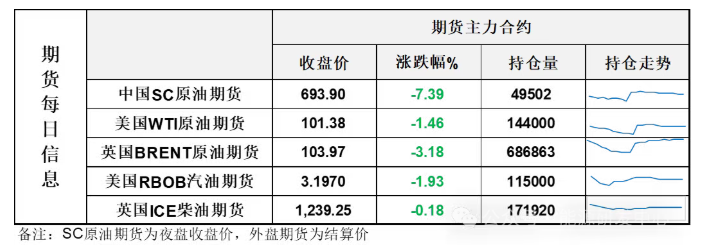
March 31: Prospects of a de-escalation in the Middle East conflict triggered a sharp reversal in the oil market, as international oil prices plunged after Iran's president stated the country would end the war if guarantees were provided.WTI crude oilDown 3.31%, closing at $101.81 per barrel.Brent CrudeIt finally closed down 5.46% at $102.09 per barrel.
Outlook for the Future Market
At 00:37 Beijing time, a statement by Iranian President Pezeshkian expressing Iran’s willingness to cease hostilities triggered an immediate plunge in oil prices. This marked a pivotal moment, signifying that both the U.S. and Iran had officially voiced their willingness to halt the conflict. Following the announcement, global oil prices sharply collapsed; domestically, the SC crude oil futures contract, fully pricing in the expectation, plunged over 10% at one point. Conversely, gold, silver, and U.S. equities surged across the board. Market expectations regarding the evolution of geopolitical risks shifted significantly, reflecting a broad global desire to end the war swiftly and restore peace and stability. Although President Pezeshkian’s ceasefire statement included clearly demanding preconditions, it still established the fundamental trajectory for oil price movements and provided the market with a crucial directional signal. Later that same night, Donald Trump commented on the Iran conflict, stating that the war was about to end. The coordinated remarks by the leaders of both countries substantially alleviated the risk of oil prices spiraling out of control.
With the ongoing Iran conflict and the de facto disruption of transportation through the Strait of Hormuz continuing, more institutions have raised their oil price targets in extreme scenarios to 150-200 dollars, reflecting the market's concern over the risk of uncontrollable geopolitical situations, which is precisely the scenario that the Trump administration is very worried about. Therefore, on Tuesday morning in the Asian session, the market reported that Trump was willing to end the Iran war under the condition of the closure of the Strait of Hormuz, causing oil prices to sharply decline from their high levels, falling by more than 4 dollars. If Trump really made such a decision, it would mean that he would rather sacrifice control over the Strait of Hormuz than bear the risk of high oil prices. Considering Trump's business nature, the market has fully taken this possibility into account.
Regarding the Strait of Hormuz, Iran’s Foreign Minister stated that the Strait of Hormuz is “fully open,” closed only to parties participating in a war against Iran. Iran has taken all necessary measures to ensure the safe passage of vessels from friendly countries through the Strait. He noted that, following the end of the war, the situation in the Strait of Hormuz will be jointly determined by Oman and Iran. In Iran’s view, the Strait of Hormuz can become a peaceful waterway open to peaceful use by vessels from all countries worldwide. At the outset of the war, Ray Dalio, founder of Bridgewater Associates, explicitly expressed the view that losing control of the Strait of Hormuz would mean the United States has lost the war, marking the beginning of the decline of this empire.
U.S. Secretary of Defense Hegseth stated that the coming days will be the decisive moment in the war with Iran—indeed, this is a critical week. The United States continues deploying its third aircraft carrier strike group to the Middle East; no ceasefire has been reached between the U.S. and Iran; and the differences between the two sides on ceasefire conditions remain substantial. Iranian Foreign Minister Araghchi said the current situation “is not negotiations,” but rather information exchanges conducted either through direct channels or via “regional friends.” This, however, does not signify the commencement of negotiations; such exchanges primarily involve “warnings or the sharing of viewpoints.” He noted that Iran is not currently engaged in negotiations with any specific party; information exchanges are being conducted by the Ministry of Foreign Affairs under coordination with security agencies and under the supervision of the government and the Supreme National Security Council, strictly within the official framework. Araghchi emphasized that Iran has not responded to any of the 15 proposals put forward by the United States, nor has it submitted any proposals or conditions of its own. Iran has yet to reach a final decision on the principles of negotiations, but its conditions for ending the war are “very clear.”Iran "will not agree to a ceasefire," but instead demands "the complete end of the war across the entire region."When discussing the regional situation, Araghchi stated, "The Iranian people do not tolerate threats," and the U.S. President must respect the Iranian people. While expressing Iran's "necessary willingness" to end the war, President Paezehchiyan emphasizedThe prerequisite is that the other party meets the demands of the Iranian side, especially by providing the necessary assurances that they will not engage in aggression again.Israel, on the other hand, expects Iran's response to U.S. conditions to lead to the collapse of negotiations. It is also hard for us to imagine how the U.S. and Iran could reach an agreement given the vast gap between their respective demands.
Time has indeed reached a very critical week. Iran's foreign minister emphasized that Iran is "prepared to deal with any ground conflict" and warned enemies not to make mistakes in their strategic calculations. It is expected that negotiations against a background of significant differences will be difficult, and this process is likely to be repetitive. The passage through the Strait of Hormuz will still take time, meaning that oil prices are still likely to experience significant fluctuations. However, both sides have a willingness to stop the war, which will serve as the anchor of the short-term logic. Cooling down will be the main theme in the short term. Considering the remaining uncertainties in the market, investors can consider options strategies, strengthen risk control, and participate cautiously.
II. Macroeconomic Market Dynamics
1. Reuters Survey:OPEC’s March output hits a new low since the peak of the COVID-19 pandemic.。
2. U.S. Customs stated that the new tariff refund system is under implementation, and processing time may take up to 45 days.
3. Warren Buffett:Stock market valuations still do not appear attractive.; sold Apple too early; currently has about $350 billion in cash and cash equivalents.
4. Iran Situation — ① President of Iran:Iran is willing to end the war., provided that its demands are met, especially the guarantee of no longer suffering aggression.
②The U.S. Navy’s aircraft carrier USS Bush is deploying to the Middle East region.
Jamshid Ehsaki, an advisor to the Chief of Staff of the Iranian Armed Forces, was assassinated.
④ Islamic Revolutionary Guard CorpsFrom April 1st, there will be a crackdown on enterprises in the Middle East related to US high-tech companies.。
⑤ US Defense Secretary: The next few days will determine the course of the Middle East conflict.
⑥ Russian ambassador: The Supreme Leader of Iran is currently in Iran but is avoiding public appearances.
⑦ Trump stated he would temporarily refrain from pressuring Iran to open the Strait of Hormuz.The Iran conflict will end within two to three weeks.。
⑧ Iranian Foreign Minister: No negotiations with the U.S. have been held, though there has been an exchange of information. Iran has not yet responded to the “15-Point Plan.”
Trump called forAllies wanting oil should fetch it from Iran themselves.。
III. Plastic Market Dynamics
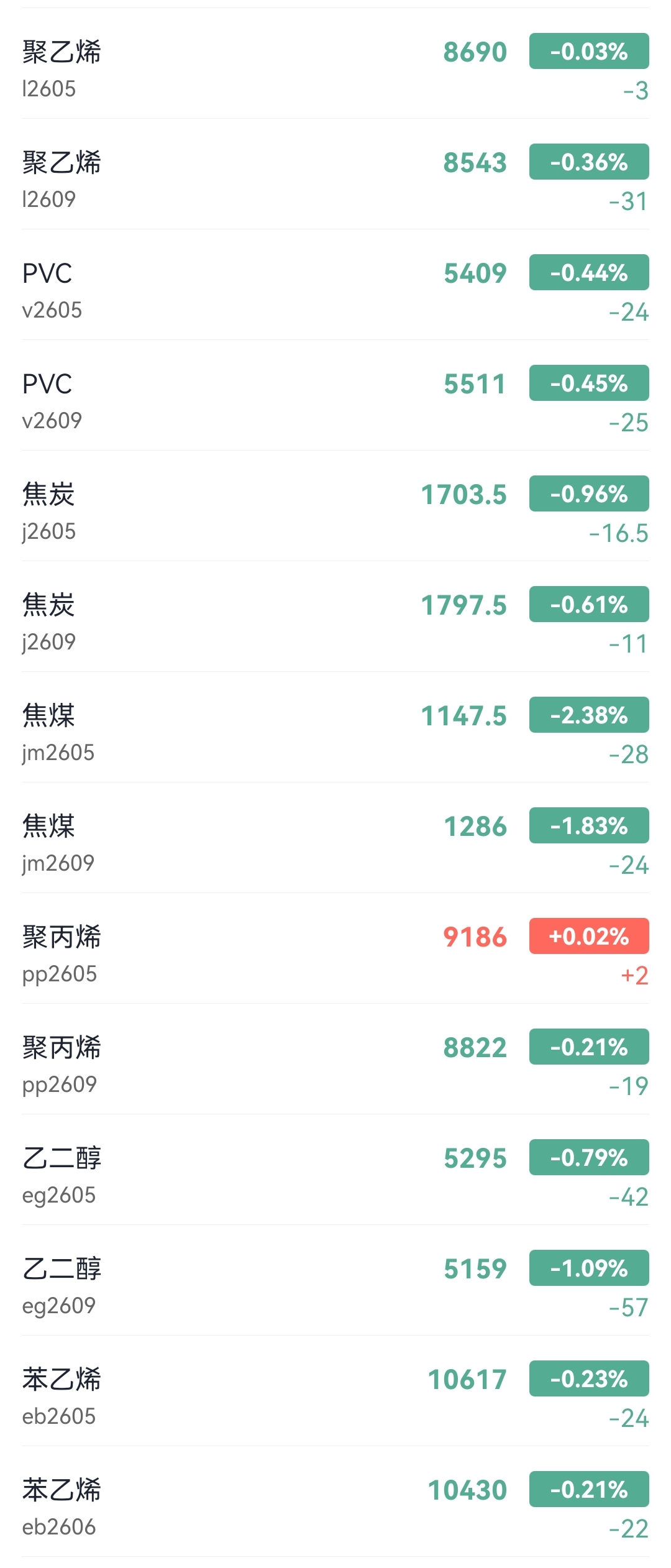
Iranian President says Iran is willing to end the war; oil prices plunge, plastic futures retreat.
Plastic reported at 8690 yuan/ton, down 0.03% from the previous trading day.
PP quoted at 9186 yuan/ton, up 0.02% from the previous trading day.
PVC is quoted at RMB 5,409 per ton, down 0.44% from the previous trading day.
Styrene is priced at RMB 10,617 per ton, down 0.23% from the previous trading day.
IV. Today's Market Forecast
PE: In the short term, there are signs of easing tensions in the Middle East, but the number of domestic facilities reducing production has increased, leading to an expanding supply gap. Combined with the expectation of increased downstream replenishment at the start of the month, the Chinese polyethylene price is expected to remain strong and fluctuate in the short term.
PP: Downstream demand is gradually picking up, but high raw material prices have dampened downstream purchasing enthusiasm. There is an expectation of reduced supply in the PP market, as domestic producers are increasingly shutting down or lowering operating rates, leading to a rise in production losses due to plant maintenance. With supply tightening and geopolitical factors adding volatility, PP prices are unlikely to see a significant decline. The market is expected to trade in a range today, digesting previous gains, with East China homopolymer PP prices projected at RMB 9,000–9,200/ton.
PVC: The domestic PVC spot market has been fluctuating lower recently due to weak regional sentiment expectations and pressure from domestic supply-demand contradictions. In the short term, domestic supply is expected to continue increasing, while both domestic and foreign trade demand lacks highlights. The market's fundamental aspects will continue to face pressure. Subsequently, attention should be paid to the recovery of overseas ethylene and especially the trend of ethylene prices. If the tight situation persists, there may be potential for an increase in foreign trade exports in the future. However, in the near term, the market is expected to maintain a weak oscillation within a range amid poor market sentiment.
【Copyright and Disclaimer】This article is the property of PlastMatch. For business cooperation, media interviews, article reprints, or suggestions, please call the PlastMatch customer service hotline at +86-18030158354 or via email at service@zhuansushijie.com. The information and data provided by PlastMatch are for reference only and do not constitute direct advice for client decision-making. Any decisions made by clients based on such information and data, and all resulting direct or indirect losses and legal consequences, shall be borne by the clients themselves and are unrelated to PlastMatch. Unauthorized reprinting is strictly prohibited.
Most Popular
-
Continental Plans to Begin Sale of ContiTech in Early 2026
-

$4 Billion! Medtronic Makes Another Acquisition
-

BASF Delivers First Batch of Innovative Cathode Materials for Semi-Solid-State Batteries to Weilan New Energy
-
Profit and Revenue Growth Struggle to Conceal Debt Repayment Pressure; Success of Kingfa Sci & Tech's High-End Strategy Yet to Be Seen
-
Why did a century-old european dental instrument giant relocate its manufacturing hub to china?