



New research by agricultural academy: Biodegradable Mulch Coupled with Controlled Irrigation Achieves Water-Saving, Yield Increase, and Emission Reduction in Rice
Recently, the Water-Saving New Materials and Agricultural Film Pollution Prevention and Control Team at the Institute of Environment and Sustainable Development in Agriculture, Chinese Academy of Agricultural Sciences, revealed the synergistic regulatory mechanisms by which biodegradable plastic film mulching combined with different irrigation management practices promotes water saving, efficiency enhancement, and emission reduction in paddy fields. The findings were published in *Agricultural Water Management*.
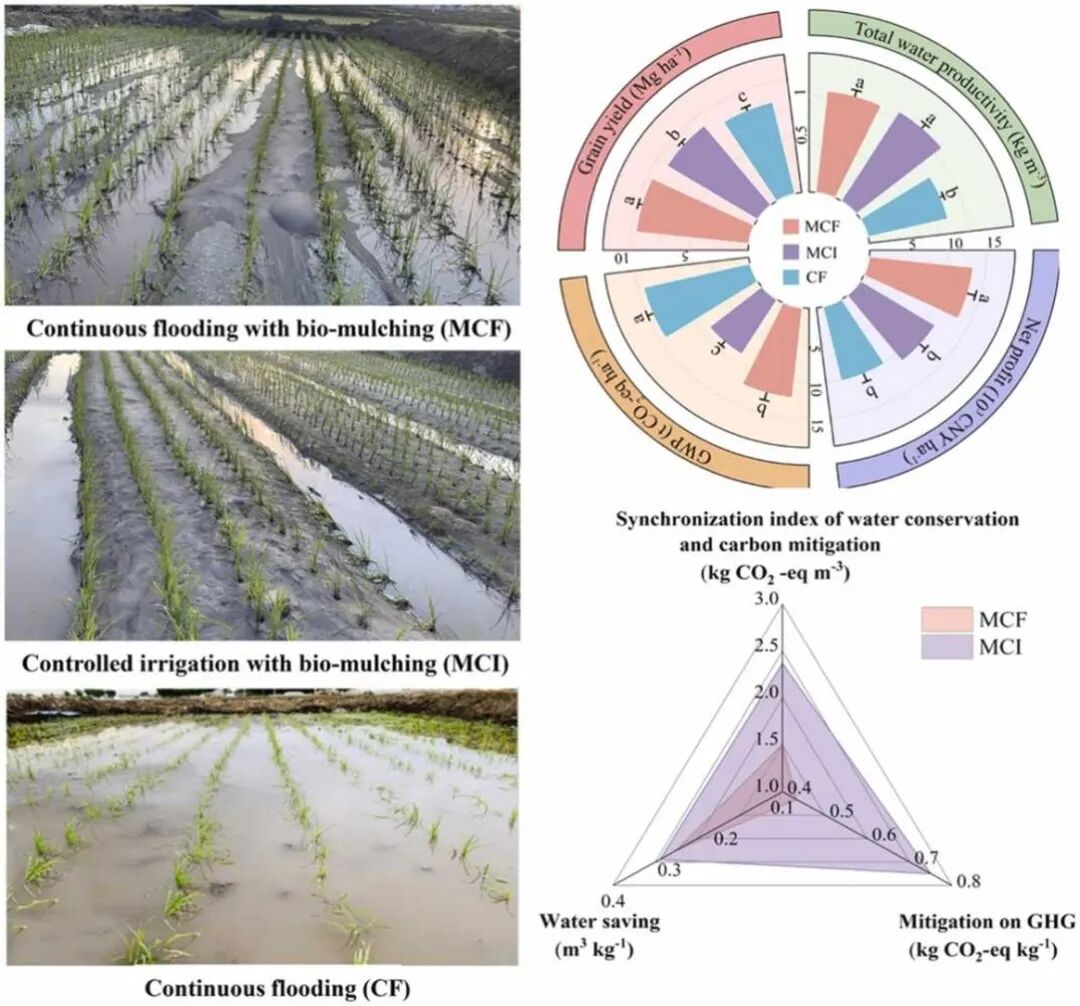
Experimental Design and Effects of Water-Saving, Efficiency Increasing, and Emission Reduction
Traditional flooded rice cultivation faces the triple constraints of high water consumption, high emissions, and plastic pollution. At the same time, it remains difficult to coordinate water saving, emission reduction, and yield stability, while conventional water-saving irrigation often leads to yield losses and reduced returns. To address these bottlenecks, this study innovatively integrates fully biodegradable film mulching with precision controlled irrigation, providing key support and a technological paradigm for rice-producing regions in China to respond to climate change, ensure food security, and achieve the strategic goals of agricultural “dual carbon” development.
Research has confirmed that, compared with traditional flood irrigation, biodegradable film mulching combined with controlled irrigation reduces irrigation water use by about 34%, while significantly increasing grain yield by about 9% and lowering global warming potential (GWP) and greenhouse gas emission intensity (GHGI) by 39% and 44%, respectively. Although biodegradable film increases production costs, the gains from higher yields and water savings result in net profit increases of 10% and 32% under mulching plus controlled irrigation and continuous mulching with flood irrigation, respectively, demonstrating the economic and environmental feasibility of this technological system. This study breaks through the long-standing technical bottleneck in rice production of reconciling water saving with emission reduction, and fully demonstrates that biodegradable film mulching combined with optimized irrigation management is an effective pathway for building climate-smart rice production systems. It is of great significance for enhancing the climate resilience of China’s agriculture, promoting the green transformation of agriculture, and safeguarding food security.
This research was supported by the State Key Laboratory of Efficient Utilization of Agricultural Water Resources, the Key Laboratory of Agricultural Plastic Film Pollution Prevention and Control of the Ministry of Agriculture and Rural Affairs, and the Science and Technology Innovation Program of the Chinese Academy of Agricultural Sciences.
【Copyright and Disclaimer】The above information is collected and organized by PlastMatch. The copyright belongs to the original author. This article is reprinted for the purpose of providing more information, and it does not imply that PlastMatch endorses the views expressed in the article or guarantees its accuracy. If there are any errors in the source attribution or if your legitimate rights have been infringed, please contact us, and we will promptly correct or remove the content. If other media, websites, or individuals use the aforementioned content, they must clearly indicate the original source and origin of the work and assume legal responsibility on their own.
Most Popular
-

Layoffs, Divestments, Plant Closures While Pouring Billions: BASF Undergoes Major Transformation!
-
Ascend Adipic Acid Hit By Force Majeure, Market Expects Supply Resumption In Mid-September
-

Raw Material Supply Shortage! INEOS Phenol Declares Force Majeure on Phenol and Acetone Businesses
-
South Korea initiates anti-dumping investigation against Chinese PVC suspension resin! The target is Tianjin Bohua and Wanhua Chemical. How to break through?
-

Sixth national procurement set to be implemented: A “Reshuffling” Moment for the $10-Billion Medical Device Market