



Peek Film: Excellent Properties, Preparation Process, Specifications, and Application Fields
PEEK (polyetheretherketone) film is a high-performance specialty engineering plastic film, known for its excellent stability under extreme conditions. As a semi-crystalline thermoplastic, it is often used to replace metals to meet the requirements of lightweight and high reliability in high-end fields such as aerospace, electronic and electrical, and medical applications. This article will comprehensively analyze this advanced material from four dimensions: core characteristics, main applications, preparation processes, and product specifications.
I. Core Features
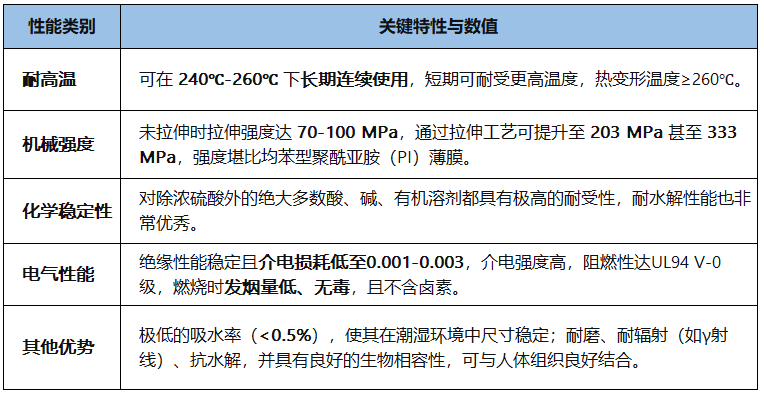
PEEK film integrates multiple outstanding properties, enabling it to perform excellently in harsh environments.
II. Major Application Fields
With its comprehensive high-performance characteristics, PEEK film plays a key role in multiple advanced fields.
Electronics and Electrical Engineering
Smartphone speaker diaphragm: Used to manufacture miniature speaker diaphragms for devices such as smartphones, significantly reducing audio distortion.
High-performance insulation: Used as slot liner in motors, insulation layer in transformers and flexible circuit boards, ensuring electrical safety under high voltage conditions.
5G Communications: Used as a dielectric material for 5G antenna substrates, filters, and other components to meet the low-loss requirements of high-frequency communications.
Aerospace
Key components: Used as interior aircraft panels, wire insulation, and high-temperature-resistant gaskets and seals near engines.
Weight Reduction Alternative: Leveraging its lightweight and high-strength properties to replace metals in manufacturing structural components such as brackets, contributing to aircraft lightweighting.
Healthcare
Implants: Used for manufacturing cranial repair plates, fracture fixation pins, and other implants, due to their biocompatibility (similar to the skull), imaging compatibility (X-ray transparent), and malleability, they have become an ideal material to replace titanium alloys.
Medical devices: Utilizing its biocompatibility and excellent mechanical properties, it is used to manufacture key components of medical imaging equipment and dental implants.
Automotive Industry
Harsh environment components: manufacturing bearings, seals, gaskets, etc., especially suitable for electric vehicle motors and components requiring chemical resistance.
Electrification components: Used as insulation for electric vehicle batteries, ensuring the safety of high-voltage systems.
Industry and New Energy
Protection and Sealing: Used as a sealing gasket film for highly corrosive chemical equipment or as a wear-resistant protective layer for high-temperature machinery.
Energy Applications: Used as critical components in fuel cells and supercapacitors, enhancing system efficiency and durability through their excellent chemical stability and electrical performance.
III. Preparation Process
The industrial production of PEEK film mainly uses the melt extrusion method, which can be specifically divided into cast extrusion and blown film extrusion. In addition, to obtain films with better performance, stretching and heat treatment are usually performed.
Two mainstream industrial preparation methods
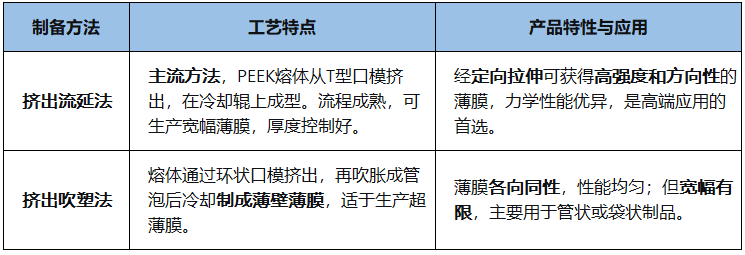
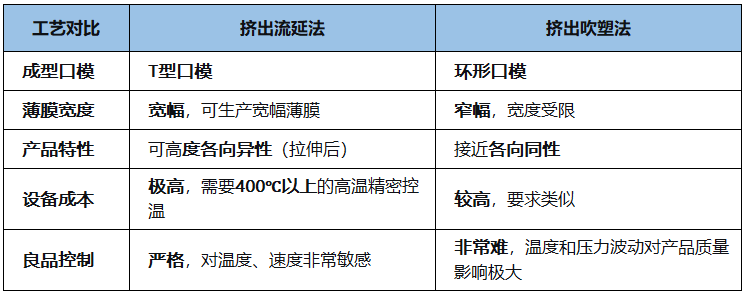
In actual production, the extrusion casting method dominates due to its technological maturity, product performance, and production efficiency.
Key Process Steps Explained
Although the methods may differ, the core process flow is essentially the same, mainly including the following steps:
1. Raw Material Preparation: PEEK resin must be pre-dried at 150°C for 3–4 hours to remove moisture. In some cases, modifiers such as nano-barium sulfate (0.5–3.0 wt%), carbon nanotubes, or talc may also be added to enhance specific film properties.
2. Melt Extrusion: The dried PEEK pellets are fed into the extruder and heated to above 400°C to melt. The extruder screw often adopts a structure used for PA or PP films. To avoid melt decomposition, precise temperature control is required, and the idle time should be 5-10 minutes. After extrusion, the melt needs to pass through a combination device with no less than three-stage filter screens (such as 20/60/250 mesh) to remove impurities.
3. Molding and Cooling:
Cast film process: The melt extrudes through a T-die, adheres to a chill roll for rapid cooling and solidification, and the film thickness is controlled by adjusting the extrusion rate and haul-off speed.
Blow molding: The melt is extruded through a ring-shaped die to form a tube blank, blown into a bubble, cooled and shaped, with the thickness controlled by the blow-up ratio.
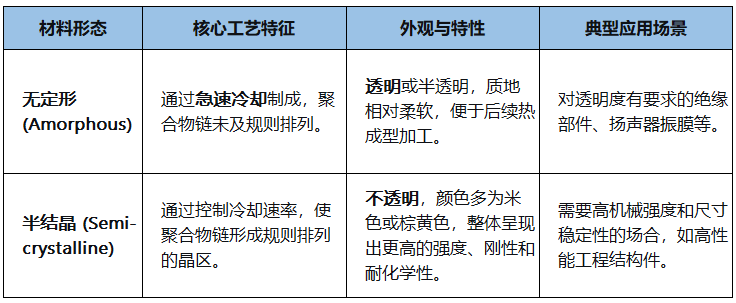
The cooling method of PEEK film directly determines its transparency and crystallinity. If the cooling roller temperature is below its glass transition temperature (Tg), an amorphous transparent film can be prepared; if it is higher than 170°C, a semi-crystalline opaque film is obtained.
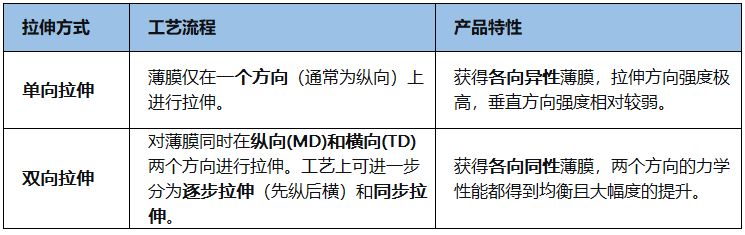
4. Directional Stretching (Core Strengthening Step):
The extruded film needs to be stretched, which is crucial for enhancing its performance. The stretching method determines the final properties of the film.
Heat treatment shaping: The stretched film is subjected to heat setting at a specific temperature to eliminate internal stress, stabilize dimensions, and optimize the crystalline structure to enhance performance.
6. Post-processing and Quality Inspection: Finally, the film is cut to specified dimensions and undergoes rigorous quality inspection. For films with special requirements (e.g., hydrophobicity), surface treatment is also performed.
Process Comparison
IV. Main Specification Parameters
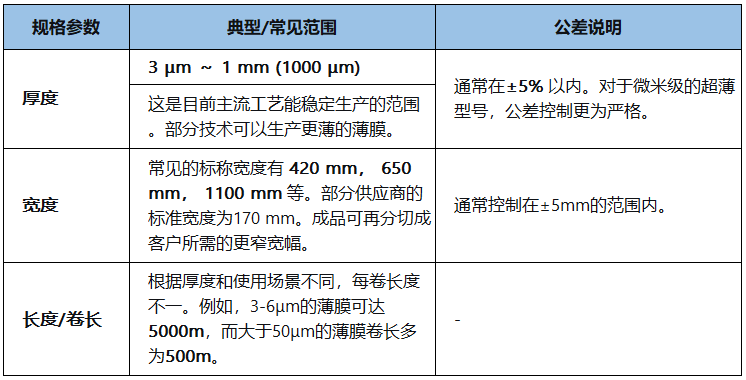
The specification system of PEEK film is very mature, and can be understood from three core dimensions: geometric dimensions, material form, and functional models.
Core geometric dimensions
Critical Material Form Classification
Model Number and Grade
Mainstream Manufacturer Models: Globally leading PEEK film manufacturers each offer comprehensive product portfolios. For example, Victrex is renowned for its APTIV™ series, which is further subdivided into the 2000 series (amorphous) and the 2100 series (mineral-filled); Evonik’s representative product is the VESTAKEEP® series; and Solvay offers the KetaSpire® series.
Product Grades: Functionally, they can be divided into general types such as PEEK 4000, and modified models developed for specific applications, such as high-sliding grade PEEK 4110. In special fields, there are also high-grade products that meet specific standards, such as implant-grade PEEK that complies with the ISO 10993 standard.
By crystallinity: PEEK film can also be classified according to its degree of crystallinity. It is usually divided into low-crystallinity type with crystallinity below 10%, and high-crystallinity type with crystallinity of 20-30%, the latter usually exhibiting higher strength and heat resistance.
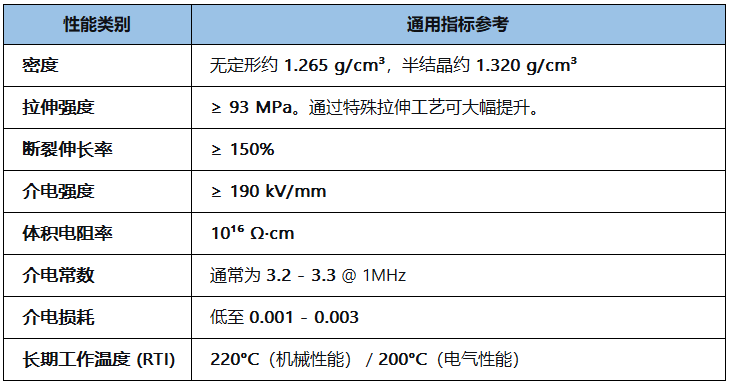
Main performance indicators reference
The following is a set of general performance specifications using a 50 μm thick film as an example; specific values may vary depending on the process, model, and thickness.
Important Notes
The correlation between performance and specifications: Many performance data (such as dielectric strength, mechanical strength) are directly related to the thickness of the film and will vary with different thicknesses.
V. Summary Translate the above content into English, output the translation result directly, without any explanation.
PEEK polyetheretherketone film is a cutting-edge material that truly embodies the concept of "plastic replacing steel." It boasts outstanding high-temperature resistance (long-term operating temperature up to 240-260°C), high mechanical strength (tensile strength can reach 70-100 MPa, and can exceed 200 MPa through stretching processes), excellent chemical stability (resistant to most chemicals except concentrated sulfuric acid), and superior electrical insulation properties (dielectric loss as low as 0.001). This makes it suitable for stable service in extremely harsh environments such as aerospace, electronics (e.g., 5G antennas, speaker diaphragms), medical implants, and the automotive industry.
From the preparation process perspective, melt extrusion casting is the dominant method, combined with key steps such as biaxial stretching and heat treatment, which can produce high-performance films with thicknesses ranging from 3μm to 1mm, in amorphous or semi-crystalline forms. The supply chain for PEEK films is gradually maturing, with international giants (Victrex, Solvay, Evonik, etc.) and domestic companies (Foshan DaFu, Jilin Province Juke High-tech, etc.) jointly driving the application of this material in more innovative fields. For engineers and product managers seeking solutions to the limitations of traditional materials in terms of heat resistance, corrosion resistance, and lightweighting, PEEK films offer a high-value solution.
【Copyright and Disclaimer】The above information is collected and organized by PlastMatch. The copyright belongs to the original author. This article is reprinted for the purpose of providing more information, and it does not imply that PlastMatch endorses the views expressed in the article or guarantees its accuracy. If there are any errors in the source attribution or if your legitimate rights have been infringed, please contact us, and we will promptly correct or remove the content. If other media, websites, or individuals use the aforementioned content, they must clearly indicate the original source and origin of the work and assume legal responsibility on their own.
Most Popular
-

A Look at the Material Suppliers Behind SpaceX
-

Government's Triple Action, Enterprises' Three Arrows in Five Days, Semiconductor Reshuffle! What Signal Does Japan's Chemical Industry Release?
-
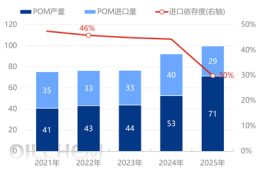
Name change without tax change: POM Anti-Dumping Duty Rate Inheritance Implemented
-
Fire breaks out at jiangsu meiside!
-
Ethylene: Production Capacity Accelerates Expansion, Global Industry Landscape Is Being Reshaped