



PLA Filament Booms! As 3D Printers Hit Sam’s Club Shelves, Polylactic Acid Enters the 120,000-Ton Era
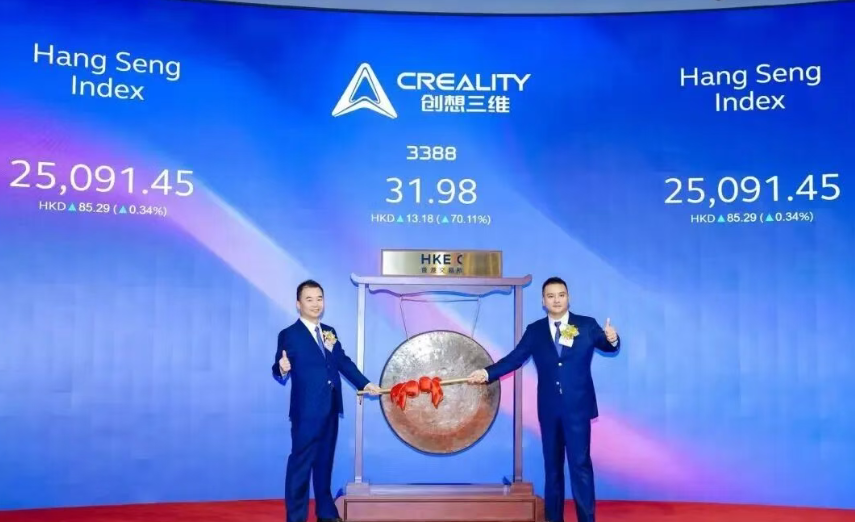
According to ZhuanSu Vision, on May 29, 2026, Creality officially went public, with an opening price of HK$33.88—over 80% higher than its issue price—instantly pushing its market value past HK$10 billion. Just a month earlier, TuoZhu Technology’s 3D printers quietly appeared on the shelves of 64 Sam’s Club stores nationwide, displayed alongside air fryers and robotic vacuum cleaners. The debut of “the first consumer-grade 3D printing stock” and “3D printers on supermarket shelves” in the same month signifies that this is no longer a niche celebration among geeks, but rather the real beginning of a mass consumer market. Behind this frenzy, an environmentally friendly material made from corn—polylactic acid (PLA)—is quietly becoming one of the biggest winners.
1. Capital Heat: 3,829 Times Subscription and HK$1.38 Billion
Creality’s listing is not an isolated case, but rather a reflection of the capital-market enthusiasm surrounding the 3D printing industry in 2026. According to disclosures by the Hong Kong Stock Exchange, the Hong Kong public offering tranche of Creality was oversubscribed by approximately 3,829 times, while 15 cornerstone investors subscribed for nearly half of the shares offered, with total proceeds of about HK$1.38 billion (source: HKEX announcement, May 2026). Its market capitalization exceeded HK$10 billion on its first day of listing, underscoring the capital market’s strong interest in this sector.
Notably, this enthusiasm was already foreshadowed in early 2026. According to publicly reported statistics, from January to March this year, the domestic 3D printing industry saw over 20 financing events, with investments covering all segments, including metal printing, printing materials, core components, and consumer-grade equipment (source: publicly available data from various investment institutions and industry media). On May 21, 3D printing materials company Anhui Sangreen Technology successfully went public on the New Third Board; high-end photo-curing 3D printing leader Heger Technology also announced the completion of over 300 million yuan in Series C financing in May. Capital is being poured comprehensively from the equipment side, material side to the application side.
II. Channel Breakthrough: From Desktop to Sam’s Club Shelves
If the capital market is an “amplifier” for the industry, then channel expansion into lower-tier markets is the real “key” to bringing 3D printers into households. For a long time, the purchase of 3D printers has largely been confined to online platforms, crowdfunding campaigns, or educational procurement lists, leaving ordinary consumers with few opportunities to actually see and touch the machines in person.
In May 2026, this situation was completely upended. Bambu Lab announced its entry into 64 Sam’s Club stores across China, placing its products directly in prominent locations within large supermarkets and retail outlets (source: public information from Bambu Lab’s official channels and Sam’s Club). Sam’s Club has more than 10 million paid members, the vast majority of whom are household consumers with purchasing power. At the same time, leading companies such as Creality and Bambu Lab have been opening offline retail stores in Shenzhen, Shanghai, Beijing, and other cities. Bambu Lab’s second offline store, located in Uniwalk Qianhai in Bao’an, Shenzhen, has seen daily foot traffic exceed 10,000 during peak periods. This omnichannel layout spanning both online and offline channels means that 3D printers are shifting from geek gadgets that “require half a year of study after purchase” into home appliances that people can “pick up casually while shopping at the supermarket.”
3. Upstream “Explosive Growth” in Performance: PLA Consumption Will Reach 120,000–140,000 Tons
The expansion of devices benefits the upstream material companies in the supply chain first. In this feast of materials, polylactic acid (PLA) is the most dazzling protagonist. In the first quarter report of 2026, the data from two A-share listed companies stands out remarkably.
Jialian Technology (301193.SZIn the first quarter, the company achieved revenue of RMB 753 million, a year-on-year surge of 48.89%. It explicitly attributed the core growth momentum to the expanded sales scale of its 3D printing products, and stated that it will develop its 3D printing business into its second growth curve.
Haizheng Bio-materials (688203.SH) performed even more impressively: in the first quarter, revenue grew by 30.28% year-on-year, while net profit attributable to shareholders soared by 348.06%. The explosive performance is attributed to the surge in demand for the core product, polylactic acid (PLA) resin, in the 3D printing materials sector. Company executives publicly stated, "The growth of PLA in this field is astonishing!"
PLA is an environmentally friendly polymer material made from plant-based resources such as corn, and it has now become the mainstream material for FDM (Fused Deposition Modeling) 3D printing. According to industry forecasts, global demand for polylactic acid is expected to reach about 300,000 tons in 2025, with the 3D printing sector alone contributing more than 40% of the incremental growth. In 2026, consumption of polylactic acid in the 3D printing industry is projected to reach 120,000 to 140,000 tons. This means that for every 10 rolls of FDM printing filament sold, more than 7 rolls are made of PLA. In addition to companies such as Jialian Technology and Hisun Biomaterials, chemical enterprises including Yinxi Technology, Nanjing Julong, and Donghua Energy are also expanding into the 3D printing consumables market, making competition in the sector increasingly diverse.
IV. The Industrial Transformation Behind the Numbers: The Global Home Turf of Chinese Enterprises
From a macro perspective, this outbreak has solid data support. According to statistics from the General Administration of Customs, in the first four months of 2026, China's 3D printer exports reached 2.46 million units, a year-on-year increase of 100.3%; domestic 3D printer production grew by 50.9% year-on-year. Chinese companies now occupy about 90% of the global consumer 3D printing market. The China Business Industry Research Institute predicts that the scale of China's 3D printing market will reach 86.2 billion yuan in 2026.
These numbers add up to a clear picture: consumer-grade 3D printing is completing a thrilling leap from "niche novelty" to "mainstream consumer product." When printers are placed on Sam's Club shelves and profits for PLA material companies triple, this industry no longer relies on the allure of "black technology" to attract attention—it is becoming a solid business aimed at households everywhere, with PLA serving as the indispensable "green blood" in this transformation.
5. The Road Ahead: Opportunities and Challenges Coexist
Of course, from “usable” to “easy to use,” and from “curiosity-driven purchases” to “daily use,” 3D printing still faces multiple challenges, including content ecosystems, printing speed, and material costs. But the intense signals in the first half of 2026 have already made one thing clear: capital, distribution channels, materials, and exports—the four major engines—are all roaring at once. Especially for the PLA industry, an annual consumption of 120,000 to 140,000 tons is just the beginning—as consumer-grade 3D printing becomes further popularized, this figure is expected to double within three years.
As one industry insider put it, “The industry only truly comes alive when your neighbor brings home a 3D printer from Sam’s Club just to print a toy dinosaur for their child, and that dinosaur is made from corn-based PLA.” In 2026, that moment is arriving.
【Copyright and Disclaimer】This article is the property of PlastMatch. For business cooperation, media interviews, article reprints, or suggestions, please call the PlastMatch customer service hotline at +86-18030158354 or via email at service@zhuansushijie.com. The information and data provided by PlastMatch are for reference only and do not constitute direct advice for client decision-making. Any decisions made by clients based on such information and data, and all resulting direct or indirect losses and legal consequences, shall be borne by the clients themselves and are unrelated to PlastMatch. Unauthorized reprinting is strictly prohibited.
Most Popular
-

Layoffs, Divestments, Plant Closures While Pouring Billions: BASF Undergoes Major Transformation!
-

Ascend Adipic Acid Hit By Force Majeure, Market Expects Supply Resumption In Mid-September
-

Raw Material Supply Shortage! INEOS Phenol Declares Force Majeure on Phenol and Acetone Businesses
-
South Korea initiates anti-dumping investigation against Chinese PVC suspension resin! The target is Tianjin Bohua and Wanhua Chemical. How to break through?
-

Sixth national procurement set to be implemented: A “Reshuffling” Moment for the $10-Billion Medical Device Market