


Structural Optimization and Growth Divergence Proceed in Parallel, February Power Battery Industry Enters New Landscape
In February 2026, China's power battery industry exhibited a clear pattern of "month-on-month decline in total volume and continuous structural optimization," influenced by seasonal factors such as the Spring Festival holiday.
According to data from the China Power Battery Industry Innovation Alliance (hereinafter referred to as the “Battery Alliance”), although output and sales volumes of power and energy storage batteries declined month-on-month, they still achieved double-digit year-on-year growth. Exports of energy storage batteries and power batteries have become the core drivers propelling industry growth. Meanwhile, domestic power battery installation volume declined year-on-year, while technological routes and market structures are rapidly diversifying. The industry is transitioning from scale expansion to high-quality development, and a new competitive ecosystem is emerging.
Energy Storage and Export Drive Growth, Structural Upgrade of Growth Momentum
In February, China's power and energy storage battery industry demonstrated strong development resilience in a complex market environment. The explosive growth of energy storage batteries and the high increase in power battery exports complemented each other, driving continuous upgrading of the industry's growth momentum.
From the production side, in February, the combined production of power and energy storage batteries in China reached 141.6GWh, a month-on-month decrease of 15.7%, but still a high year-on-year growth of 41.3%; the cumulative production for January-February was 309.7GWh, with a cumulative year-on-year increase of 48.8%.
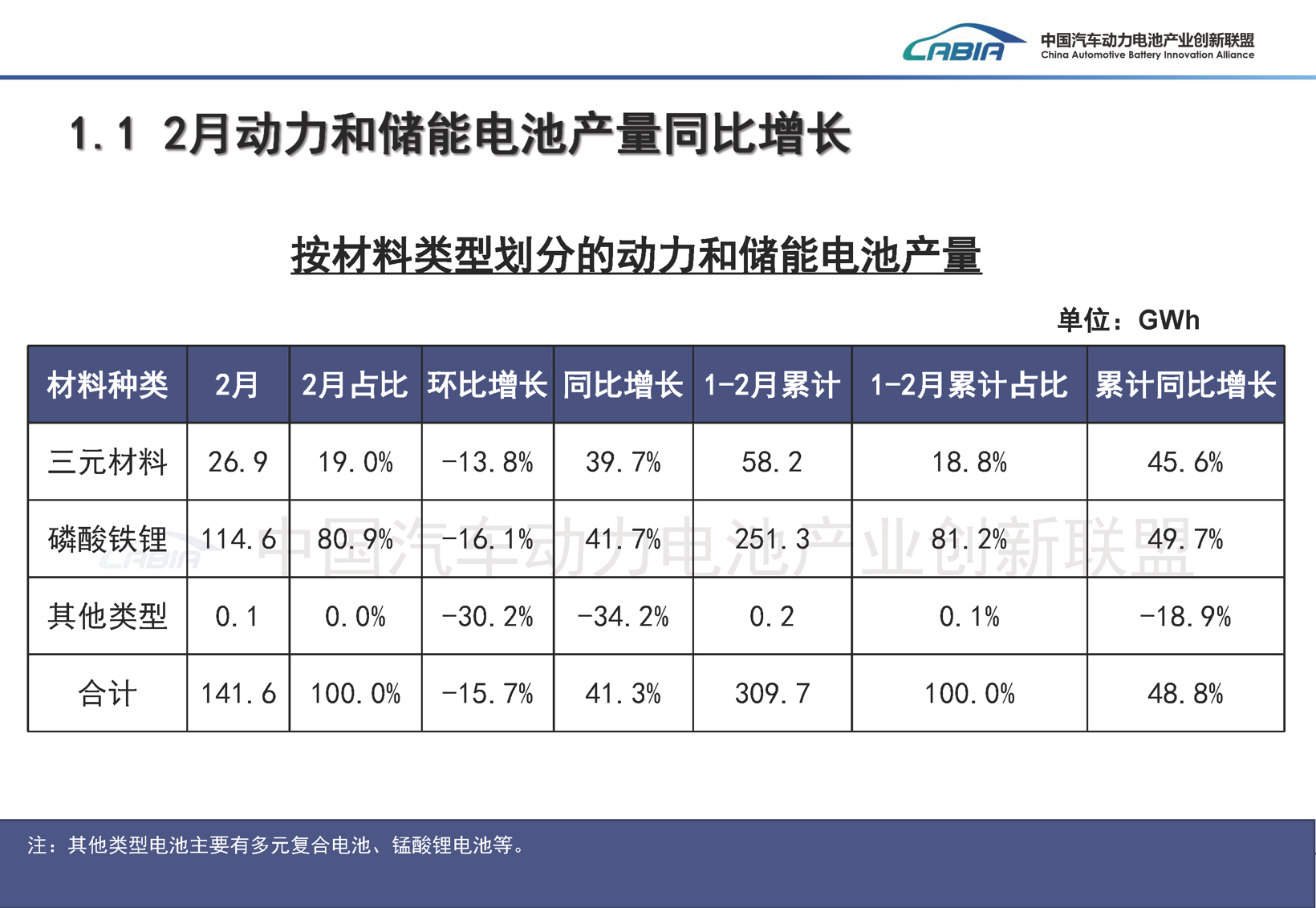
Image source: Battery Alliance (same below)
In terms of cathode material type, lithium iron phosphate (LFP) batteries continue to dominate, with a production volume of 114.6 GWh in February, accounting for 80.9% of the total and representing a year-on-year increase of 41.7%; their cost-effectiveness and safety advantages remain prominent in both power and energy storage applications. Nickel-cobalt-manganese (NCM) batteries produced 26.9 GWh, representing 19.0% of the total and a year-on-year growth of 39.7%, maintaining steady demand in high-end power applications.
Changes in sales composition better reflect industry development trends. In February, total sales of power and energy storage batteries reached 113.2 GWh, down 23.9% month-over-month but up 25.7% year-over-year. Among these, energy storage batteries stood out as the biggest highlight, with February sales reaching 38.6 GWh, a substantial year-over-year increase of 67.3%. Cumulative sales for January and February totaled 84.8 GWh, surging 108.9% year-over-year, and accounting for 32.4% of total sales—8.6 percentage points higher than the same period last year. This growth is driven by the rapid global expansion of the energy storage market and the accelerated implementation of domestic integrated solar-wind-storage projects.
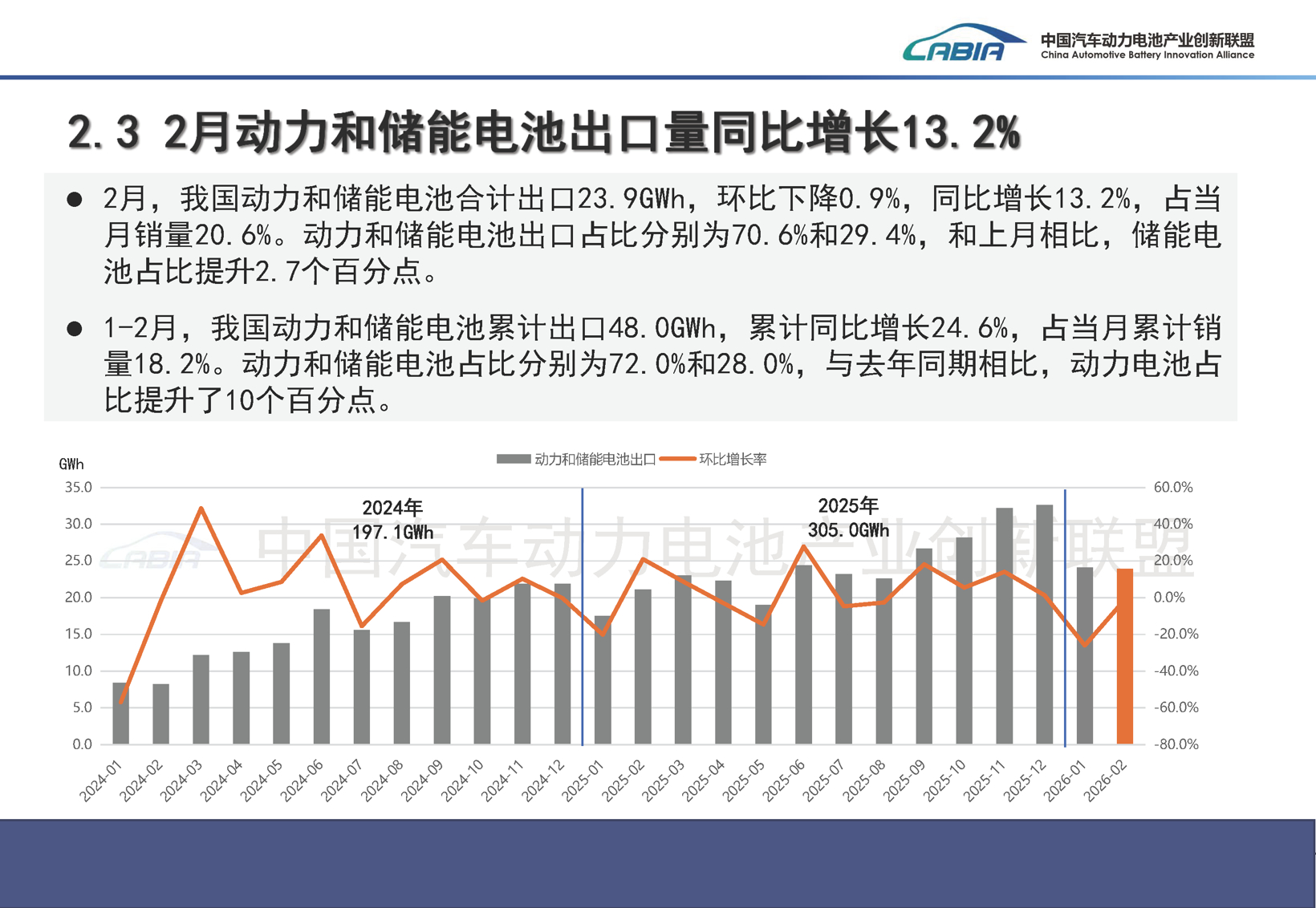
The export market also performed impressively, serving as a key pillar for industry growth. In February, the combined export volume of power and energy storage batteries reached 23.9 GWh, representing a 13.2% year-on-year increase and accounting for 20.6% of the monthly sales volume. Among them, power battery exports amounted to 16.9 GWh, up 31.9% year-on-year; cumulative exports for January–February totaled 34.6 GWh, reflecting a 44.6% year-on-year increase. Exports of both ternary and lithium iron phosphate (LFP) materials registered substantial growth, with ternary materials accounting for 54.6% of power battery exports and LFP materials achieving a year-on-year growth rate of 43.6%. Notably, although energy storage battery exports declined by 15.5% year-on-year, they rose 9.3% month-on-month, indicating a gradual recovery in overseas energy storage demand.
Market structure is accelerating its differentiation, with technology and scenario matching becoming the key to competition.
In February, the domestic power battery installation market showed a year-on-year decline, but the differentiation in market structure and technology application became more pronounced. Competition among leading companies intensified, while the second-tier players performed impressively. The precise matching of technology routes and application scenarios has become the core logic for companies to break through.
The power battery installation volume data shows that in February, the domestic power battery installation volume was 26.3 GWh, a 37.4% monthly decrease and a 24.6% year-on-year decline. The cumulative installation volume for January-February was 68.3 GWh, a 7.2% year-on-year decrease, mainly due to the slowdown in production caused by the Spring Festival holiday.
From a technical perspective, lithium iron phosphate batteries still dominate, with a loading volume of 20.6GWh in February, accounting for 78.3%, but a year-on-year decrease of 27.5%; the loading volume of ternary batteries was 5.7GWh, accounting for 21.7%, with a year-on-year decrease of 11.4%. The energy density advantage of ternary batteries remains irreplaceable in the high-end passenger car market, and the cumulative loading volume for January-February achieved a positive growth of 0.6% year-on-year.
In terms of market structure, the competitive landscape of "two kings dominating, with other teams chasing" continues to evolve. In February, CATL achieved a battery installation volume of 12.90 GWh, capturing 49.10% of the market share, firmly securing the top position in the industry; BYD ranked second with 3.56 GWh, accounting for 13.56% of the market share, but the market shares of both leading companies declined slightly compared to the previous month.
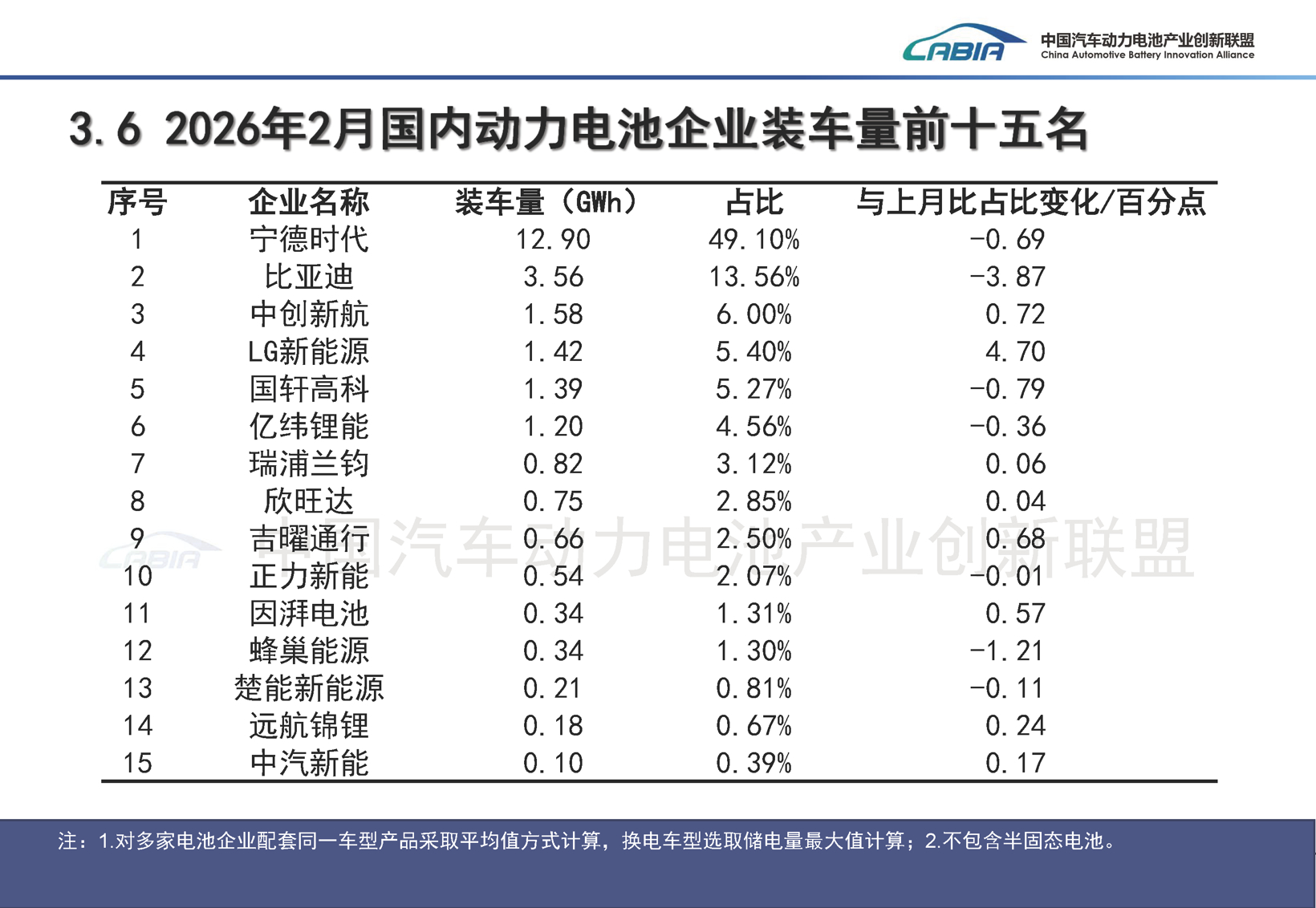
Meanwhile, the second-tier companies showed active performance. CATL's battery installation volume in February reached 1.58 GWh, accounting for 6.00%, an increase of 0.72 percentage points from the previous month; LG Energy Solution, relying on its advantage in ternary batteries, achieved an installation volume of 1.42 GWh, with its market share rising to 5.40%. According to the cumulative data for January-February, companies such as Guoxuan High-Tech, Sunwinner, and Ruipulanjun saw their market shares increase year-on-year, indicating a gradual dispersion in industry concentration.
In terms of vehicle model compatibility, the differentiated demands of niche markets are becoming increasingly prominent. In February, the installation volume of pure electric passenger vehicles accounted for 58.8%, a year-on-year decrease of 27.2%, but it remains the core application scenario for power batteries; pure electric trucks performed impressively, with an installation volume accounting for 24.6%, a year-on-year increase of 5.8%, and a cumulative year-on-year growth rate of 21.1% for the first two months. Plug-in hybrid trucks and special-purpose vehicles have become new growth highlights, with year-on-year growth rates in February reaching as high as 283.8% and 314.0% respectively, reflecting the accelerated progress of the electrification transformation in the commercial vehicle sector.
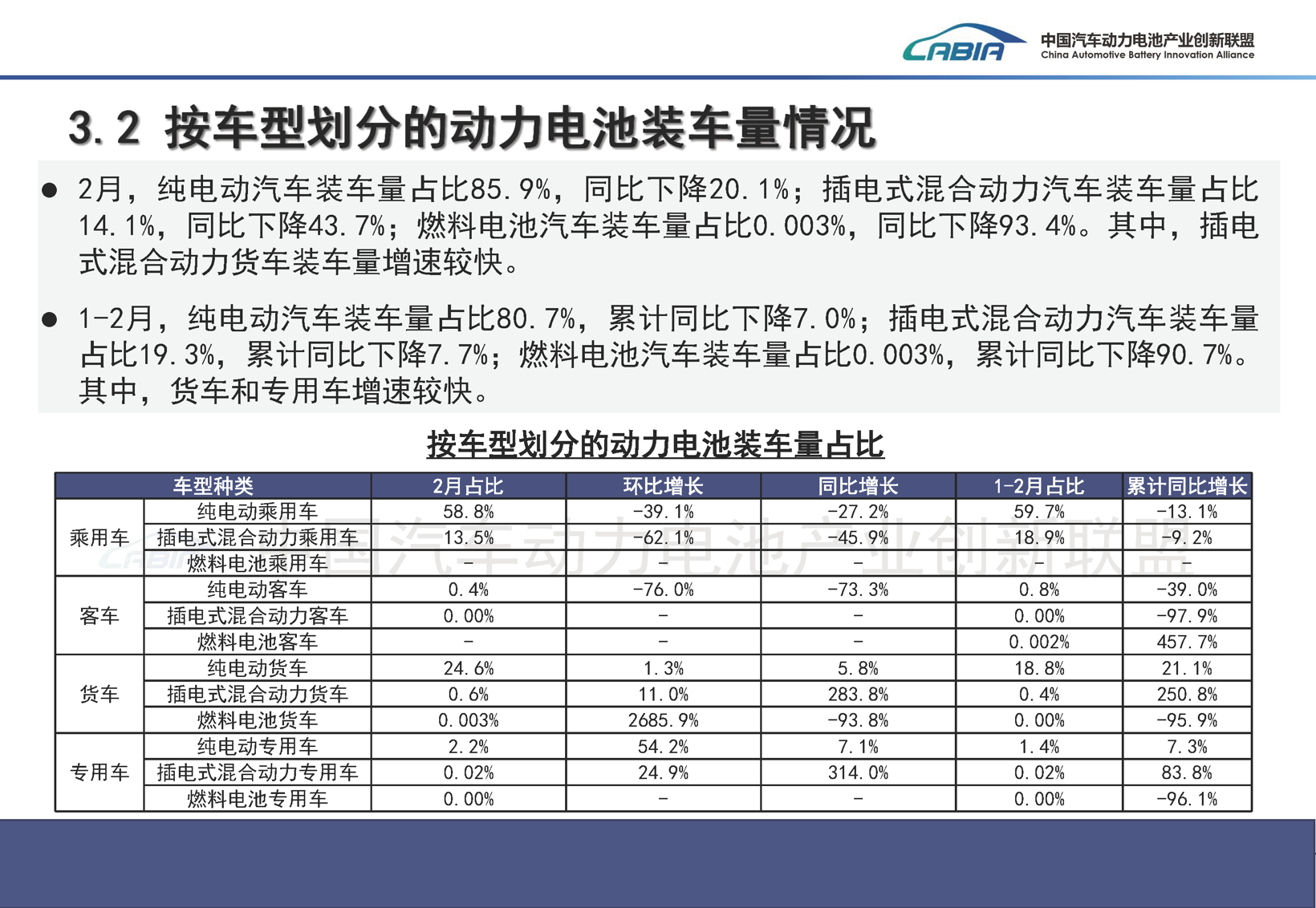
In addition, the average power capacity per vehicle continues to increase. In February, the average power capacity per new energy vehicle was 75.9kWh, a year-on-year increase of 52.6%. Among these, the average power capacity per pure electric passenger car was 68.6kWh, a year-on-year increase of 28.5%, reflecting an upgrade in consumer demand for range.
From the perspective of industry development trends, the power battery industry is undergoing profound structural adjustments in 2026. The surge in the energy storage market and the expansion of export markets are injecting new momentum into industry growth, while short-term fluctuations in China's vehicle installation market are compelling companies to accelerate technological innovation and scenario adaptation. Going forward, as LFP (lithium iron phosphate) technology continues to achieve breakthroughs in energy density and ternary batteries deepen their presence in the premium market—coupled with the ongoing expansion of emerging applications such as energy storage and commercial vehicles—the power battery industry will achieve higher-quality development amid differentiation. Market competition will shift from a pure scale-driven race to a comprehensive contest centered on technology, cost efficiency, and scenario adaptability.
【Copyright and Disclaimer】The above information is collected and organized by PlastMatch. The copyright belongs to the original author. This article is reprinted for the purpose of providing more information, and it does not imply that PlastMatch endorses the views expressed in the article or guarantees its accuracy. If there are any errors in the source attribution or if your legitimate rights have been infringed, please contact us, and we will promptly correct or remove the content. If other media, websites, or individuals use the aforementioned content, they must clearly indicate the original source and origin of the work and assume legal responsibility on their own.
Most Popular
-
Continental Plans to Begin Sale of ContiTech in Early 2026
-

$4 Billion! Medtronic Makes Another Acquisition
-

BASF Delivers First Batch of Innovative Cathode Materials for Semi-Solid-State Batteries to Weilan New Energy
-
Profit and Revenue Growth Struggle to Conceal Debt Repayment Pressure; Success of Kingfa Sci & Tech's High-End Strategy Yet to Be Seen
-

Why did a century-old european dental instrument giant relocate its manufacturing hub to china?