


Tensions Rise as Hormuz Strait Closes Again; Iran: Three Peace Terms Violated
Iranian media: Strait of Hormuz fully closed
According to Iran's Press TV, the Strait of Hormuz has been completely closed, and some oil tankers have been forced to turn back.
According to Tasnim News Agency on the same day, a large number of ships remain stranded in the waters near the Strait of Hormuz.
Iran Publishes Safe Navigation Routes Map for the Strait of Hormuz
Iran's Ports and Maritime Organization on the 8th released a safety navigation chart for the waters of the Strait of Hormuz, informing passing vessels to adhere to maritime safety principles and avoid mine contact.
The organization stated in its announcement that from February 28 to April 8, hostilities continued in the waters of the Persian Gulf and the Strait of Hormuz, and various types of anti-ship mines may be present in the main shipping lanes of the Strait of Hormuz. To ensure maritime navigation safety and avoid mine strikes, vessels transiting the area should follow the safe navigation routes published by Iranian authorities until further notice.
Iranian Parliament Speaker: Negotiations with the US Have Not Begun, 3 Ceasefire Terms Already Violated
Iranian Parliament Speaker Ali Larijani stated on social media on the 8th that negotiations between Iran and the United States have not yet begun, and three of the 10 ceasefire terms proposed by Iran have already been violated.
The statement says that Iran’s “deep-rooted” distrust of the United States stems from Washington’s repeated violations of commitments in various forms. Regrettably, this situation has once again recurred. U.S. President Trump had described Iran’s proposed ten-point ceasefire terms as a “feasible basis for negotiations,” yet this very basis for negotiations was openly undermined before negotiations even began.
According to Khabbaz, the content that was violated includes: first, achieving a ceasefire in Lebanon. Pakistani Prime Minister Shabaz previously announced that Iran, the United States, and their respective allies had agreed to immediately cease hostilities in all areas, including Lebanon. Second, prohibiting violations of Iranian airspace, due to the fact that the Islamic Revolutionary Guard Corps shot down a drone over the city of Lar in Fars Province that day. Third, accepting Iran's uranium enrichment activities.
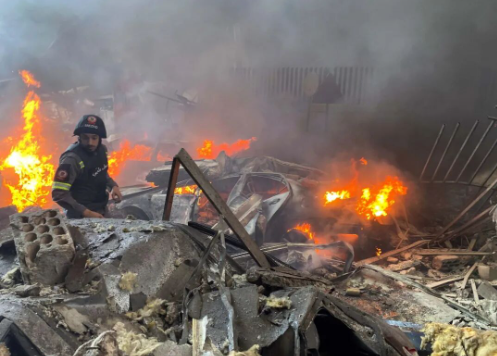
On April 8, rescue workers put out a fire caused by Israeli air strikes in Beirut, the capital of Lebanon. (Photo by Bilal Jaziri, Xinhua)
White House Press Secretary Levitt said at a press conference on Monday that the U.S. and Iran will hold the first round of talks on the morning of the 11th in Islamabad, the capital of Pakistan. She said the U.S. has accepted Iran's revised new proposal, not the original terms initially put forward.
According to earlier reports by Iranian media, Kalibaf will lead the Iranian delegation in the negotiations, while the U.S. delegation will be led by Vice President Vance. However, informed sources stated that the Iranian delegation leader has not yet been finalized.
【Copyright and Disclaimer】The above information is collected and organized by PlastMatch. The copyright belongs to the original author. This article is reprinted for the purpose of providing more information, and it does not imply that PlastMatch endorses the views expressed in the article or guarantees its accuracy. If there are any errors in the source attribution or if your legitimate rights have been infringed, please contact us, and we will promptly correct or remove the content. If other media, websites, or individuals use the aforementioned content, they must clearly indicate the original source and origin of the work and assume legal responsibility on their own.
Most Popular
-

Continental Plans to Begin Sale of ContiTech in Early 2026
-

$4 Billion! Medtronic Makes Another Acquisition
-

BASF Delivers First Batch of Innovative Cathode Materials for Semi-Solid-State Batteries to Weilan New Energy
-
Profit and Revenue Growth Struggle to Conceal Debt Repayment Pressure; Success of Kingfa Sci & Tech's High-End Strategy Yet to Be Seen
-

Why did a century-old european dental instrument giant relocate its manufacturing hub to china?