


Trump shatters ceasefire hopes, sending oil prices soaring 8%; butadiene hits 9-year high; engineering materials surge 20%
On April 2nd, the global energy and chemical market welcomed "Epic VolatilityAt 1 a.m. local time on April 1, U.S. President Trump gave a national speech, declaring that the war against Iran had achieved a "fast, decisive, and overwhelming victory," while clearly stating that "stronger firepower attacks against Iran will be carried out in the coming weeks," threatening to strike all of Iran's power plants.

This speech completely shattered expectations of a ceasefire, causing a sharp escalation in U.S.-Iran tensions! Iran immediately launched missiles to strike Israel in a forceful counterattack, declaring, “The war will continue until the enemy surrenders,” and vowing even more intense retaliation, sending global geopolitical risks soaring.
Oil Prices Soar by 8%! Traffic Through the Strait of Hormuz Plummets by 90%, Global Oil Crisis Looms
Geopolitical tensions have suddenly escalated, directly cutting off the global energy lifeline. As a "chokepoint" for global oil transportation, the Strait of Hormuz handles about 20% of the world's maritime oil shipments. Affected by the US-Iran conflict, it is reported that"Strait traffic volume plummeted by over 90%"In the past, massive oil tankers that routinely plied the waters have now cast off their mooring lines and are standing by, as the global oil market faces the most severe supply disruption in history.
As of 14:38 on April 2nd,International oil prices surged: Brent crude futures rose by 7% to $108.3 per barrel; WTI crude increased by 6.5% on the day to $106.66 per barrel.
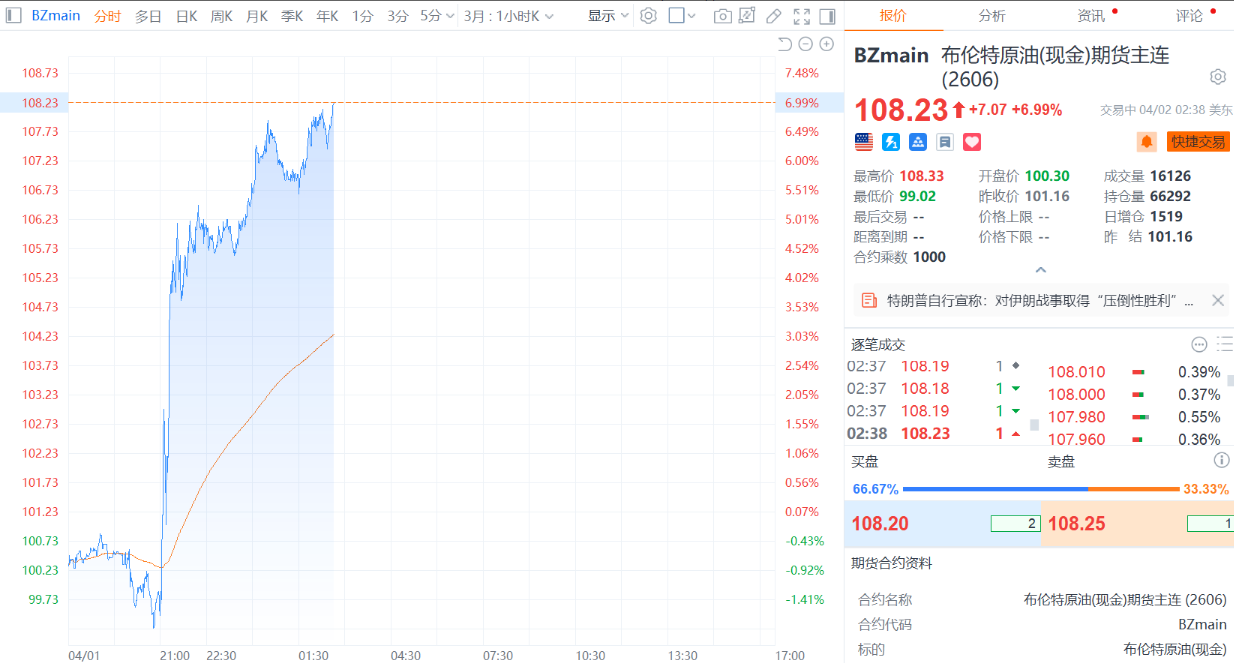
What's more, since the first U.S.-Israel attack on Iran on February 28, international crude oil has surged by 64% in March! Brent crude oil recorded a 64% monthly gain in March, the highest in history, while U.S. crude oil rose by about 52%, the largest increase since May 2020.The International Energy Agency (IEA) has issued an emergency alert, warning that the global oil market is facing the “most severe supply crisis in history.”,Institutions say: If the conflict lasts for half a year, the impact will be comparable to the first oil crisis in 1973.
International oil prices will still remain at a high level of $100 per barrel in 2026.The global economy will face the dual pressure of slowing growth and rising inflation. Institutions such as Nomura Securities and OCBC Singapore have clearly pointed out that Trump's statements did not release a cooling signal, and the market must be prepared for further escalation of conflicts and sustained high oil prices.
II. Surge at the Source Ripples Through Entire Chain: Butadiene Hits 17,000, Reaching a 9-Year High; ABS Soars 43% in a Month
As the core of the chemical industry, the sharp rise in crude oil prices is rapidly spreading to downstream sectors, causing a chain reaction in the plastic market.
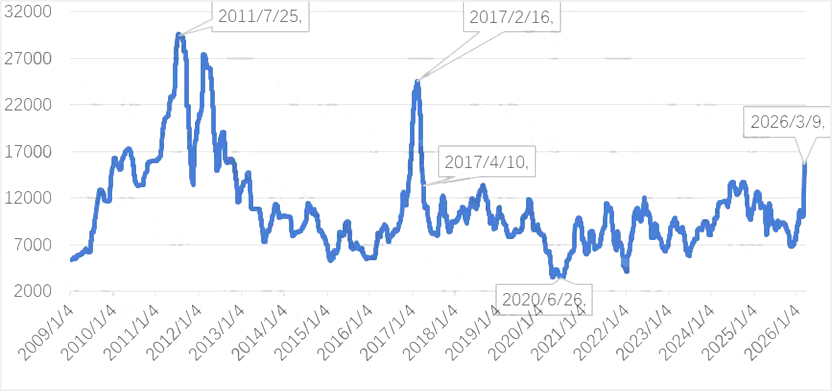
1. Butadiene prices surge dramatically.As a core raw material for ABS and synthetic rubber, its consumption share exceeds 45%.As of the end of March, domestic butadiene market prices surpassed RMB 17,000 per ton, surging over 102% in March alone—the highest level in nearly nine years and second only to the historical peak seen in 2011.
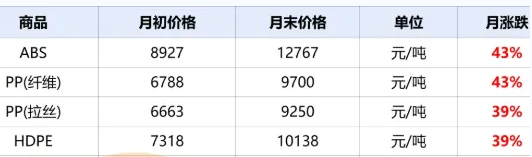
2.ABS jumps 43% in one monthFrom March 8th 8927 yuan/ton to 12767 yuan/ton at the end of the month, an increase of 3840 yuan/ton;
3. Synchronized Surge Across All CategoriesAccording to statistics, the just-ended MarchPP fiber up 43% monthly, HDPE up 39% monthly, PET up 37%, PS, nitrile rubber, and butadiene rubber all up over 35% monthly.The fully plasticized market has fallen into panic-driven restocking, with rare scenes of long truck queues forming in Dongguan's Zhangmutou and Taiwan as buyers rush to secure supplies.
Although some ABS grades saw slight declines today (April 2), markets for PC, PA, and others remained strong at high levels, and the upward trend driven by costs has not undergone a fundamental reversal.
III. Conflict Spreads to High-End Manufacturing: Engineering Plastics Surge Up to 20%, Pressuring Semiconductor Supply Chains
The unrest upstream is spreading to downstream industries, as learned by Zhuanshu World.The surge in plastic prices triggered by the Middle East conflict has rapidly spread to high-end manufacturing sectors such as semiconductors and electronics manufacturing., causing cross-sectoral shocks.

According to the Sci-Tech Daily, affected by rising oil prices and supply chain tensions, South Korea's Kumho Petrochemical and Japan's Mitsubishi Chemical have sent price increase notices to South Korean semiconductor equipment companies.Engineering plastic prices increased by 5%–20%., with prices ranging from $100 to $50,000 per kilogram.
Engineering plastics are core materials for semiconductor equipment and are widely used in the CMP precision process, accounting for 10%–20% of equipment production costs. Currently, equipment manufacturers mostly absorb price-increase pressures internally; however, if oil prices remain high for an extended period, corporate profitability will decline significantly, while only enterprises with low consumption volumes will be minimally affected. China’s Kaiyuan Securities and Galaxy Securities note that escalating geopolitical conflicts are intensifying supply-chain anxieties.The domestic substitution process of semiconductor materials will be fully accelerated.
Four, Post-market Analysis: Geopolitical Risks Dominate the Market, High-level Fluctuations in Plasticization Will Become the Norm
From the current situation, the US-Iran standoff shows no sign of easing in the short term, and the shipping risk in the Strait of Hormuz remains high, which will continue to affect international oil prices.Easy to rise, difficult to fall, high-level fluctuationThis will become the dominant market trend going forward. As the cost cornerstone of the entire plastic and chemical industry chain, crude oil’s strong market position will continue to provide robust support to upstream raw materials, midstream plastics, and downstream chemical products. The current cost-driven price increase has not yet shown any fundamental reversal signals.
The industry as a whole will enter a new phase of "high costs, high volatility, and high attention."
For companies throughout the plasticizer industry, risk control should be the top priority at this stage. They should closely monitor the progress of the US-Iran conflict, fluctuations in international oil prices, port deliveries, and changes in downstream production operations. They should focus on on-demand procurement and steady stockpiling, avoiding blind high-price inventory accumulation. At the same time, they should accelerate the diversification of their supply chains, enhance their ability to pass on costs and withstand risks, and ensure operational safety while seizing structural opportunities in this period of significant volatility in the global energy and chemical markets.
(The above information is a comprehensive summary from Cailian Press, Wall Street News, Plastics Price Today, and China Star Market Daily.)
【Copyright and Disclaimer】This article is the property of PlastMatch. For business cooperation, media interviews, article reprints, or suggestions, please call the PlastMatch customer service hotline at +86-18030158354 or via email at service@zhuansushijie.com. The information and data provided by PlastMatch are for reference only and do not constitute direct advice for client decision-making. Any decisions made by clients based on such information and data, and all resulting direct or indirect losses and legal consequences, shall be borne by the clients themselves and are unrelated to PlastMatch. Unauthorized reprinting is strictly prohibited.
Most Popular
-
Continental Plans to Begin Sale of ContiTech in Early 2026
-

$4 Billion! Medtronic Makes Another Acquisition
-

BASF Delivers First Batch of Innovative Cathode Materials for Semi-Solid-State Batteries to Weilan New Energy
-
Profit and Revenue Growth Struggle to Conceal Debt Repayment Pressure; Success of Kingfa Sci & Tech's High-End Strategy Yet to Be Seen
-

Why did a century-old european dental instrument giant relocate its manufacturing hub to china?