



Can't Afford Full-Stack Self-Development, Is "Ready-Made" Autonomous Driving Truly Appealing?
Chery, in order to keep up with the progress in assisted driving this year, has broken its own pot and started eating from someone else's bowl.
In April, Chery Chairman Yin Tongyue openly stated at the Horizon HSD launch that he wanted to "eat Yu Kai's food."
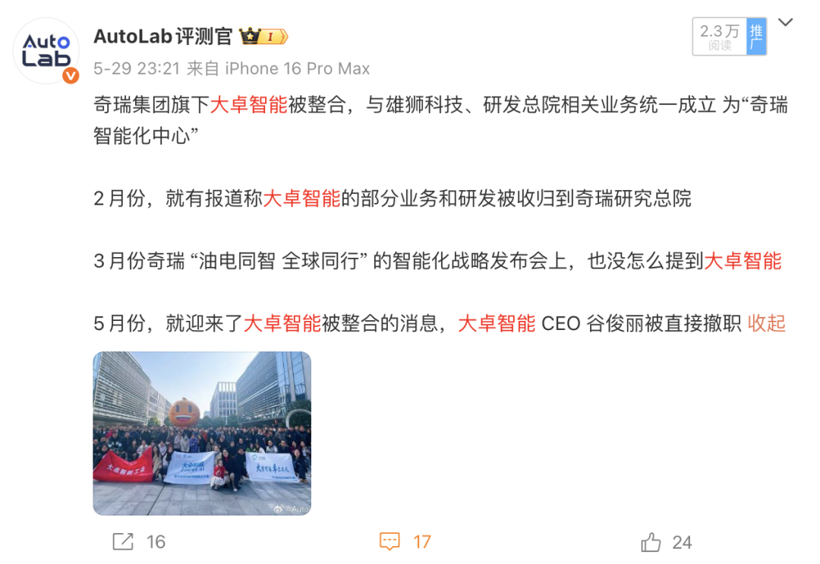
About a month after this statement was made, Da Zhuo Intelligent, which was originally responsible for Chery's self-developed driver assistance, announced its dissolution, and its head Gu Junli resigned in disappointment.
With the support of the big cane of Dazhu Intelligence, Chery walked on the bumpy road of assisted self-research for only two years, before abandoning the self-research route and giving a big embrace to Horizon.
Recently, the Xingtu ET5, equipped with Horizon HSD, has also announced its market launch, making an early entry into the 150,000-level market with urban navigation.
In the past year, apart from new forces like NIO, Xpeng, and Li Auto continuing to develop their own technologies, various car companies have shifted from rapid expansion to drastic contraction in the field of assisted driving, and have started to actively embrace suppliers. Chery is just one example of this trend.
Perhaps everyone has already noticed that the "full-stack self-research" that was hyped up in the past two years is now basically silent.
For most car manufacturers, the advancement of assisted driving cannot be delayed, and the market competition is fierce and tumultuous—developing in-house is cool, but embracing suppliers is clearly more appealing.
The Disappearing Full-Stack Self-Developed Spokesperson
In the seismic shift of assisted driving transformation, those who are disappointed include Gu Junli from Chery Dazhu Intelligent and Gu Weihao, the head of Great Wall's Haomo Zhixing.
HaoMo Intelligent Travel was established in November 2019, and its predecessor was the Advanced Driving Assistance Department of Great Wall Motors.
Gu Weihong, who previously served as the General Manager of Baidu Intelligent Automotive Business Unit, was appointed as the CEO of Haomo Zhixing in early 2021.
In this year, Gu Weihao led Haomo Zhixing to adopt an assisted driving approach that emphasizes heavy perception and light mapping.
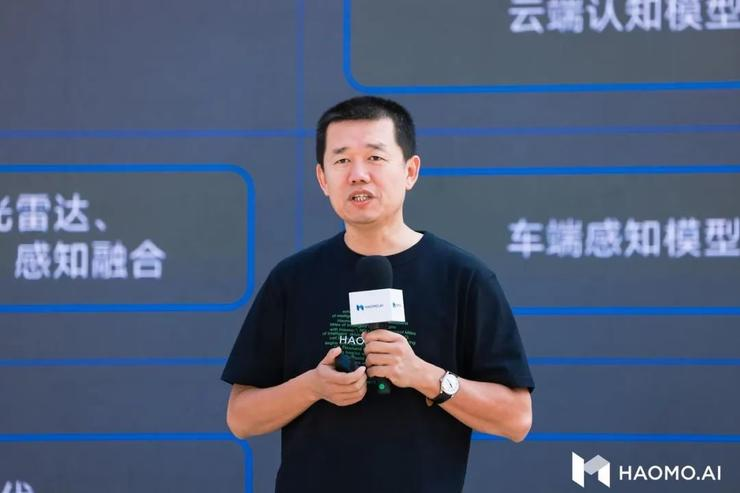
In 2021, when assisted driving still heavily relied on high-definition maps, Gu Weihao's vision was undoubtedly farsighted.
Unfortunately, the grounded actions have yet to catch up with the visionary insights.
The result is well known: Haimo Zhixing's assisted driving has been mass-produced in many Great Wall models.
However, the presence of Great Wall's assisted driving in the entire industry has remained lukewarm in the following days.
A subtle turning point in the relationship between Haima Zhixing and Great Wall occurred in 2024.
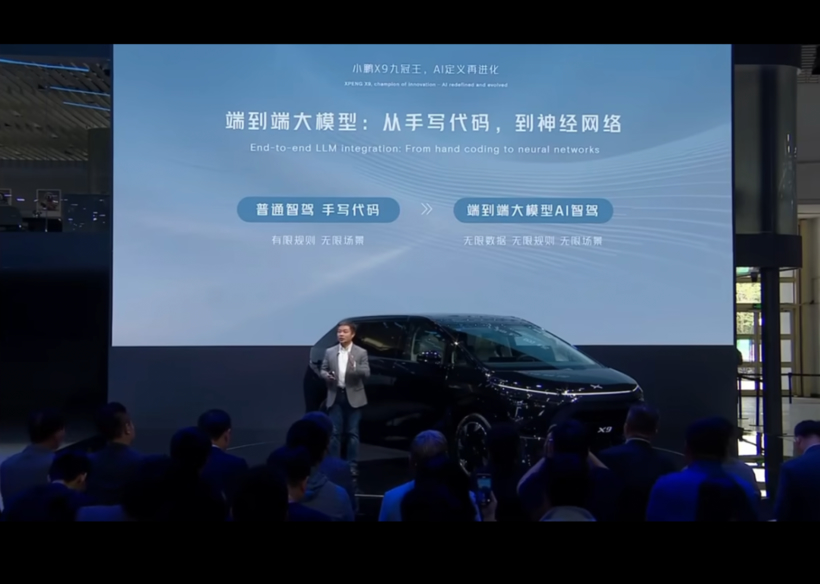
In 2024, the urban NOA is in full swing, with Huawei, Xiaopeng, and Ideal rushing in like a whirlwind. The pressure of Tesla's FSD entering China looms over the Chinese assisted driving industry like dark clouds.
At this time, the actions of Haomo Zhixing have slowed down, and the city NOA has not been delivered for a long time.
Great Wall can't just sit and watch its assisted driving fall behind, so to catch up quickly, Great Wall has chosen to introduce Yuanrong Qixing to urgently supplement its urban NOA.
Yuanrong Qixing's arrival indeed helped Great Wall a lot.
On one hand, the city NOA has been successfully delivered on the brand new Blue Mountain; on the other hand, this year, Great Wall has accelerated its pace further and is now keeping up with market trends, becoming one of the first car manufacturers to launch VLA.

Last November, Gu Weihao released an internal letter, pointedly stating, "The intelligent driving market has entered a life-and-death competition period."
However, after a year of "life or death," Haomo Zhixing did not survive the winter of 2025.
Haomo Zhixing was once the representative of Great Wall's fully self-developed assisted driving and was nurtured by Great Wall.
Advanced driver assistance systems have now become a necessary condition for selling cars, and the competition is extremely fierce.
Time waits for no one. If one does not repay the "nurturing grace" as quickly as possible, the fate that awaits may be to become a discarded pawn.
Compared to the abandoned Great Intelligence and Haomo Zhixing, the fate of Lingxue Technology appears to be somewhat more fortunate.
Zero Technology was established in 2021 and was once hailed as SAIC's "intelligent brain," also bearing the responsibility of SAIC's fully self-developed driver assistance.
After three or four years of effort, Zero Technology has not produced anything significant for SAIC.
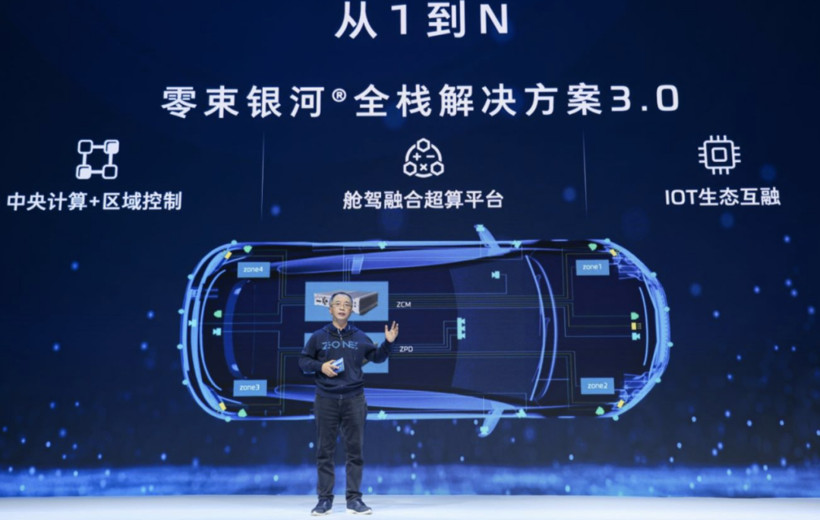
Nowadays, SAIC's models rely more on suppliers such as Huawei and Momenta for assisted driving, while Zero Beam was merged into SAIC Research and Development General Institute in April this year as part of a major internal restructuring at SAIC.
When assisted driving was just emerging, many car companies were clamoring for "full-stack self-research" and set up related departments or companies one after another.
Nowadays, amidst the, only the new forces are still.
Ultimately, by now, everyone has finally understood that assisted driving has never been a game that anyone can just jump into.
The Game of the Few
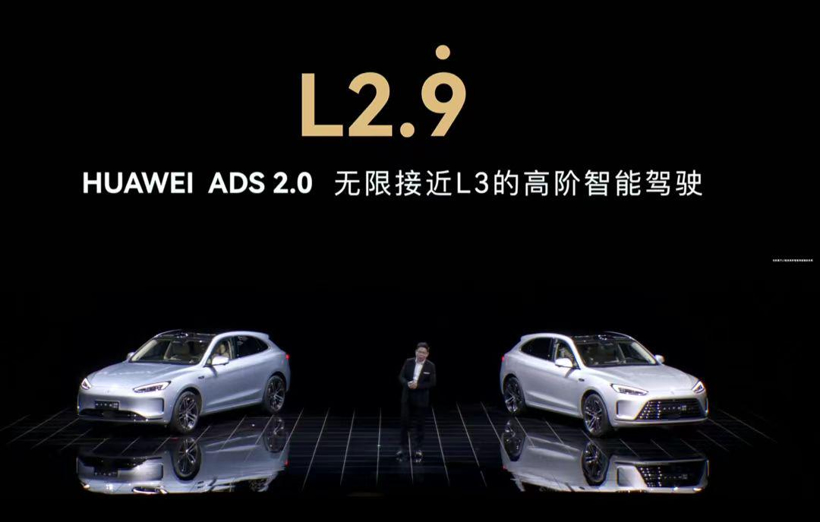
In the first half of 2023, Huawei ADS 2.0 became an instant hit, rapidly expanding Huawei's influence in the automotive industry with overwhelming momentum.
Behind the explosive success of ADS 2.0 is the fact that the vehicle business unit has invested a total of 30 billion RMB from its establishment in 2019 to 2023, and has built a large R&D team of 7,000 people.
This means that in order to pursue assisted driving, one must have the guts to spend money and take risks.
If it's just about burning money and causing accidents, then the game of assisted driving becomes easier.
The reality is that the complexity of assisted driving is far beyond imagination.
Entering 2024, end-to-end large models have become mainstream, the industry has launched a battle to eliminate rule-based coding, and assisted driving has entered the AI era, with computing power and data becoming the industry's oil.
To stay competitive, automakers must continue to invest heavily in building cloud computing centers with EFLOPS-level processing power to handle the skyrocketing parameter volume in the hundreds of billions.
Musk revealed in 2024 that just buying NVIDIA graphics cards is expected to cost 3 to 4 billion dollars.
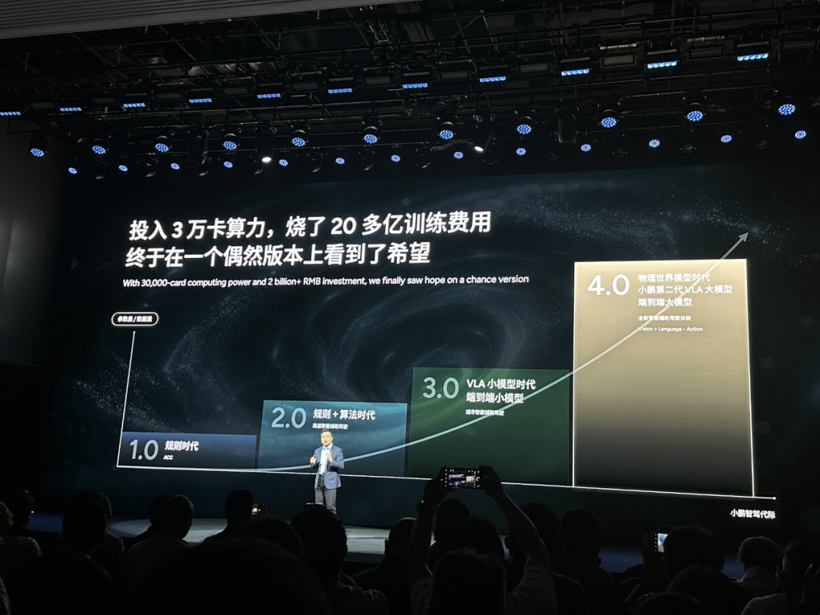
At this year's Technology Day, He Xiaopeng stated that the second-generation VLA had an investment of 30,000 AI compute power and over 2 billion in training costs by Xpeng, and finally saw hope in a random version — having money is not enough; sometimes you also need luck.
It is worth noting that this computing power is not something that can be bought at will.
The primary GPU for training is NVIDIA's H100, but due to a U.S. ban, Chinese companies can only purchase the restricted A800.
Political uncertainty, like an invisible hand, also influences the assisted driving industry.
The surge in the number of parameters demands substantial cloud computing power, reaching the vehicle end. Even after distillation, the vehicle end often has tens of billions of parameters, requiring the vehicle's computing power to keep up.
Therefore, since the beginning of this year, large computing power chips have started to get on board.
NVIDIA has launched the Thor-U with 700 TOPS, XPeng has introduced the Turing AI chip with 750 TOPS, and NIO's Shenzi NX9031 exceeds 1000 TOPS in computing power.
It is important to note that in order to do a good job in assisting driving, some non-technical work must also be done.
Since the rapid rise of assisted driving, the technological route has been changing rapidly.
From heavy mapping to light mapping and no mapping, from rule-based to end-to-end, the technology routes for assisted driving have been rapidly switching.
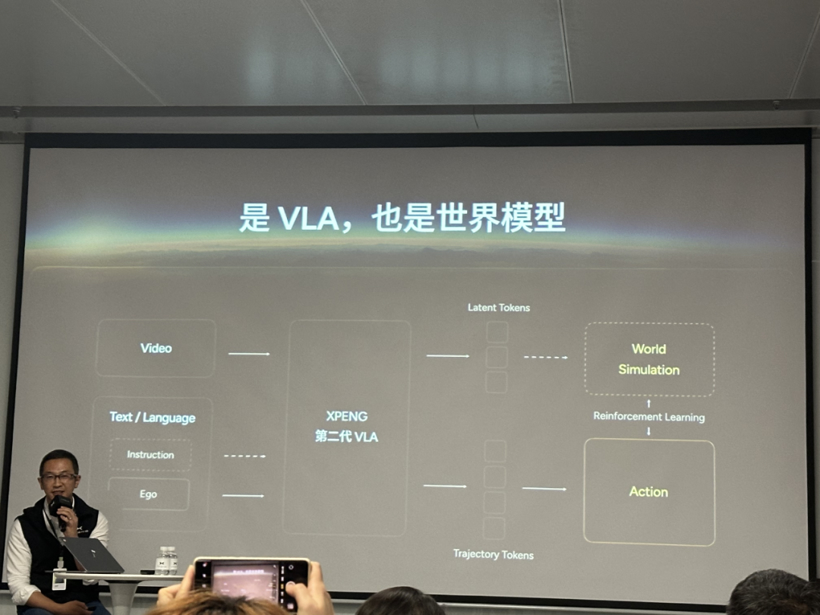
Now that we have finally converged to end-to-end, there are still differences between VLA, the second generation VLA, and world models.
This means that, on one hand, car manufacturers must have a long-term vision, producing current popular technologies while also choosing the right path for the next generation of technologies.
On the other hand, in case the wrong path is taken, car companies must have enough flexibility to quickly change direction.
Overall, today's assisted driving is incomparable to what it was a few years ago.
To succeed, you must be able to spend money, retain talent, have foresight, and adapt quickly.
Of course, if something goes wrong, you have to be able to bear the blame.
If there wasn't enough accumulation in the earlier years, it's indeed too late to develop independently now as the window of opportunity has been missed.
To keep up with the pace of assisted driving, it's better to honestly practice "adoptism" and find suppliers.
Written at the end
From the hype of "fully self-developed" to the rush of seeking suppliers, the assisted driving industry is actually experiencing a return to order.
Automakers are beginning to truly realize that handing over what should be given to suppliers and then collaborating efficiently is the real way to reduce costs, accelerate iteration speed, and keep up with the industry's pace.
In fact, as technology continues to mature, assisted driving itself is rapidly becoming standardized, increasingly integrated into cars like suspension systems and tires.
In the future, as Horizon CEO Yu Kai anticipated, only 20% of assisted driving will be self-developed, while the remaining 80% will consist of supplier solutions.
Following Yu Kai's line of thought, the remaining 80% are likely solutions from a few suppliers like Horizon Robotics, Huawei, Momenta, and Zoyoi, among others.
This also means that the differences in the assisted driving experience between different models may be reduced, with only the self-developed 20% capable of providing more differentiated experiences, possibly even emotional value, similar to Tesla's Mad Max mode.
Today we will discuss whether it's worth paying extra for assisted driving, and in the future, we might discuss whether it's worth paying extra for differentiated assisted driving.
【Copyright and Disclaimer】The above information is collected and organized by PlastMatch. The copyright belongs to the original author. This article is reprinted for the purpose of providing more information, and it does not imply that PlastMatch endorses the views expressed in the article or guarantees its accuracy. If there are any errors in the source attribution or if your legitimate rights have been infringed, please contact us, and we will promptly correct or remove the content. If other media, websites, or individuals use the aforementioned content, they must clearly indicate the original source and origin of the work and assume legal responsibility on their own.
Most Popular
-
Dow, Wanhua, Huntsman Intensively Raise Prices! Who Controls the Global MDI Prices?
-
Clariant Unveils Cost-Cutting Plan Details, Plans to Shut Down Multiple Plants
-
[Today's Plastics Market] General Materials Weakly Fluctuate, Engineering Materials Steadily Rise
-

New Breakthrough in Domestic Adiponitrile! Observing the Rise of China's Nylon Industry Chain from Tianchen Qixiang's Production
-

Daily Review: Polyethylene Prices Under Weak Consolidation, Sellers Face Significant Pressure to Move Inventory