



Caprolactam Shows A Trend Of "New And Old Kinetic Energy Conversion"
The domestic caprolactam industry is undergoing a profound "transformation of new and old driving forces." This is not only an inevitable choice for the industry to shift from extensive expansion to high-quality development, but also a structural change driven by the interplay of market, policy, and technological forces.

This transformation is mainly reflected in the following three major changes:
Transformation of Growth Drivers: From Resource Expansion to Technology-Driven Development
The core driving force of industry is shifting from reliance on investment and resource inputs to dependence on technological innovation.
Industry-wide technological innovation: represented by the “disruptive complete caprolactam technology” developed over more than a decade by the Sinopec Research Institute of Petroleum Processing, featuring internationally pioneering technologies such as cyclohexene esterification hydrogenation, it has achieved intrinsic safety in the production process and significantly reduced costs while improving efficiency, leading the industry toward high-end and green development.
Enterprise Process Optimization: Xuyang Group has adopted advanced cyclohexanone aqueous method in its Cangzhou Phase II project, achieving nearly 100% conversion rate and significantly reducing waste emissions; Dongming Xuyang has collaborated with universities to develop key clean production technologies, addressing the issue of large amounts of low-value ammonium sulfate byproducts generated by traditional rearrangement processes.
Comparison of New and Old Benchmarks: The benchmark project has achieved significant results.
Hunan Petrochemical Relocation and Upgrade Project: By applying the above transformative technologies, the newly built 600,000-ton-per-year plant, compared with the original older plant, has reduced total production costs by 20%, cut total wastewater discharge by 70%, and lowered comprehensive energy consumption per unit of product by 20%.
● Pingmei Shenma Retrofit Project: Through the green transformation of existing facilities, steam consumption per unit of product has been reduced by 55%, and circulating water consumption by 35%. The project is expected to save approximately RMB 100 million in costs annually.
The Shift in Growth Logic: From Scale Expansion to Prioritizing Quality and Efficiency
The logic of industry growth has shifted from the previous “additive” expansion that simply pursued capacity and scale to stock optimization focused on efficiency and benefits.
Old momentum slows down (farewell to barbaric growth): The period of rapid expansion has ended. Since the 13th Five-Year Plan, domestic production capacity has been rapidly released, but in the past year, the industry has collectively started to "hit the brakes." Companies are responding to the oversupply in the market by reducing production loads and proactively cutting output, which is helping to improve the supply-demand relationship.
New Momentum Sets Sail (Focusing on Quality Improvement of Existing Resources)
Capacity growth is expected to slow significantly: in 2026, domestic caprolactam capacity growth is projected to drop to 1.96%, with planned capacity of only 140,000 tons, mainly from technical retrofits and expansion projects by existing enterprises.
Supply-demand dynamics are tightening: in 2026, newly added consumption capacity is expected to exceed newly added production capacity by 445,000 tons per year. Overall supply is projected to remain tight throughout the year, and the industry’s long-standing oversupply pattern is likely to improve.
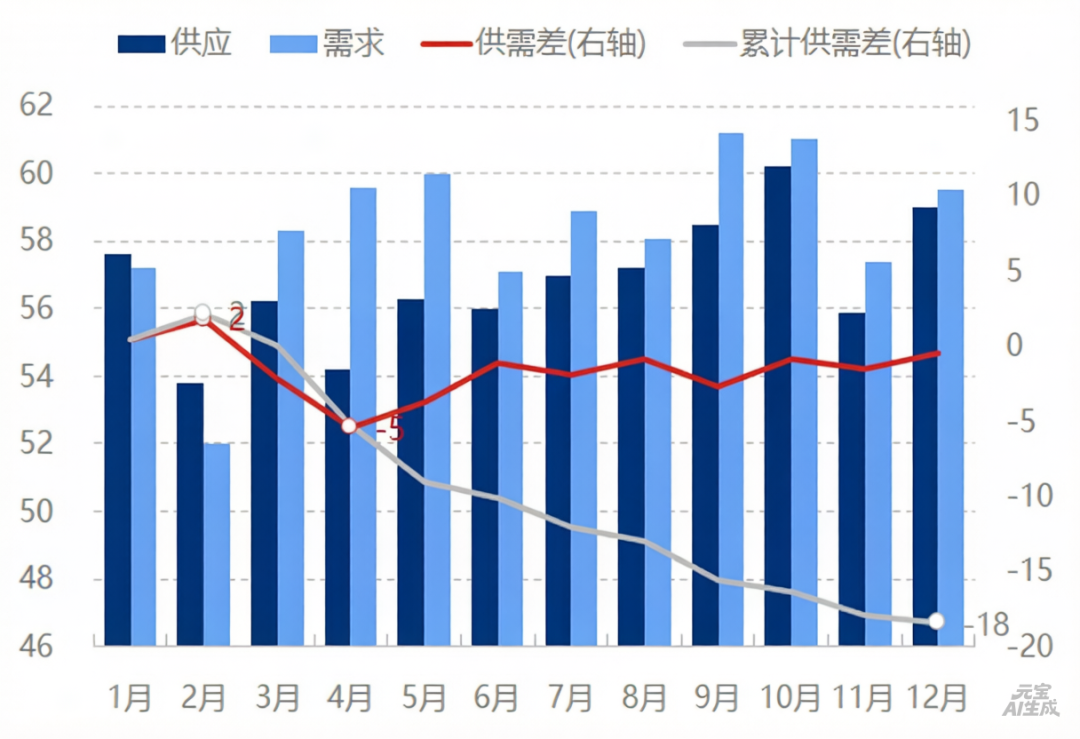
Source: Longzhong Information’s 2025–2026 China Caprolactam Market Annual Report
Profit-Driven Supply-Demand Rebalancing (Supply-Demand Data Comparison)
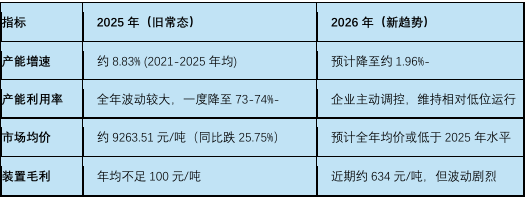
The shift in the focus of competition: from a single product to the industrial chain and green development
The dimensions of corporate competition are expanding from a focus on individual products to the ability to build industrial chains and pursue green development.
Vertical integration is accelerating: leading companies are extending downstream, building a complete industrial chain from caprolactam to PA6 (nylon 6) chips and even textiles to enhance their resilience against risks.
Horizontal expansion into new fields: the caprolactam-based route for producing hexamethylenediamine has risen rapidly, accounting for 43% of the approximately 300,000 tons of planned new capacity in 2025, breaking the monopoly of the traditional adiponitrile route and opening a pathway into high-performance materials such as PA66 (nylon 66).
Green low-carbon has become a necessity: Environmental compliance has shifted from a "bonus" to a "ticket to entry."
Policy-driven: In 2025, multiple national ministries and agencies jointly issued the Action Plan for the Control of Nitrous Oxide Emissions in the Industrial Sector, requiring the caprolactam industry to reduce unit product nitrous oxide emissions to an internationally leading level by 2030, indicating that green production has become a binding constraint.
Industry practice: Benchmark projects have already achieved remarkable emission reduction results. For example, the Hunan Petrochemical relocation project reduced discharged wastewater by 73% and COD emissions by 67%.
The trend of “replacing old growth drivers with new ones” in China’s caprolactam industry has become increasingly clear: in terms of development momentum, the industry is shifting from resource expansion to technology-driven growth; in terms of growth logic, it is moving from scale expansion to prioritizing quality and efficiency; and in terms of competitive focus, it is transitioning from a single-product approach to industrial chain integration and green development. The future leaders of the industry will be those comprehensive enterprises capable of integrating technological innovation, cost control, and a green ecosystem into one cohesive strategy.
【Copyright and Disclaimer】The above information is collected and organized by PlastMatch. The copyright belongs to the original author. This article is reprinted for the purpose of providing more information, and it does not imply that PlastMatch endorses the views expressed in the article or guarantees its accuracy. If there are any errors in the source attribution or if your legitimate rights have been infringed, please contact us, and we will promptly correct or remove the content. If other media, websites, or individuals use the aforementioned content, they must clearly indicate the original source and origin of the work and assume legal responsibility on their own.
Most Popular
-

Layoffs, Divestments, Plant Closures While Pouring Billions: BASF Undergoes Major Transformation!
-

Ascend Adipic Acid Hit By Force Majeure, Market Expects Supply Resumption In Mid-September
-

Raw Material Supply Shortage! INEOS Phenol Declares Force Majeure on Phenol and Acetone Businesses
-
South Korea initiates anti-dumping investigation against Chinese PVC suspension resin! The target is Tianjin Bohua and Wanhua Chemical. How to break through?
-

Sixth national procurement set to be implemented: A “Reshuffling” Moment for the $10-Billion Medical Device Market