



Evonik Launches New Chemical Recycling Solution! Factory Closures Continue, Can Chemical Recycling Still Move Forward?
In recent years, chemical recycling (also known as advanced recycling) has become one of the most contentious topics in global plastic pollution governance. Proponents regard it as a key technological breakthrough for achieving a circular economy for plastics, while critics denounce it as nothing more than a green smokescreen for the petrochemical industry to sustain and expand production.
Recently, Evonik launched a comprehensive solution for upgrading pyrolysis oil, particularly the Purocel™ 505 adsorbent, which enhances the ability to remove chlorides to three times that of traditional solutions, allowing waste plastics to return to the value chain and promoting chemical recycling of plastics. On June 11, Freepoint Eco-Systems announced the complete shutdown of its Hebron, Ohio plant. As one of only seven operational plastic pyrolysis plants in the U.S., designed to process 81,600 tons annually and with purchase agreements signed with Shell and Dow, this leading project has ceased operations less than two years after starting production.
Image source: Evonik
The emergence of new solutions and the shutdown of demonstration plants have occurred almost simultaneously. Coupled with the continuous shutdown of chemical recycling plants worldwide in recent years, is there still a future for chemical recycling? Today, let’s take a systematic look at this issue.
1. Shutdown List Since 2025: The Commercialization Bubble Is Being Squeezed Out
By mid-2026, looking back, the issue with chemical recycling will not be about "whether plastics can be cracked," but rather that the pilot-to-commercial scale-up system loop has not been successfully completed—fluctuations in raw materials, uncontrollable impurities, upgrading segment costs, downstream purchasing, and oil price pressures combined have pushed a number of leading projects out of the game.
1) APPI — 500,000-ton pyrolysis project at the Port of Ostend, Belgium: Cancelled in January 2025
Ostend Port CEO Dick de Clerk publicly stated: “Cheap virgin plastic imports from China have undermined the business case for chemical recycling.”
2) NOVA Chemicals - Sarnia Chemical Recycling Plant, Ontario, Canada: Feasibility completed, announcement to pause in April 2025.
Greg DeKunder, Vice President of Circular Solutions at the company, put it bluntly: “Large scale and high costs,” with unstable feedstock supply and insufficient offtake further compounding the risks.
Brightmark - Indiana Pyrolysis Plant, USA: March 2025
Designed to process approximately 90,000 tons annually, court documents reveal that it is operating at only about 5% capacity, with a monthly operational cost of $3.5–4 million and a debt of $178 million.
4) Pryme - Rotterdam, Netherlands Pryme One (Pyrolysis): Phase I is operational but with very low output, Phase II is on hold.
Phase I was designed for 40,000 t/y, but actual pyrolysis oil output in 2024 was only 340 tons (capacity utilization <1%), with losses exceeding EUR 12 million; Phase II (originally planned for end-2026) has been postponed. The Fraunhofer map classifies such projects under operating capacity statistics, but operating does not mean economically viable.
5) Neste — Termination of the Vlissingen Project in the Netherlands (Alterra process, 550,000 tons): August 2025
A Neste spokesperson stated: "After evaluation, it was determined that the project did not meet the conditions for a final investment decision, primarily due to the economic viability and stability of large-scale production not meeting expectations."
6) Dow × Mura — Böhlen, Germany 120,000-ton chemical recycling plant: canceled (August 2025)
Dow previously announced in July 2025 that it would permanently shut down the Böhlen steam cracker in 2027. With the cracker furnace gone, the recycling plant loses its downstream anchor, and the economics naturally collapse.
7) Braven — Texarkana, Texas (previously had signed an offtake agreement with BASF for pyrolysis oil): abandoned the plant construction / the offtake agreement fell through;
8) Alterra - Expansion cancellation in Point Township, Pennsylvania (second half of 2025)
These two fall into the category of projects that “haven’t even really begun construction,” but they likewise show that offtake and financing conditions are tightening.
9) Freepoint Eco-Systems — Hebron, Ohio 81,600-ton-per-year pyrolysis plant: announced shutdown on June 11, 2026.
Alterra’s licensed process and two pyrolysis furnaces once had offtake agreements from Shell and Dow; yet they were shut down less than two years after commissioning: the oil yield fell below the 70% compliance threshold for three consecutive quarters, seal failures brought environmental compliance risks and OSHA/local regulatory pressure, and the project in effect ran into the “80,000-ton-scale scale-up” bottleneck.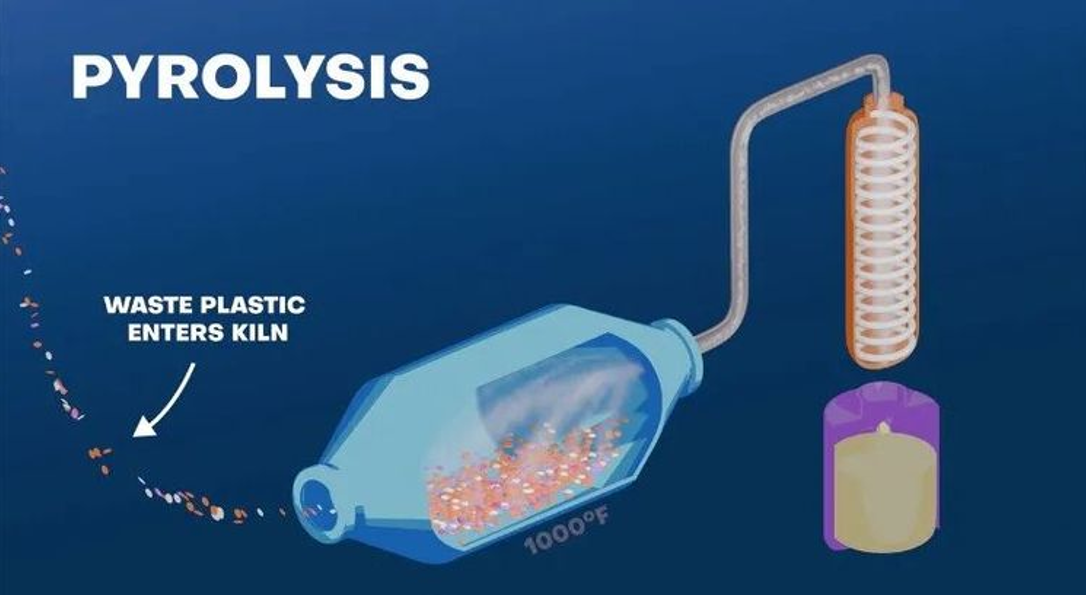
Image source: Freepoint
Fraunhofer Europe 2025Year 12Monthly chemical recycling information map is more intuitive: Europe pipeline 65projects, 279.9Planned production capacity of ten thousand tons, but only 18 are actually in operation.Seat, 28.910,000 tons—Operating capacity is less than 10% of the planned level.Cancel Project 981.9ten thousand tons, of which 7Pyrolysis。
The reasons for shutdown were highly overlapping: declining oil yields, insufficient feedstock, high upgrade costs, inability to secure offtake agreements, low oil prices making virgin materials cheaper, and policy uncertainty. No one disputes the technical principles, but “pilot 210,000 tons →Commercial 8More people have stumbled at the “10,000-ton” hurdle than in the past decade combined.
II. Why Is It Still Being Bet On: Which Fields Have Already Proven Viable, and What Hurdles Must Mixed Plastics Still Overcome?
Chemical recycling encompasses four fundamentally different technological pathways. Treating the four types as one will obscure the real issues.
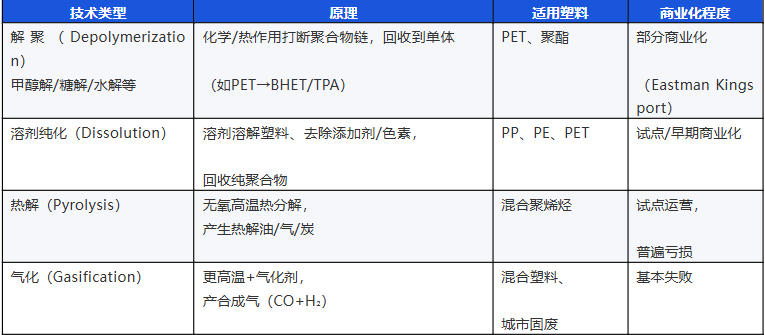
Source: Qingyue ESG
Chemical recycling must first be properly positioned: it is not a substitute for mechanical recycling, but rather a necessary complement to it, designed specifically to handle the “hard cases” that mechanical recycling cannot process—multilayer flexible packaging, contaminated films, composite materials, automotive plastics, and the like. Mechanical recycling (physical shredding and remelting) is, in essence, a form of “downcycling”: with each cycle, polymer chains become shorter and material properties degrade, so after several cycles the material can only be used in lower-value applications. More importantly, mechanical recycling has strict requirements for feedstock—it has a kind of “cleanliness obsession” and can only process clean, single-resin waste plastics (mainly PET bottles and HDPE containers). It is helpless in the face of multilayer composite packaging, textiles, and colored or opaque PET. As a result, although about 15% of plastics worldwide are collected for recycling, less than 9% is actually recycled into new materials.
It is precisely this gap of over 90% in waste plastics—where mechanical recycling cannot reach, and landfilling and incineration are rapidly being phased out—that has pushed chemical recycling to the forefront: it is not a chosen option, but one that has been forced into existence.
1. Successfully tested narrow road: PETDepolymerization (methanolysis/Glycolysis)
This route is the least controversial. Eastman’s Kingsport plant in the United States processes about 250 million pounds of waste plastic annually (equivalent to roughly 11 billion bottles), and its LCA shows greenhouse gas emissions about 30% lower than virgin PET; Ohio has already connected its curbside collection system to it. BASF × Porsche completed a pilot for chemical recycling of automotive plastics in September 2025. The logic is also very clear: PET is a condensation polymer, so targeted bond cleavage can depolymerize it back into monomers, yielding pure products with a high degree of closed-loop recycling, provided thatRaw materials are clean and properly sorted.The problem is that it only consumes PET/polyester, which accounts for about 6% of the total global plastic, and cannot handle the main battlefield of mixed waste plastics.
2. Still on the uphill climb in the main battleground: mixed polyolefin pyrolysis
PE/PP/PS mixed soft packaging is the real battleground for pyrolysis, and it is also the area with the highest incidence of failures. The Freepoint incident report lays out the industry’s common issues in detail:
The checkpoint of chlorinePVC carryover generates HCl corrosion in the cracking furnace, and the Hebron plant lacks specialized hydrochloric acid scrubbing, relying only on a liquid ring compressor for simple water adsorption, leading to long-term non-compliance of exhaust gases—this is precisely the scenario for Evonik Purocel™ 505, which increases dechlorination capability up to three times compared to traditional solutions and can be used in conjunction with hydrogen treatment for regenerating Purocel H catalysts.
Amplification effectAlterra Akron pilot plant: 20,000 tpa with an oil yield of 75%+; after scaling up to 80,000 tpa, issues emerged with temperature control, oxygen control, and pressure drift. Hebron’s oil yield fell below 70% for three consecutive quarters.
Front-end preprocessing is underestimated.Any fluctuation in PVC, ash content, moisture, or metal contamination will cause subsequent yield and corrosion to spiral out of control; the Hebron crushing section lacks enclosed dust collection, triggering an OSHA investigation.
upgradingis the real doorPyrolysis oil coming out of the furnace is only half the job. If chlorine, oxygen, nitrogen, unsaturated hydrocarbons, and trace metals are not removed, steam crackers will not accept it. So the projects that have been successfully implemented in Europe, "Pyrolysis+Upgrade+Refinery/"Cracking furnace coupling"Wipe out in one goNeste Porvoo 150,000-tonne upgrading unit (scheduled to come onstream in 2026), OMV ReOil (expanding from 16 kt to 200 kt), and the Plastic Energy + SABIC / TotalEnergies projects in the Netherlands / France are all being built adjacent to refineries.
The pyrolysis reactor itself is not the bottleneck.The front end canPVCPress down to how much; backend to marinate/Hydrogenation /分馏稳不稳、下游愿不愿签长期承购If these three obstacles cannot be overcome, the 80,000-ton commercial scale will just be a bubble.
3、兜底路线:气化
It has the highest feedstock tolerance, but requires higher capital intensity and a longer purification chain. In the Fraunhofer map, gasification is planned at 860 kt, 0A vision exists, yet fulfillment is nowhere in sight.
III. On the regulatory side: how do we shift from “setting targets” to “figuring out how to calculate the accounts”?
Whether chemical recycling can survive, the final hurdle lies in policy. The keyword for 2025–2026 isrecycled contentHow is the (recovery rate) calculated?。
The EU has moved the fastest:
PPWR(Packaging and Packaging Waste Regulation) Effective in February 2025, packaging must be recyclable/reusable; by 2030, plastic beverage bottles must contain 30% recycled content.
2025 The European Commission has launched a consultation on the "content of chemical recycling in single-use plastic bottles," with the core point being:fuel-use excluded— Portions that are used for fuel or energy recovery shall not be counted toward recycled content. For pyrolysis plants this is a hard constraint: if the oil is sold as fuel, the recorded recycled content is zero.
2026 The EU member states voted in favor.Mass BalanceMaterial Balance Accounting RulesThe chemical recycling industry has long awaited this policy victory. However, there are still disagreements regarding "proportional allocation" versus "free attribution."
America is more fragmented.
24 states have passed laws supporting chemical recycling, reclassifying it from “waste management” to “manufacturing.”
Nine states have introduced bills to restrict chemical recycling as of May 2024, with Maine having already passed one—raising questions about whether pyrolysis oil plastics should count as “recycled” and whether they can be included in recycled content targets.
Three comprehensive judgments:
① PET depolymerization and similar technologies have already proven competitive, and the Eastman model will continue to expand. According to Plastics News, although Eastman’s overall revenue declined in 2025, its chemical recycling business was a bright spot, driven by accelerating demand from major brand owners for chemically recycled plastics.
② Mixed polyolefin pyrolysis is still reshuffling; the next players to survive will be those with integrated capabilities to make the oil qualified for entry into cracking furnaces.
Gasification and pilot projects are likely to remain "more planning, less operation" before 2027.
How the regulatory-side mass balance is implemented, and whether fuel-use is excluded or not, will directly determine whether the premium for offtaking pyrolysis oil can still be sustained — if this is not put into practice, Dow’s cancellation of Böhlen will not be the last.
Editor: Lily
Source of materials: Qingyue/Shanghai Qingyue Environmental Protection, Special Plastic Vision, Evonik, Neste official announcements, Bioplastics Research Institute, etc.
【Copyright and Disclaimer】This article is the property of PlastMatch. For business cooperation, media interviews, article reprints, or suggestions, please call the PlastMatch customer service hotline at +86-18030158354 or via email at service@zhuansushijie.com. The information and data provided by PlastMatch are for reference only and do not constitute direct advice for client decision-making. Any decisions made by clients based on such information and data, and all resulting direct or indirect losses and legal consequences, shall be borne by the clients themselves and are unrelated to PlastMatch. Unauthorized reprinting is strictly prohibited.
Most Popular
-
Ineos inovyn proposes full acquisition of runcorn chlor-alkali operations
-

Rhein River Water Level Hits Record Low! Covestro And BASF Announce Force Majeure For Some Products
-
Precision in Every Cycle: WINTEC e-win All-Electric Machines for High-Cavity Medical Injection Moulding
-

A Look at the Material Suppliers Behind SpaceX
-
又一项“卡脖子”材料被攻克!仁信新材10万吨光学级PMMA剑指日韩垄断