



Eight Principles and Basic Process for Developing Modified Plastic Formulas
The development of modified plastic formulations is a systematic project that involves the comprehensive application of multidisciplinary knowledge. Its core principles can be summarized as:Under the premise of, achieve products that meet specific performance requirements through scientific selection, formulation, optimization, and verification, with the optimal cost-effectiveness ratio.
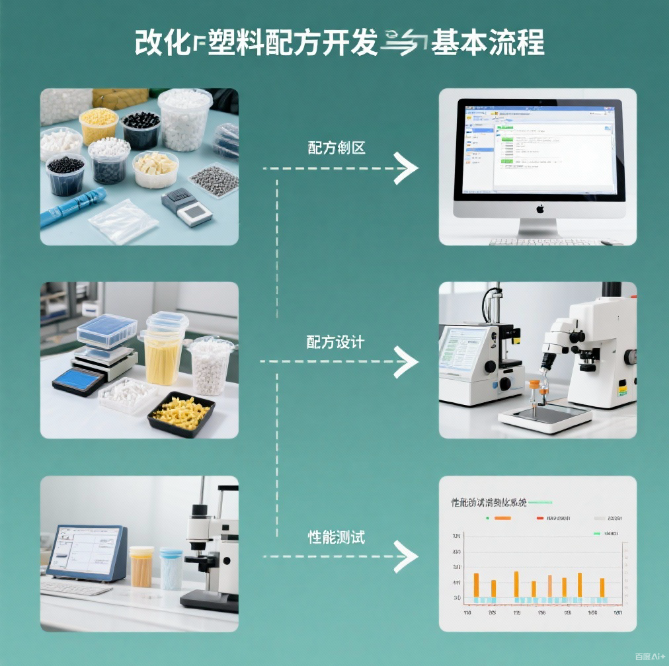
The following are the eight core principles that need to be followed in the development of modified plastic formulations:
01
Goal-Oriented Principle (Primary Principle)
This is the starting and ending point of all development work. The formula is not about being more advanced, but about precisely matching the application scenario and requirements of the final product.
Clarify the final purpose.In which field is the product used? (e.g., automotive, home appliances, electronics and electrical, medical devices)
Performance Indicator QuantificationWhat specific performance standards need to be met? (e.g., heat resistance temperature, impact strength, flame retardant rating, chemical resistance, dielectric constant, color, gloss, etc.)
Regulations and Environmental RequirementsDo specific certifications such as RoHS, REACH, FDA, UL need to be met? Are there requirements for environmental protection (e.g., recyclable, bio-based)?
Cost Control ObjectivesWhat is the target cost? This directly determines the range of basic resins and additives to be selected.
02
Principle of Component Compatibility and Synergy
The compatibility and interaction between the components (resin, filler, additives) in the formulation are crucial, as they do not exist in isolation.
CompatibilityEnsure that additives (such as toughening agents and flame retardants) have good compatibility with the matrix resin to avoid precipitation (migration) and phase separation, which could affect product performance and appearance.
SynergyCleverly utilize the synergistic effect among components to achieve a "1+1 > 2" outcome. For example:
Flame retardant synergyCombination of phosphorus-based and nitrogen-based flame retardants.
Anti-aging synergyCombination of antioxidants with different mechanisms (primary antioxidants + secondary antioxidants) and UV absorbers.
Antagonistic effects: Avoid mutual neutralization or negative effects between components. For example, certain fillers may adsorb other additives, leading to their ineffectiveness.
03
Principle of Process Feasibility
An excellent laboratory formula must be able to adapt to industrial production.
Matching processing technologyThe formulation must meet the requirements of specific processing methods such as injection molding, extrusion, and blow molding (e.g., flowability, thermal stability, melt strength).
Process windowThe formulation should have a wide processing window (such as temperature and shear rate) to facilitate production control and ensure product stability.
Device AdaptabilityConsider the requirements of the formulation for production equipment (such as screw combinations and length-to-diameter ratio) to avoid causing corrosion or excessive wear on the equipment.
04
Cost Optimization Principle (Cost-Effectiveness Principle)
Pursue the lowest cost while meeting all performance requirements.
"Sufficiency is enough."Do not blindly pursue high-performance metrics to avoid "over-design" and "performance waste."
Material SelectionWithin the range of acceptable performance, prioritize the use of lower-priced and more stable supply general materials.
Formula simplificationMinimize the types and amounts of additives, simplify the production process, and reduce management and production costs.
Value Engineering AnalysisConsider the total lifecycle cost, including material cost, processing efficiency, defect rate, and service life.
05
Principle of Productivity and Stability
The success of the laboratory is just the first step; the key is whether it can be stably produced on a large scale.
Raw Material StabilityEnsure that each batch of raw materials (especially fillers and additives) is of stable quality and from reliable sources.
Formula robustnessThe formula should be insensitive to minor fluctuations in raw materials and process parameters, ensuring consistency in product quality.
Variance and Uniform DistributionEnsure that fillers and additives can be uniformly dispersed in the matrix, as this is the foundation for performance consistency. This often requires appropriate surface treatment and processing techniques.
06
Sustainability and Environmental Principles
Modern product development must consider environmental impact factors.
Regulatory complianceStrictly comply with global and regional environmental regulations, and restrict or prohibit the use of harmful substances (such as heavy metals, polybrominated biphenyls, etc.).
Green Material ApplicationPreferably choose non-toxic, low smoke, and halogen-free additive systems; consider using bio-based plastics, biodegradable plastics, or recycled materials (PCR).
LightweightAchieving product lightweighting by improving material performance, indirectly reducing carbon emissions.
07
Standardization and Normalization Principles
Ensure the development process is scientific, efficient, and traceable.
Database creationEstablish a raw material database, a formula database, and a performance database to accumulate technical experience.
Testing standards unifiedConduct performance testing according to international/national/industry standards to ensure data comparability and authority.
Document RecordRecord the formula, process, test results, and analysis of each experiment in detail to form technical accumulation.
08
Iteration and Validation Principles
Formulation development is rarely accomplished in one go; it is an iterative closed-loop process of "design-preparation-testing-analysis-optimization."
Prototype Manufacturing and TestingCreate prototypes and samples for comprehensive performance testing.
Simulated Application Environment TestingConduct tests that simulate actual usage conditions (such as long-term thermal aging, ultraviolet aging, fatigue testing).
From small-scale trials, to pilot tests, to mass production.Gradually expand production scale and promptly identify and resolve issues in large-scale production.
Basic Process of Formula Development
Based on the above principles, a typical development process is as follows:
Demand AnalysisClearly define all performance, cost, and regulatory requirements.
Preliminary DesignBased on experience and database, select the matrix resin, key additives, and fillers to design an initial formulation.
Laboratory trial productionPreparation of small samples using equipment such as a mixing machine, torque rheometer, and twin-screw extruder.
Performance Testing and EvaluationPerform mechanical, thermal, electrical, and combustion performance tests on the samples.
Analysis and OptimizationAnalyze the test results, identify the issues, adjust the formulation ratio or replace components, and proceed with the next iteration.
Pilot scale-upConduct trial production on a small-scale production line to verify machinability and stability.
Customer Verification and AuthenticationSend samples to the client for testing and apply for third-party certification if necessary.
Mass Production ConversionDevelop the final product standards, process specifications, and inspection standards to achieve stable mass production.
In summary, the development of modified plastic formulations is a combination of science, experience, and art. It requires engineers to have not only a deep understanding of polymer materials, additives, rheology, and other theoretical knowledge, but also rich practical experience and a holistic perspective to find the optimal solution under multiple constraints.
【Copyright and Disclaimer】The above information is collected and organized by PlastMatch. The copyright belongs to the original author. This article is reprinted for the purpose of providing more information, and it does not imply that PlastMatch endorses the views expressed in the article or guarantees its accuracy. If there are any errors in the source attribution or if your legitimate rights have been infringed, please contact us, and we will promptly correct or remove the content. If other media, websites, or individuals use the aforementioned content, they must clearly indicate the original source and origin of the work and assume legal responsibility on their own.
Most Popular
-
Dow, Wanhua, Huntsman Intensively Raise Prices! Who Controls the Global MDI Prices?
-

Clariant Unveils Cost-Cutting Plan Details, Plans to Shut Down Multiple Plants
-
[Today's Plastics Market] General Materials Weakly Fluctuate, Engineering Materials Steadily Rise
-

New Breakthrough in Domestic Adiponitrile! Observing the Rise of China's Nylon Industry Chain from Tianchen Qixiang's Production
-

Daily Review: Polyethylene Prices Under Weak Consolidation, Sellers Face Significant Pressure to Move Inventory