



Global Oil Market Oversupply Concerns Intensify as OPEC+ Agrees to Pause Production Increase in Q1 Next Year
OPEC+ agreed on a slight increase in production in December on Sunday.OPEC+ adjusted its original plan aimed at reclaiming market share and will suspend production increases in the first quarter of next year due to growing concerns about an oversupply in the oil market.。
Affected by this news,International oil prices edged up slightly on Monday during Asian trading hours.Brent crude futures rose above $65 per barrel, while WTI crude futures climbed above $61 per barrel.
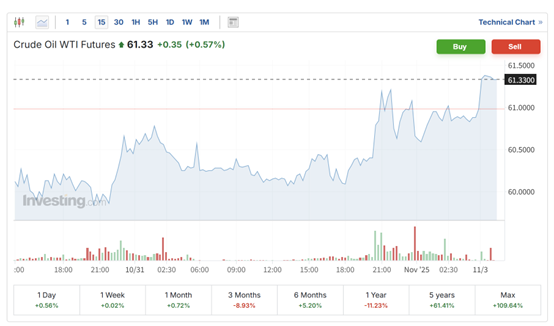
(WTI Crude Oil Futures 15-Minute Chart Source: Investing.com)

(Brent Crude Oil Futures 15-Minute Chart Source: Investing.com)
On Sunday, eight member countries participating in the OPEC+ monthly meeting—Saudi Arabia, Russia, the UAE, Iraq, Kuwait, Oman, Kazakhstan, and Algeria—agreed to increase the daily production target for December by 137,000 barrels, the same increase as in October and November.
The pause in production increases from January to March will be the first interruption in the pace of production increases since OPEC+ began rapidly restoring previously suspended oil supplies in April this year.
The first quarter is usually a period of relatively weak global oil demand. "After December this year, due to seasonal factors, these eight countries have also decided to suspend production increases in January, February, and March 2026," OPEC+ stated in a statement.
Since April, OPEC+ has raised its production targets by approximately 2.9 million barrels per day, accounting for about 2.7% of global supply. However, as the market anticipates an impending supply surplus, the organization has slowed its pace of production increases starting in October.
Increasing signs indicate that the crude oil market is facing an oversupply situation as demand cools and supply surges.Traders point out that the current oil oversupply problem is continuously worsening, and it is expected that this situation will further deteriorate by next year.
In addition, the new round of sanctions imposed by Western countries on OPEC+ member Russia is bringing more challenges to the organization's strategy. Previously, the United States and the United Kingdom had implemented new sanctions against Russia's major oil producers, Rosneft and Lukoil, making it difficult for Russia to further increase its oil production.
The International Energy Agency (IEA) predicts that global oil supply may exceed demand by more than 3 million barrels per day this quarter, and that the surplus situation next year could reach unprecedented levels. JPMorgan and Goldman Sachs predict that oil prices will continue to decline, falling below $60 per barrel.
Due to market concerns about oversupply, oil prices fell to a five-month low of about $60 per barrel on October 20. However, they rebounded to around $65 per barrel, boosted by sanctions on Russia and optimistic sentiment regarding negotiations between the U.S. and its trade partners.
"OPEC+ is making concessions, but these are deliberate concessions. The sanctions on Russian oil producers have injected new uncertainties into supply forecasts, and the organization is well aware that overproduction now could backfire later," said Jorge Leon, an analyst at independent research and energy intelligence firm Rystad.
He added, "By pausing production increases, OPEC+ is protecting prices, demonstrating unity, and buying time to observe the actual impact of sanctions on Russian oil exports."
Helima Croft, Head of Commodity Strategy at RBC Capital, said, "The pause in production increase is undoubtedly another plot twist, but considering the uncertainties on the supply side in the first quarter of next year, I think it's a prudent decision."
Amrita Sen, an analyst at the energy consultancy firm Energy Aspects, stated that January to March is the weakest quarter for oil supply and demand balance, and OPEC+'s pause in production cuts indicates that it is actively managing the market.
Eight OPEC+ member countries will hold another meeting on November 30, on the same day as the OPEC+ general meeting, to review the production levels for 2026.
【Copyright and Disclaimer】The above information is collected and organized by PlastMatch. The copyright belongs to the original author. This article is reprinted for the purpose of providing more information, and it does not imply that PlastMatch endorses the views expressed in the article or guarantees its accuracy. If there are any errors in the source attribution or if your legitimate rights have been infringed, please contact us, and we will promptly correct or remove the content. If other media, websites, or individuals use the aforementioned content, they must clearly indicate the original source and origin of the work and assume legal responsibility on their own.
Most Popular
-
Dow, Wanhua, Huntsman Intensively Raise Prices! Who Controls the Global MDI Prices?
-

Clariant Unveils Cost-Cutting Plan Details, Plans to Shut Down Multiple Plants
-
[Today's Plastics Market] General Materials Weakly Fluctuate, Engineering Materials Steadily Rise
-

New Breakthrough in Domestic Adiponitrile! Observing the Rise of China's Nylon Industry Chain from Tianchen Qixiang's Production
-

Daily Review: Polyethylene Prices Under Weak Consolidation, Sellers Face Significant Pressure to Move Inventory