



India's Revocation of BIS Policy for PCs Brings Opportunities for China's PC Market
On November 12, the Indian government announced the one-time revocation of mandatory Indian Standard Certification (BIS certification) requirements for 14 key chemicals and polymers, including PC. What opportunities will this move bring to the Chinese PC market?
On November 12, 2025, the Indian Ministry of Chemicals and Fertilizers issued a significant announcement, abolishing the BIS certification requirements for 14 key chemicals and polymers, including PC, in one go. This means that in the future, Indian importers will no longer need to go through the mandatory certification process by the Bureau of Indian Standards when procuring chemical products like PC, and can directly import products that meet international standards.
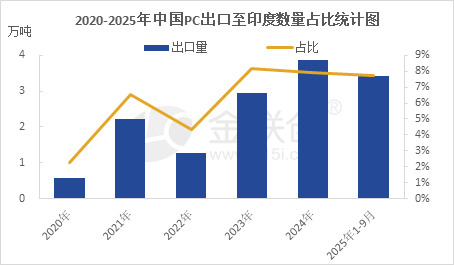
Data Source: JLC Network Technology
According to historical data, from 2020 to 2024, China's PC exports to India increased from 5,700 tons to 38,500 tons, with the proportion of total domestic exports rising from 2.27% to 7.91%. This trend clearly indicates that India has become one of the important overseas markets for China's PC industry, ranking among the top five export destinations.
From January to September 2025, China's PC exports to India amounted to 34,100 tons, accounting for 7.74% of the total exports. Although the proportion has decreased compared to previous years, the total annual PC exports to India in 2025 are expected to increase. The recent adjustment in BIS policies will directly impact the export strategies and market competition landscape for Chinese PC companies.
The export cost of PCs has decreased, and short-term orders are expected to increase.
After the policy cancellation, new orders can be exported directly without waiting for certification to be completed, thus shortening the transaction cycle. Meanwhile, due to the lowered certification threshold, some orders that were previously delayed or abandoned in the Indian market due to BIS certification may be restarted. Starting from November 2025, Chinese PC companies' export quotes to India will be more competitive, especially for products that were previously priced higher due to high certification costs, which now have more channels to compete for market share.
Opportunities are followed by challenges.
The demand for PC (polycarbonate) is primarily concentrated in fields such as automotive lightweight components, electronic appliance housings, and building lighting materials. India is currently in a phase of accelerated industrialization, and industry estimates predict that demand for PC will maintain a growth rate of 6%-8% over the next five years. However, India's domestic production capacity can only meet about 40% of the demand, which means it still relies heavily on imports for PC. As the world's largest PC producer, China is expected to continue expanding its export volume to India in the future, thanks to its mature integrated industrial chain and cost-effectiveness.
Despite the cancellation of BIS certification lowering the import threshold, it also brings new challenges for PC manufacturers. The policy benefits not only domestic PC companies but also attract PC manufacturers from regions such as the Middle East, South Korea, and Taiwan to enter the Indian market. If Chinese PC companies rely solely on price advantages, it may lead to the risk of price wars and even trigger anti-dumping investigations.
Strategies for the Domestic PC Industry Response
The increase in demand from the Indian market will promote the optimization of China's PC export structure, shifting the focus not only to Southeast Asia but also towards emerging economies, further capturing more market share.
At the same time, in response to the intensifying competition in the Indian market, domestic PC manufacturers need to accelerate their development towards high-end PC materials, offer more differentiated grades to enhance product competitiveness and avoid falling into low-end price wars, as well as strengthen the management and development of an integrated industrial supply chain to lay a foundation for reducing costs.
Finally, companies need to closely monitor subsequent policy developments in India, reduce the impact of uncertainties, and adjust their export strategies.
India's revocation of mandatory BIS certification reduces export costs for Chinese PC manufacturers in the short term, stimulating an increase in orders. However, in the medium to long term, as India's demand for PCs gradually increases, international competition intensifies, and quality trust issues also pose challenges. Domestic PC companies should seize this critical period to optimize industrial structure, enhance product competitiveness, and closely monitor Indian policy trends to expand their advantageous position in the global PC supply chain.
【Copyright and Disclaimer】The above information is collected and organized by PlastMatch. The copyright belongs to the original author. This article is reprinted for the purpose of providing more information, and it does not imply that PlastMatch endorses the views expressed in the article or guarantees its accuracy. If there are any errors in the source attribution or if your legitimate rights have been infringed, please contact us, and we will promptly correct or remove the content. If other media, websites, or individuals use the aforementioned content, they must clearly indicate the original source and origin of the work and assume legal responsibility on their own.
Most Popular
-
Dow, Wanhua, Huntsman Intensively Raise Prices! Who Controls the Global MDI Prices?
-
Clariant Unveils Cost-Cutting Plan Details, Plans to Shut Down Multiple Plants
-
[Today's Plastics Market] General Materials Weakly Fluctuate, Engineering Materials Steadily Rise
-
New Breakthrough in Domestic Adiponitrile! Observing the Rise of China's Nylon Industry Chain from Tianchen Qixiang's Production
-
Daily Review: Polyethylene Prices Under Weak Consolidation, Sellers Face Significant Pressure to Move Inventory