



Japan's Interest Rate Hike: End of Manufacturing "Devaluation Dividend," China's Total Industrial Assault Launches
Today, on December 19, 2025, the Bank of Japan (BOJ) announced an increase of 25 basis points in the benchmark interest rate, bringing it to 0.75%.
This number may not mean much to many young people, but if you look at Japan's interest rate chart over the past 30 years, you'll find that this is an extremely significant turning point. 0.75% is already the highest level Japan has seen since 1995.
Over the past three years, I have written many articles about Japanese industries. I have always maintained a perspective: the so-called "recovery" of Japanese manufacturing in recent years has largely been sustained by the sharp depreciation of the yen. When giants like Toyota, Nissan, and Sony earn US dollars in North America and then convert them into yen, which has depreciated by nearly 30%, the net profit shown on the financial statements indeed looks good. However, this prosperity is superficial, built on depleting the purchasing power of the citizens and driving up the cost of imported energy.
Now, the Bank of Japan can no longer hold on. With the interest rate hike finally happening, the yen exchange rate has begun to rebound, and the last layer of "protection" for Japanese manufacturing has been stripped away.
Japan's 0.75% interest rate hike marks the end of an era. When Japan can no longer rely on "self-destructive devaluation" to maintain the false prosperity of its manufacturing industry, the real clash of strength is just beginning.
I am optimistic about Chinese manufacturing because our moat is not the exchange rate, but the most complete industrial chain on this planet.
To delve into these two "foundation" industries of Japanese manufacturing, we must not only look at the macro level but also analyze the financial reports and cost structures of specific companies.
Japan's interest rate hike to 0.75% has completely different impacts on these two industries: the auto parts industry faces "zero profit," while the precision machine tool industry faces "customer exodus."
Let's create a table and use data to tell the story.
Part 1: Auto Parts - The "Death Squeeze" After the Disappearance of Exchange Rate Benefits
Japan's automotive parts are strong due to the deep "Keiren Kai" system of companies like Denso and Aisin.
1. The secrets in financial reports: I reviewed Denso's recent financial report. In the fiscal year 2024, for every 1 yen depreciation of the yen, Denso's operating profit increases by approximately 3 billion yen. Last year, when the yen was above 150, Denso recorded a record profit. However, if you look at its profit margin, it is only about 7%.
Let's do some simple math: if the yen appreciates from 155 to 130 due to interest rate hikes, the appreciation rate is about 16%. For a company like Denso, which has a global presence but conducts research and core manufacturing in Japan, this 16% change in exchange rate can directly erode a significant portion of its profit margin.
2. The opportunity for Chinese enterprises to reap benefits: When observing Japan's interest rate hikes, we must pay attention to the corresponding Chinese leaders — such as Sanhua Intelligent Controls (thermal management) and Tuopu Group (chassis systems).
Cost side: The energy cost of Chinese automotive parts companies is only one-third of that in Japan.
Response speed: The iteration cycle for Chinese electric vehicles is 12-18 months, while Japanese suppliers are still accustomed to the traditional development cycle of 48 months.
Comment: In the past, the "cheap yen" covered up the flaws of slow development and high costs. Now that interest rates have risen, that cover is gone. When Toyota and Honda have to ask their second- and third-tier suppliers for price reductions due to exchange rate pressures, the only option for these small and medium-sized Japanese suppliers is to go bankrupt, and the market share that opens up will be quickly taken over by Chinese suppliers from the Yangtze River Delta and the Pearl River Delta.
Part Two: High-Precision Machine Tools - From "Brand Faith" to "Survival Choice"
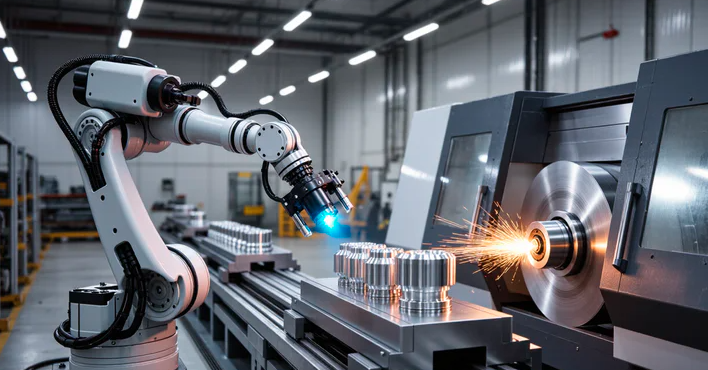
Machine tools are the mother of industry. Fanuc, DMG MORI, and Mazak were once revered in the Chinese market.
1. Key Data Comparison: I looked into Fanuc's gross profit margin. Fanuc has consistently maintained a high gross margin of over 30%, relying on its monopoly in software systems and barriers in precision manufacturing. However, I reviewed the order data from the Japan Machine Tool Builders' Association (JMTBA): since 2025, Japanese machine tool export orders to China have been continuously declining.
Why?
Price inversion: After Japan's interest rate hike, the cost of capital has increased. A 5-axis machining center that Chinese companies could originally afford has now seen its cost rise by over 100,000 RMB due to expectations of yen appreciation.
Domestic entrants: Dalian Machine Tool (General Technology), Neway CNC, Haitian Precision. Although we still have a gap in the top 1% of the highest-end market, in the remaining 99% of the mid-range market, Chinese companies have achieved micron-level precision.
2. Core Game Point: The competition in high-precision machine tools essentially depends on the prosperity of downstream customers. The current logic is that China's new energy vehicles, photovoltaics, and commercial space are booming, and these customers are right at the doorstep of Chinese factories. Japanese machine tool companies face increased domestic financing costs and higher overseas quotes due to interest rate hikes, whereas Chinese companies provide 24-hour on-site maintenance and continuously upgraded control systems right at home.
Summary: Don't underestimate this 0.75%.
Many keyboard warriors will say that 0.75% is still a low interest rate. Wrong! For a Japanese manufacturing system that has been accustomed to "zero-cost capital" for 30 years, a 0.75% rate hike is like a patient who has been living on low-pressure oxygen suddenly having their oxygen tube removed.
What we need to do is not to mock Japan, but to quickly absorb the technical talents they have lost due to management difficulties, and in Southeast Asia and Latin America, which were once their "backyards," use Chinese components and Chinese machine tools to completely erase their brand imprint.
The competition for high-end positions is not driven by wining and dining, but by the triple constraints of exchange rates, costs, and technological cycles.
【Copyright and Disclaimer】The above information is collected and organized by PlastMatch. The copyright belongs to the original author. This article is reprinted for the purpose of providing more information, and it does not imply that PlastMatch endorses the views expressed in the article or guarantees its accuracy. If there are any errors in the source attribution or if your legitimate rights have been infringed, please contact us, and we will promptly correct or remove the content. If other media, websites, or individuals use the aforementioned content, they must clearly indicate the original source and origin of the work and assume legal responsibility on their own.
Most Popular
-
Key Players: The 10 Most Critical Publicly Listed Companies in Solid-State Battery Raw Materials
-

Vioneo Abandons €1.5 Billion Antwerp Project, First Commercial Green Polyolefin Plant Relocates to China
-

EU Changes ELV Regulation Again: Recycled Plastic Content Dispute and Exclusion of Bio-Based Plastics
-
Clariant's CATOFIN™ Catalyst and CLARITY™ Platform Drive Dual-Engine Performance
-

List Released! Mexico Announces 50% Tariff On 1,371 China Product Categories