



Listing immediately below ipo price, autonomous driving unicorn collides with business reality
On November 6, 2025, WeRide-W (00800) and Pony.ai-W0 (02026) appeared one after another on the electronic screen of Exchange Square in Central, Hong Kong, both entering the capital market with the identity of dual listing in "US stocks + Hong Kong stocks". One claims to be the "first Robotaxi stock in Hong Kong", while the other promotes itself as the "largest IPO in the global autonomous driving industry in 2025".
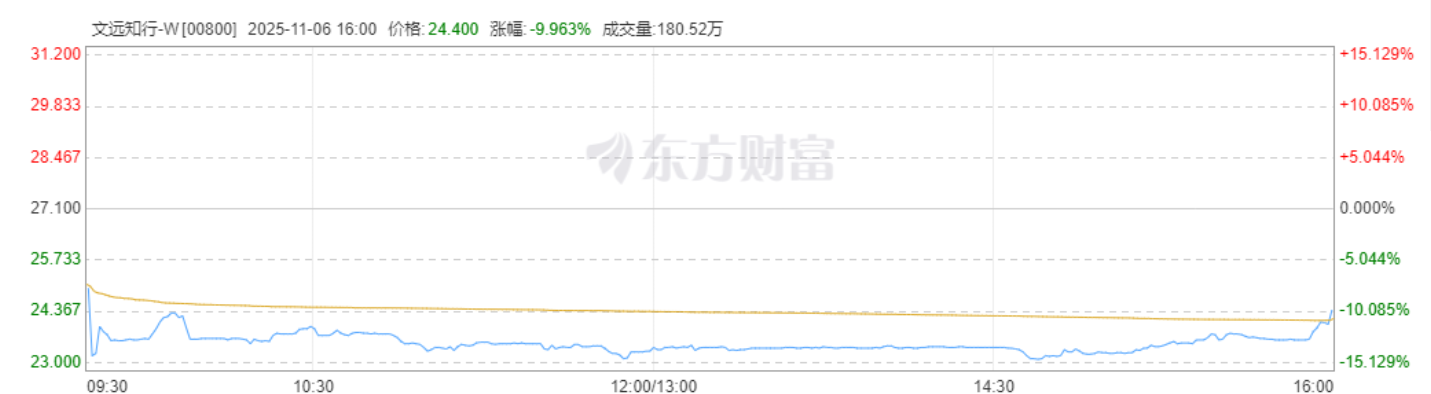
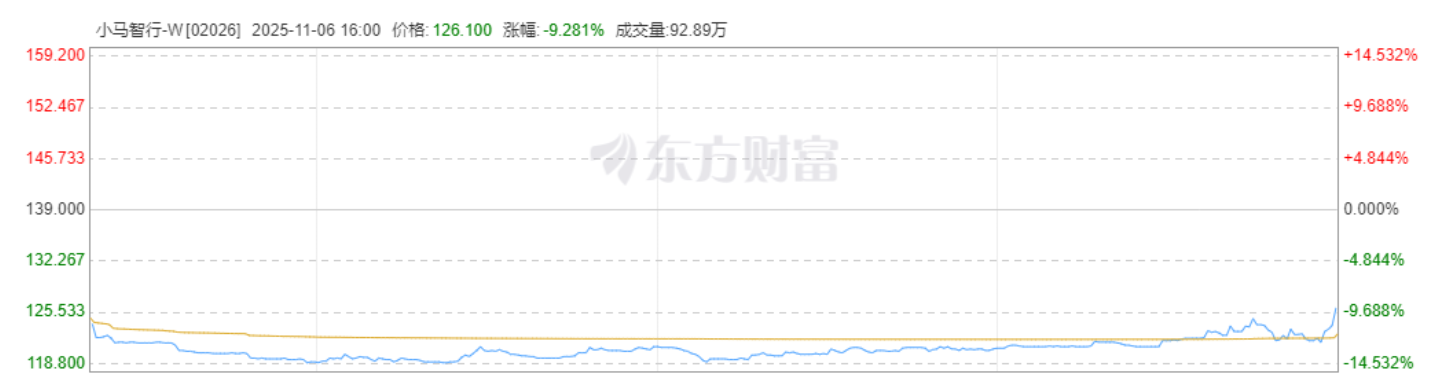
As of the close on November 6, the stock price fluctuations on the opening day for WeRide and Pony.ai; image source: East Money.
However, even before the bell rang, a controversy stirred up by WeRide's CFO Li Xuan exploded in the capital circle. According to reports, both companies fell below their issue prices during the dark pool phase, with the former having a dark pool price of HKD 23.62, a drop of 12.84% from the issue price of HKD 27.10, and the latter having a price of HKD 123.5, a decline of 11.15% from the issue price of HKD 139. After the market opened, the decline further expanded, once touching -13%.
A RoboTaxi "twin star IPO," initially full of expectations, was abruptly doused with cold water by capital voting with its feet—the technology narrative has concluded, and the commercial truth is starting to be questioned.
The Dilemma of Industry Standards Amid the Struggle for Data Discourse Power
The matter originated from a group of nearly 200 institutional investors.
On October 30th, with only 7 days left until the two companies were listed, WeRide's CFO Li Xuan made an accusation that disrupted the calm before the listing. He publicly reported in an analyst group aimed at institutional investors that Pony.ai's presentation materials for Hong Kong investors contained "deliberately disparaging false statements" about its competitor. The core dispute centered on four dimensions:
In terms of operational areas, Pony.ai claims that WeRide only provides fully driverless Robotaxi services in Beijing, while in fact, it has already achieved regular operations in Guangzhou.
Pony.ai claims that WeRide's "commercialization has completed zero orders" in terms of operational data, but public information shows that its fleet of over 700 vehicles has been in operation for a cumulative 2,200 days.
In terms of technology strategy, Pony.ai prides itself on achieving "full-stack one-stage end-to-end mass production," while questioning WeRide's mastery of only two-stage technology, despite WeRide having mass production applications verified by Bosch and Chery.
In terms of global expansion, Pony.ai downplays WeRide's operational achievements in 30 cities across 11 countries, and conceals its industry breakthrough of obtaining driverless operation licenses in 5 countries.
"This kind of behavior has exceeded the scope of normal competition." Li Xuan bluntly stated in the group, demanding Pony.ai to immediately correct the misinformation. As of now, no direct response from Pony.ai has been seen in the public information.
The phrase "Rome wasn't built in a day" implies that the controversy is rooted in long-standing issues of data transparency and PR battles within the autonomous driving industry. In June this year, Pony.ai CTO Lou Tiancheng publicly stated that companies like WeRide are already two and a half years behind. At that time, Li Xuan retaliated on social media by bringing up past incidents where Pony.ai had its license revoked in the U.S. due to a crash and a fire incident in Beijing after hitting a curb, directly questioning the reliability of their technology.
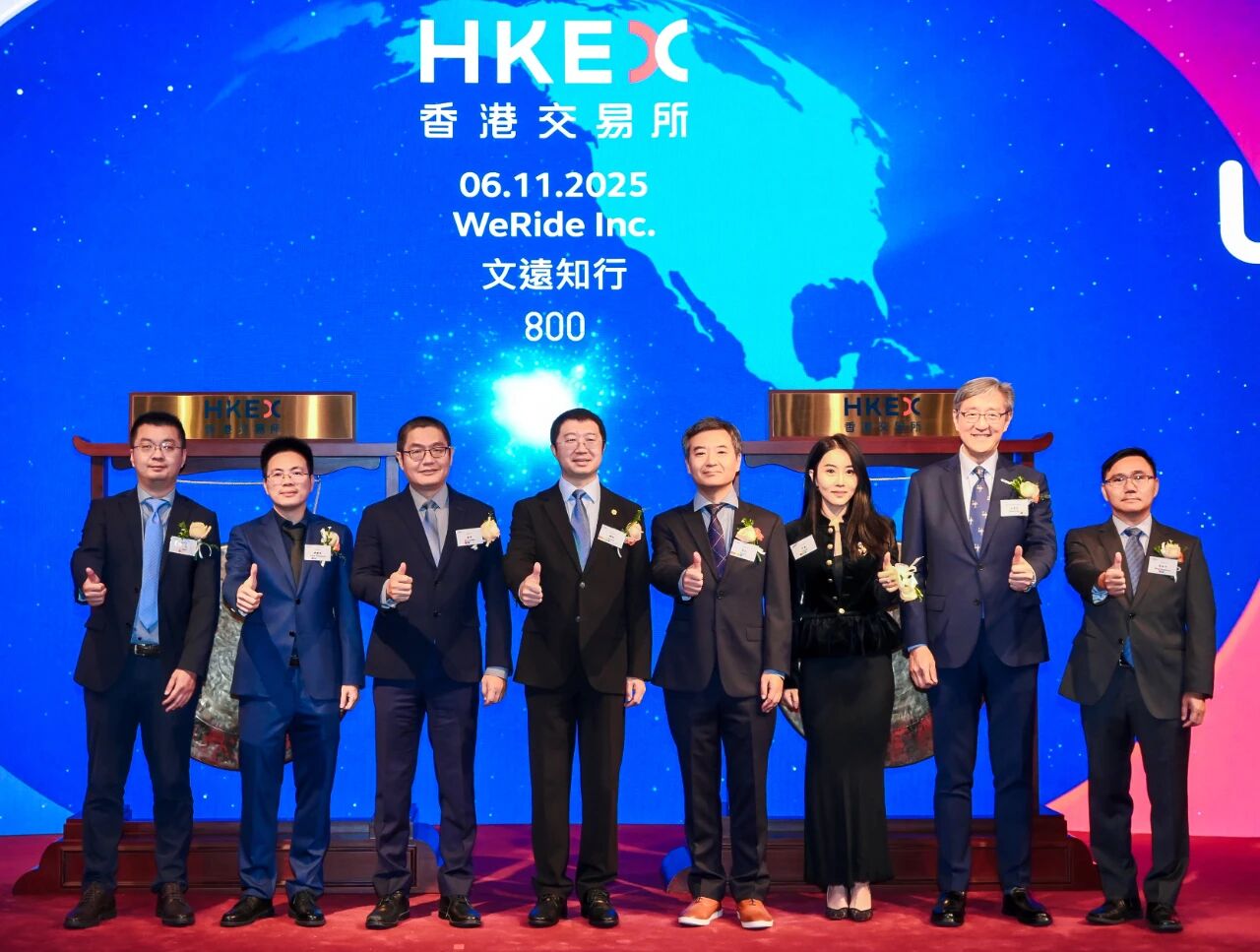
Image Source: WeRide
What is more intriguing is that the core teams of both companies come from Baidu's autonomous driving department. Peng Jun and Lou Tiancheng from Pony.ai were once Baidu's chief architect and youngest T10 engineer, while WeRide's founder Han Xu also came from Baidu as a chief scientist. Former comrades-in-arms, they now face off in the capital market, highlighting the intensity of the competition.
At the Hong Kong Stock Exchange listing ceremony, the founders of the two companies, Peng Jun and Han Xu, shook hands to congratulate each other. Peng Jun said, "We are also very pleased to see another excellent autonomous driving company, WeRide, listed here on the same day as us. This is not only a milestone for both companies but also an important sign of the accelerated development of the entire autonomous driving industry."
Under the pressure of losses, a "blood replenishment" survival battle.
The almost identical listing pace of these two companies, to some extent, reflects the predicament of the entire autonomous driving industry: reliant on financing and unable to escape burning through cash. In October 2024, WeRide took the lead in going public on NASDAQ, earning the title of the "first U.S.-listed Robotaxi stock." Just a month later, Pony.ai followed suit, with the competition for the "first stock" title becoming almost fierce. In less than a year, both companies simultaneously turned to the Hong Kong stock market, establishing a "U.S. + Hong Kong" dual listing structure—behind which lies the undeniable pressure of losses and the rigid demand for R&D investment.
Turning to the accounts, the numbers are not promising. From 2022 to 2024, WeRide accumulated net losses of nearly 5.8 billion yuan, while Pony.ai lost more than 4 billion yuan. Even going into the first half of 2025, both companies have not managed to escape the mire of losses, each burning through nearly 800 million and 650 million yuan respectively. Where did the money go? Research and development is the biggest outlet. During the same period, WeRide's R&D expenditure exceeded 3.5 billion yuan, with R&D expenses at one point accounting for 322% of revenue; Pony.ai invested 4.4 billion yuan in R&D funds, with the R&D ratio soaring to 320% in 2024.

Image Source: WeRide
Even as industry leaders, they cannot escape the dilemma of "research and development consuming revenue". According to their respective financial reports, WeRide's revenue in the first half of 2025 was $27.865 million (equivalent to RMB 199 million), while R&D expenses reached $89.988 million (equivalent to RMB 640 million); Pony.ai's revenue was $35.434 million (equivalent to RMB 252 million), with R&D investment amounting to $96.516 million (equivalent to RMB 688 million).
Listing has almost become their only option for survival. In this Hong Kong stock market listing, Pony.ai is expected to raise approximately 6.7 billion HKD, while WeRide's net proceeds are about 2.9 billion HKD. The allocation of funds is highly consistent: research and development and fleet expansion.
Pony.ai founder Peng Jun publicly predicted that the industry's breakeven point won't be reached until at least 2028 to 2029, and until then, it can only rely on financing to support its scale. Han Xu from WeRide also admitted that to achieve scale for Robotaxi, a fleet of thousands of vehicles is necessary. Although the cost per vehicle has dropped from millions to 300,000, funding is still needed to offset the costs.
The swift transition from U.S. stocks to Hong Kong stocks also reflects the chill in the capital environment. In 2025, the valuation of the U.S. stock technology sector generally corrected, with the average price-to-earnings ratio of Chinese concept stocks falling by more than 20% compared to 2024. Meanwhile, Hong Kong stocks have relatively clear policy support for smart driving companies, naturally becoming the priority choice for secondary financing.
The strategic approaches of the two companies are also beginning to show differences in their IPO stories. Pony.ai emphasizes "deepening technology," highlighting itself as the only company to have obtained fully driverless operation permits in Beijing, Shanghai, Guangzhou, and Shenzhen. In the first half of 2025, its Robotruck business revenue reached $17.3 million, with technology licensing revenue increasing by 169.68% year-on-year to $14.878 million, accounting for nearly 60% of the total. Meanwhile, WeRide emphasizes "global deployment," collaborating with Grab to explore the Southeast Asian market and launching Robotaxi services with Uber in Riyadh, Saudi Arabia. In the second quarter of 2025, WeRide's Robotaxi revenue was four times that of Pony.ai.
This difference is also reflected in the issuance strategy: Pony.ai set its issue price at 139 HKD, highlighting the technology premium; while WeRide set its price at 27.1 HKD, attempting to attract retail investors with scale advantages.
However, no matter how the story is told, the capital markets no longer seem to easily buy in. Looking back at 2024 when WeRide went public on the U.S. stock market, it could still rise by 18% on the first day; but this time with the listing of the two Hong Kong stock giants, they both fell below the offering price at the opening.
Apart from the controversies mentioned earlier, Pony.ai's Robotaxi revenue still accounts for less than 10%, and WeRide's global revenue has not met expectations, which raises doubts among investors about their profitability prospects.
Under pressure, the two companies had to accelerate commercialization—WeRide plans to expand its fleet in the Middle East by 50 vehicles by 2025, while Pony.ai aims to increase its Robotaxi fleet from 250 to 1,000 vehicles. Whether these goals can be achieved on schedule remains to be seen.
The Commercialization Life and Death Situation of Autonomous Driving
The day before Pony.ai and WeRide went public, Seres, as the first "A+H shares" luxury new energy vehicle company, was listed on the Hong Kong Stock Exchange, yet it also couldn't escape the fate of breaking the issue price. The issue price was set at HKD 131.5, but it fell below that at the opening, once dropping to HKD 118 during the session, with a decline of nearly 10%.
Despite Seres raising a net amount of HKD 14.016 billion in its IPO on the Hong Kong Stock Exchange, making it the largest IPO of a car company globally this year, and attracting HKD 170 billion in funds with an oversubscription of 133 times, it still failed to reverse the trend of opening below its issue price. This is not an isolated phenomenon. According to statistics, out of the 83 new stocks listed on the Hong Kong Stock Exchange this year, 17 closed below their issue price on the first day of trading, with a break-even rate of over 20%. If calculated based on the intraday lowest price, the number of stocks that have broken their issue price reaches 30. The sobriety of the capital market is evident.
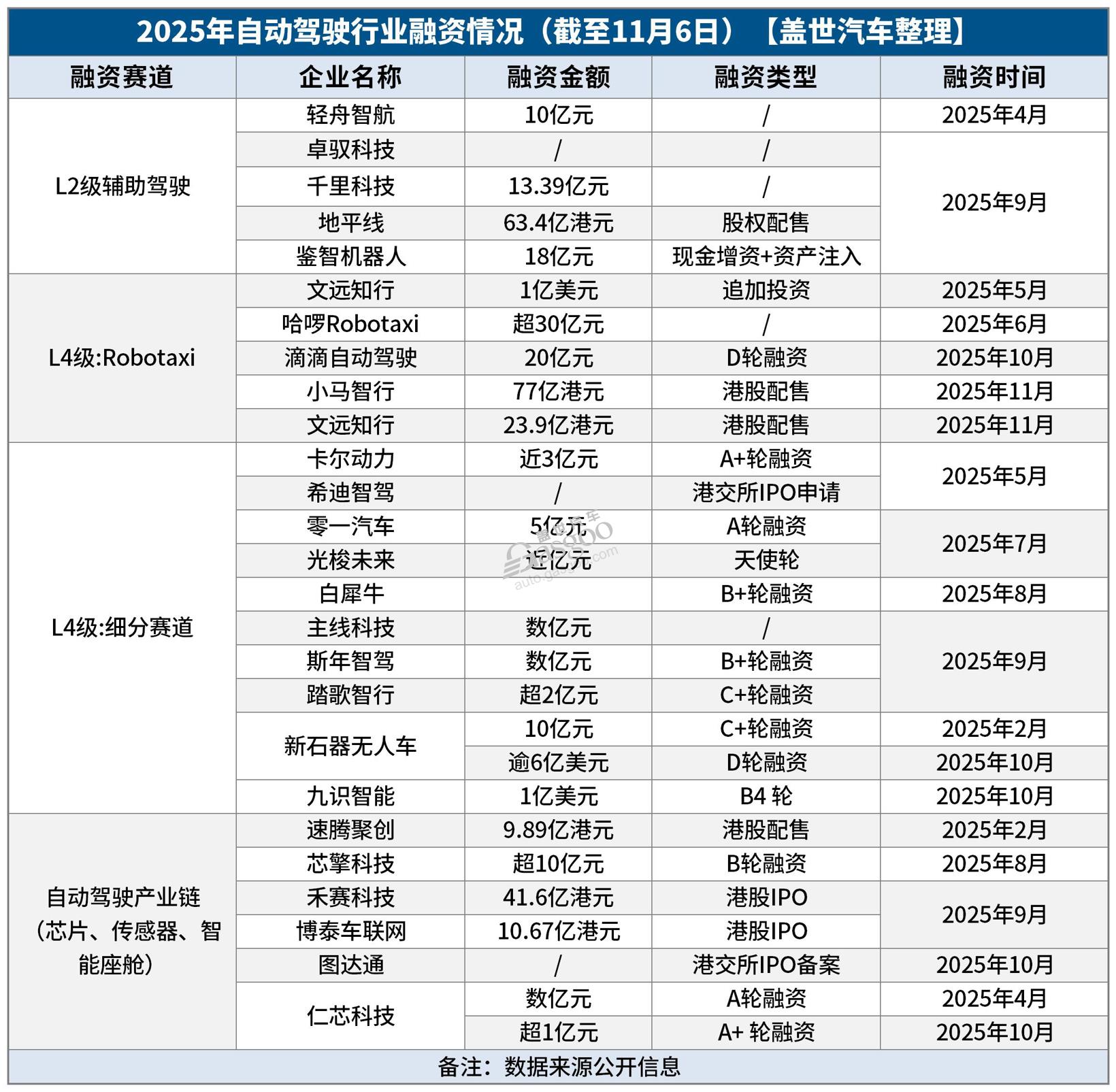
In contrast to the overall cautious sentiment in the Hong Kong stock market, the autonomous driving sector has shown significant signs of a financing recovery in 2025. According to incomplete statistics from Gasgoo Auto, the autonomous driving industry in China has become exceptionally active since 2025, marking a departure from the "capital winter" of the past three years. However, upon closer examination of the capital flow, the once hotly pursued Robotaxi sector is undergoing a harsh shift from "technology worship" to "commercial pragmatism."
On the eve of WeRide and Pony.ai's listing, a new round of industry encirclement has quietly unfolded. XPeng Motors announced the launch of three Robotaxi models by 2026, AutoNavi officially announced its entry into the field, Didi Autonomous Driving clarified its commercialization timeline for 2026, and Hello TransTech, in collaboration with CATL and Ant Group, launched pre-installed mass-produced Robotaxis with a deployment target of ten thousand units.
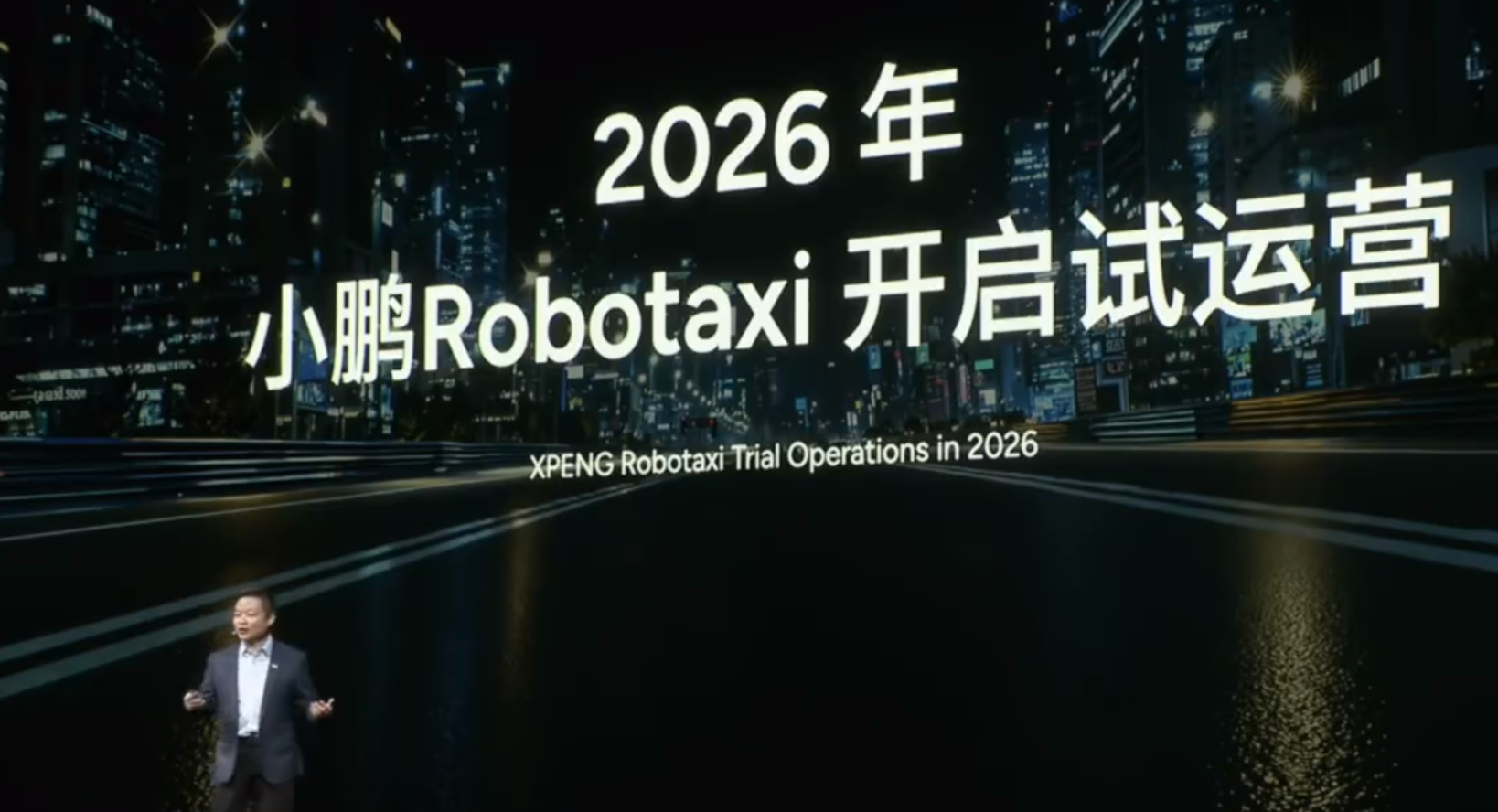
Image source: Screenshot from Xiaopeng Motors' Weibo video
Most of these new players come with industrial backgrounds and ecosystem advantages, directly raising the competition threshold from technology demonstration to large-scale manufacturing and cost control capabilities.
Faced with this kind of dimensionality reduction attack, the "technological leadership" emphasized by WeRide and Pony.ai in their prospectus is losing its persuasive power in the capital market. Currently, the evaluation standards of investors have undergone profound changes, shifting from primarily focusing on technical indicators and testing mileage to placing more emphasis on the comprehensive strength of "manufacturing capability × operational network × commercialization progress."
When the competition in the track shifts from rivalry between two leading companies to a multi-party melee, the attractiveness of financing for pure technology companies inevitably decreases significantly. XPeng can rely on the cash flow from its vehicle business, Didi can leverage the traffic from its mobility platform, and Hello can achieve synergies through its vast two-wheeler network—these ecological advantages are difficult for WeRide and Pony.ai to build in the short term.
The differentiation of business models is becoming increasingly evident in the new competitive environment. Pony.ai's transformation into a "technology supplier" inevitably faces pressure from giants like Baidu and Huawei. Meanwhile, WeRide's commitment to the "mobility service provider" path requires confronting competition from platforms like Didi and AutoNavi. More crucially, new players generally adopt an integrated model of "technology + manufacturing + operations," making companies that focus on a single aspect appear strategically weak.
The short-term reactions of the capital market, such as aftermarket slump and a cold opening, might be the necessary pains for the autonomous driving industry to squeeze out bubbles and return to the essence of business. WeRide and Pony.ai are facing not only a technical route battle between each other but also an ultimate test of survival models. At this critical turning point where the industry is transitioning from "technology validation" to "commercial implementation," the setback of this dual listing might very well become a landmark event for the autonomous driving industry to bid farewell to the worship of technology and embrace industrial integration.
【Copyright and Disclaimer】The above information is collected and organized by PlastMatch. The copyright belongs to the original author. This article is reprinted for the purpose of providing more information, and it does not imply that PlastMatch endorses the views expressed in the article or guarantees its accuracy. If there are any errors in the source attribution or if your legitimate rights have been infringed, please contact us, and we will promptly correct or remove the content. If other media, websites, or individuals use the aforementioned content, they must clearly indicate the original source and origin of the work and assume legal responsibility on their own.
Most Popular
-
Key Players: The 10 Most Critical Publicly Listed Companies in Solid-State Battery Raw Materials
-
Vioneo Abandons €1.5 Billion Antwerp Project, First Commercial Green Polyolefin Plant Relocates to China
-

EU Changes ELV Regulation Again: Recycled Plastic Content Dispute and Exclusion of Bio-Based Plastics
-
Clariant's CATOFIN™ Catalyst and CLARITY™ Platform Drive Dual-Engine Performance
-

List Released! Mexico Announces 50% Tariff On 1,371 China Product Categories