



Next Generation Plastic Extrusion: Innovation Driving Efficiency and Sustainability
Plastic extrusion has long been a cornerstone of manufacturing, quietly creating various types of products such as PVC pipes and window frames, food packaging, and films. It is an extremely fundamental process, often overlooked. However, behind the scenes of this technology, a silent revolution is taking place. Driven by digitalization and environmental urgency, the next generation of plastic extrusion is evolving into a smart, clean, and highly efficient industry that meets the demands of a circular economy.
The basic principle remains the same: raw plastic material is melted, pressed into a mold to form a continuous profile, and then cooled. However, nowadays, each of these processes has been redesigned in the new era. These innovations are reflected not only in the triggering properties but also in the structure, affecting the properties of the materials we use, the precision of operations, and the ultimate fate of our production.
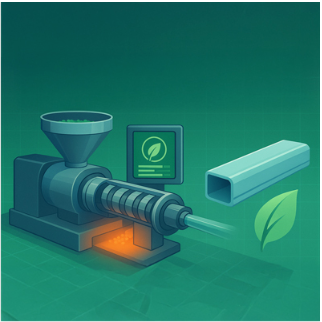
Source: "Data-Driven Leap: The Application of Industry 4.0 and Artificial Intelligence in the Extrusion Field."
The biggest shift in the extrusion industry today is towards data-centric extrusion rather than mechanical processes. The implementation of the Industry 4.0 concept is shaping predictive, adaptive, and self-optimizing intelligent extrusion production lines.
Using AI for process control: In traditional extrusion, human operators monitor the values of melt temperature, pressure, and weight on the motors. The current practice involves analyzing large amounts of data in real-time using artificial intelligence (AI) and machine learning algorithms. These systems can detect hidden patterns indicating faults, such as screen blockages or motor overload, and automatically adjust parameters or alert technicians for preventive maintenance. This not only avoids costly unexpected downtime but also promotes product quality consistency to reduce waste caused by unspecified production.
Advanced Online Monitoring: Laser measurement devices and advanced vision systems can perform 100% inspection of extrusions as they emerge. They are used to measure critical dimensions, identify surface defects (such as gels or voids), and even monitor color consistency with exceptional precision. This real-time feedback loop enables immediate corrections and integrates quality control into the actual manufacturing process rather than leaving it as a post-production checklist. As a result, material waste is significantly reduced while ensuring high-quality products.
Digital Twin: Before a single batch melts, engineers can now convert the entire extrusion production line into a digital twin. This computerized model shows how variations in new materials, screw designs, or process parameters will perform. It also supports rapid prototyping and optimization without disrupting on-site production, saving significant time, effort, and raw materials.
Material Revolution: Crossing the Loop with Sustainable Materials. Process efficiency is crucial, but the real sustainability challenge lies in materials. The next generation of extruders is embracing a new generation of raw materials with minimal environmental impact.
High-performance recycling: The linear take-manufacture-dispose model is being phased out. There is a strong emphasis on recycling post-consumer and post-industrial recycled plastics (PCR/PIR) into high-value products. Advanced filtration and purification systems, such as melt filters and degassing extruders, can extract contaminants and volatiles from the recycling stream, resulting in high-quality recyclates that can compete with virgin materials. This is closed-loop extrusion, which is at the core of the circular economy.
Biobased and biodegradable polymers: Extrusion technology is evolving towards new materials such as polylactic acid (PLA) and polyhydroxyalkanoates (PHA). These are biopolymers made from renewable materials like corn starch or sugarcane, which have different melt flow and thermal properties. The next generation of extruders features mild thermal treatment and specialized screw design to effectively process these delicate materials without damaging them, opening up new markets in compostable packaging and agricultural films.
Additive enhancement functions: Additives are becoming a means to improve material performance. Online masterbatch additives can be precisely compounded to produce products with specific functions. This involves enhancing UV resistance for outdoor use, creating antibacterial surfaces for medical tubing, or adding oxygen scavengers in advanced food packaging to extend shelf life and minimize food waste.
Designing very quickly: hardware design. Physical hardware, which is being pushed to the limits, is also experiencing a revival that surpasses software and materials, with a focus on energy efficiency and precision.
Energy-saving extruder drivers: New types of AC vector drivers and servo drivers have replaced older, less efficient systems. The new drivers provide excellent control over screw speed and torque, significantly reducing power consumption during motor start-up and operation. When this combination is used with high-efficiency gearboxes and motors, the energy savings for the entire plant can be substantial.
High-tech screw and barrel design: The screw is the core of the extruder, redesigned using computational fluid dynamics (CFD). Barrier screws, mixing screws, and wave-dispersing screws have been developed to maximize melting, enhance mixing, and minimize shear heat. This reduces the temperature energy consumed by the melt, decreases thermal degradation, and improves productivity.
The future is pushed out: ahead is a sunken road.
Not only these technologies can define the future of plastic extrusion, but it is the combination of all these trends. We are advancing towards fully automated extrusion plants, where:
The production line using artificial intelligence technology can automatically adjust the formula based on the variability of recycled materials.
Twins are used to simulate the manufacturing process of new biopolymers and send the optimal settings to the actual machines.
This new generation solution directly addresses the biggest issues in the plastic industry. It optimizes manufacturing efficiency and productivity while significantly reducing the environmental footprint. Embracing the spirit of the circular economy, with the use of high-tech recycling and new bio-polymers, extrusion is shedding its reputation as a dirty, wasteful process and is becoming a key driver towards a more environmentally friendly and material-saving future.
This simple extruder is no longer just a machine that melts plastic at a certain temperature. It is now a complex, interconnected, and multifunctional platform that is essential for changing our relationship with plastic materials and creating a world without any waste.
【Copyright and Disclaimer】The above information is collected and organized by PlastMatch. The copyright belongs to the original author. This article is reprinted for the purpose of providing more information, and it does not imply that PlastMatch endorses the views expressed in the article or guarantees its accuracy. If there are any errors in the source attribution or if your legitimate rights have been infringed, please contact us, and we will promptly correct or remove the content. If other media, websites, or individuals use the aforementioned content, they must clearly indicate the original source and origin of the work and assume legal responsibility on their own.
Most Popular
-
Breakthrough! 13.6-million-ton new giant emerges as world’s fourth-largest polyolefin producer, reshaping industry landscape
-
Massive Loss of $960 Million! Wansheng Co., Ltd. Sees Rising Revenue But Declining Profits—Why Did the Phosphorus-Based Flame Retardant Leader Falter?
-

BASF's $8.7 Billion Zhanjiang Site Fully Operational, Covestro, SABIC, Arkema and Other Plastics Giants Double Down on China
-

Deadly Impact: Hormuz Strait Blockade Sparks Shortage of Plastic Raw Materials, Threatening Shutdowns at Japanese and Korean Chemical Plants
-
Domestic PBE Breakthrough, Polyolefin Modification Industry to Break the Impasse