



North China Research Institute Members Stayed At The Plastic Film Production Frontline For 23 Days, Promoting The Application Of “Black And White Dual-Color” Plastic Film
In the vast fields of Baiyang City, Xinjiang, stretches of black-and-white biodegradable mulch film are laid out neatly. Sugar beet seedlings poke their heads through the pre-punched holes in the film, spreading their leaves under its protection and brimming with vitality. On June 9, as Guo Peng, a member of the PBST (polybutylene succinate-co-terephthalate) technical service team at BRICI, watched a video sent by a grower showing the ideal mulching results in the field, he finally felt relieved.
This new type of plastic mulch is made from PBST fully biodegradable material independently developed by the Beijing Institute of Chemical Technology and produced by Hainan Refining & Chemical. It can naturally degrade, fundamentally solving the longstanding agricultural problem of residual traditional mulch and soil pollution from the source, and laying a solid ecological foundation for the development of green agriculture.
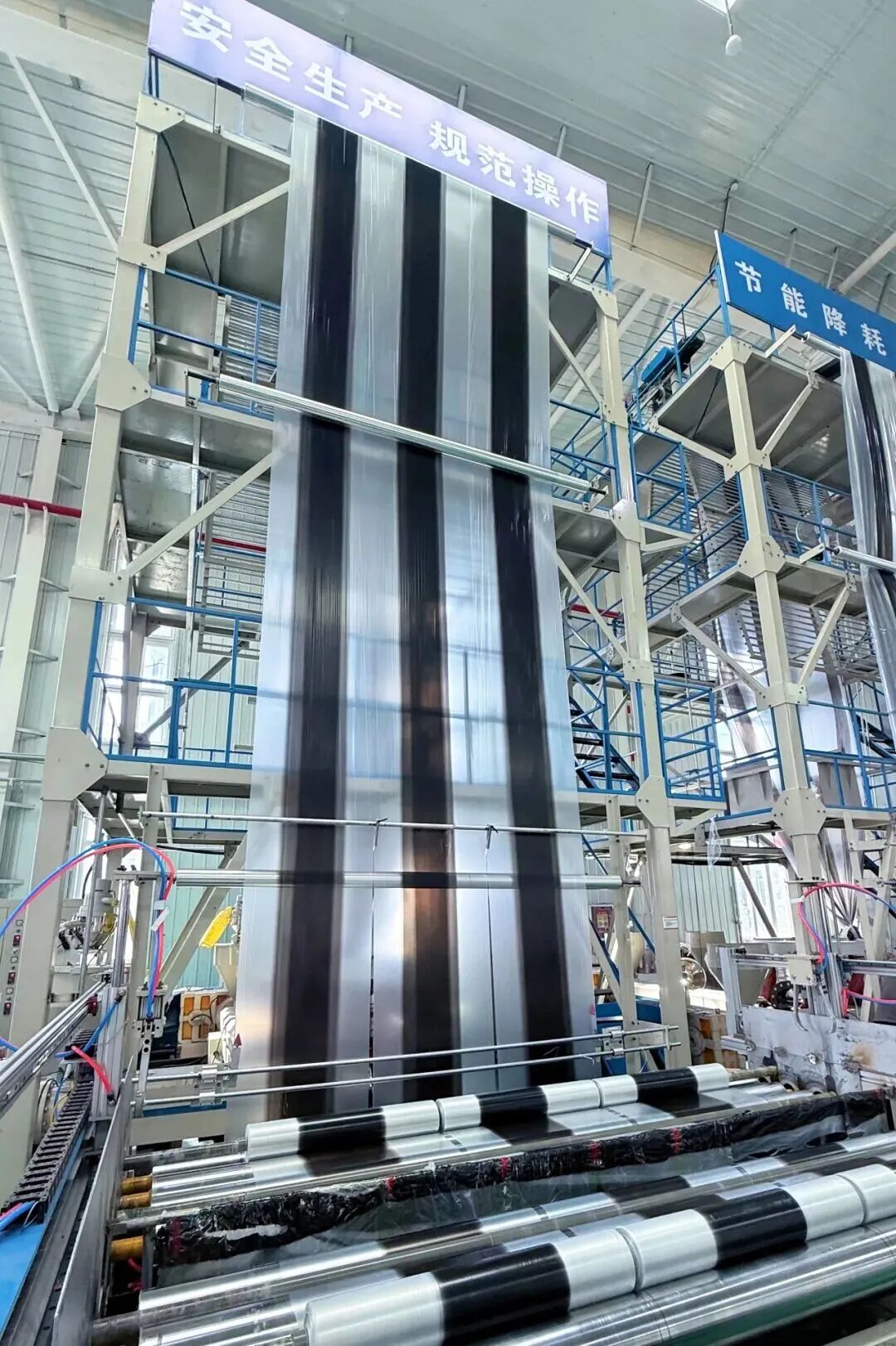
The mulch film adopts an innovative black-and-white dual-color structure, precisely tailored to the local climate, where spring temperatures rise slowly. The black film in the middle suppresses weeds, retains moisture, and reduces manual labor, while the white film on both sides captures heat and raises temperatures, helping increase crop yields. However, this differentiated structural design significantly increases the difficulty of product processing. To overcome the processing challenges of this new mulch film, the PBST technical service team from the Beijing Research Institute of Chemical Industry stayed on the front line of mulch film production for 23 days before spring plowing, repeatedly adjusting process parameters and optimizing the production workflow to achieve continuous and stable mass production, safeguarding agricultural production with professional technical support.
While providing technical services for the film production line, the PBST technical service team visited the fields of sugar beet growers. They carefully examined the flatness and fit of the film while engaging in detailed discussions with farmers and agricultural technicians about their experiences. They verified the film's adaptability in the field, its moisture retention and thermal insulation effects, and closely monitored the compatibility between the film's degradation rate and the sugar beet growth cycle. "The real feedback from the front lines is an important basis for us to optimize our product formulas, which will lay a solid foundation for the subsequent iterative optimization of film material performance and promote the large-scale application of our products," said Guo Peng.

Since the beginning of this year, the Beijing Research Institute of Chemical Industry has fully implemented the plans set out at the Group Company’s work conference, making every effort to advance the critical campaign for integrating science and technology, industry, finance and innovation. Focusing on production pain points, technical bottlenecks and transformation challenges in the chemical industry, the institute has integrated high-quality research resources, established 10 specialized, full-chain and highly efficient technical service teams, and mobilized more than 100 research experts to work on the front lines. It has also put in place a rapid-response service mechanism to promptly address enterprises’ production needs, solve various technical problems related to equipment operation and process optimization, provide integrated sci-tech innovation solutions for partner enterprises, and accelerate the application and commercialization of research achievements.
“Research cannot remain floating in the laboratory; it must take root in industrial sites to identify and solve problems, and its value must ultimately be reflected in industrial performance,” said Du Kai, Manager of the Technology Market Department of the Beijing Research Institute of Chemical Industry (BRICI). Relying on the development of a professional technical service team, BRICI has continuously improved a closed-loop innovation system of “industry demand-driven, precise research breakthroughs, and effective application of results,” promoting research forces to move down to the front line and technical services to reach the site directly. In this way, urgent industrial needs are transformed into targeted research topics, enabling laboratory innovations to be precisely adapted to the realities of industrial production.
【Copyright and Disclaimer】The above information is collected and organized by PlastMatch. The copyright belongs to the original author. This article is reprinted for the purpose of providing more information, and it does not imply that PlastMatch endorses the views expressed in the article or guarantees its accuracy. If there are any errors in the source attribution or if your legitimate rights have been infringed, please contact us, and we will promptly correct or remove the content. If other media, websites, or individuals use the aforementioned content, they must clearly indicate the original source and origin of the work and assume legal responsibility on their own.
Most Popular
-

Layoffs, Divestments, Plant Closures While Pouring Billions: BASF Undergoes Major Transformation!
-

Ascend Adipic Acid Hit By Force Majeure, Market Expects Supply Resumption In Mid-September
-

Raw Material Supply Shortage! INEOS Phenol Declares Force Majeure on Phenol and Acetone Businesses
-
South Korea initiates anti-dumping investigation against Chinese PVC suspension resin! The target is Tianjin Bohua and Wanhua Chemical. How to break through?
-

Sixth national procurement set to be implemented: A “Reshuffling” Moment for the $10-Billion Medical Device Market