



Roll smoothly, resist cracking—toy rollers made with glass fiber reinforced pp
When taking a child to the park, you may notice an interesting phenomenon: whether it’s a wiggle car, a scooter, a tricycle, or a toy suitcase, their wheels all look pretty much the same—sturdy, smooth, and brightly colored. Despite countless rounds of friction and collisions, they still remain intact. Behind this lies a small secret in materials science:Glass fiber reinforced PP material。
Traditional plastics such as ordinary polypropylene (PP) are lightweight, non-toxic, and cost-effective, but they fall short in strength and rigidity. Some engineering plastics offer outstanding performance, but they are expensive, and certain materials also raise concerns regarding environmental impact and safety. Is there a material that can combine safety, non-toxicity, light weight, and durability, while also withstanding intense, high-stress use?
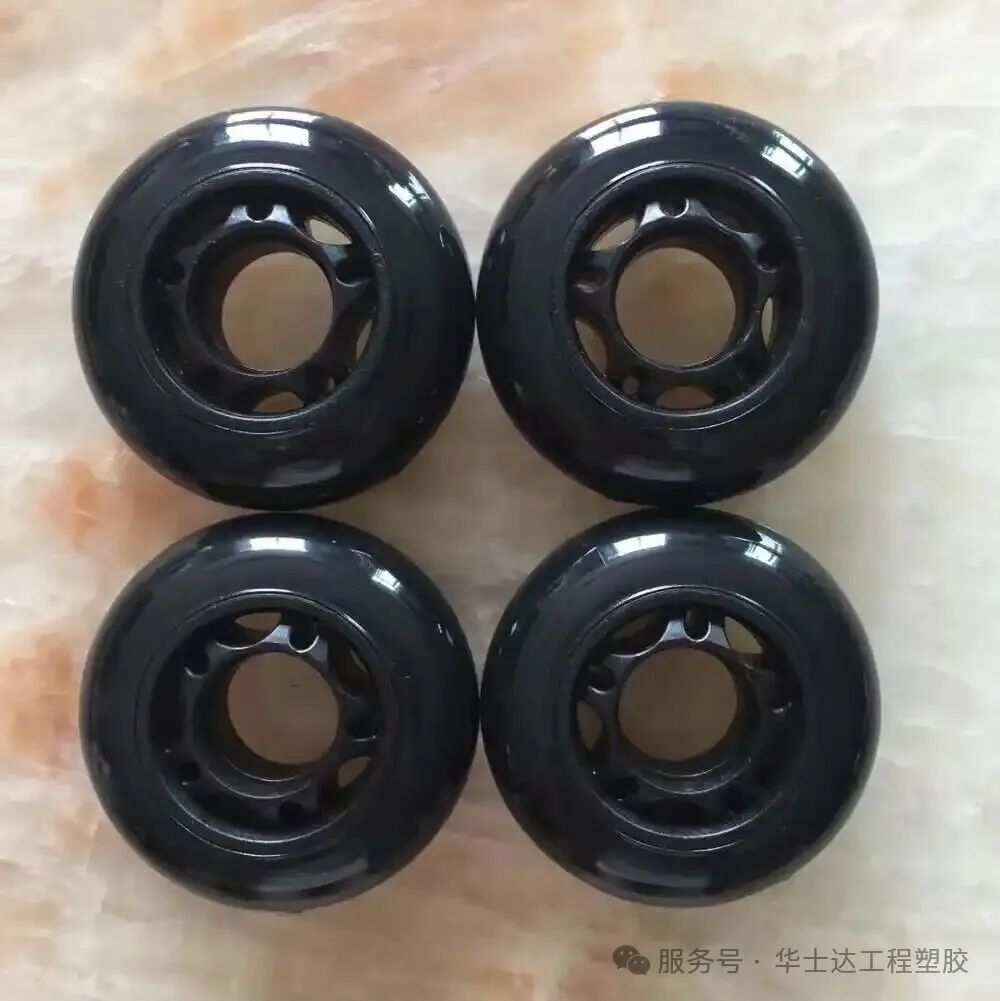
Glass fiber reinforced PP, the answer has been provided.
Glass fiber reinforced PP refers to a composite modification in which glass fibers are incorporated into a polypropylene matrix. You can understand it as being based on the principle of “reinforced concrete” — polypropylene is the “cement,” and glass fibers are the “steel bars.” With their high strength and high modulus, glass fibers are embedded in the polypropylene matrix like a skeleton, making the originally flexible material rigid and strong.
The enhancement of this "internal skill" is comprehensive: the rigidity, impact strength, and heat resistance of the materials have all been significantly improved. When applied to toy rollers, it means that the rollers are less likely to deform under high-speed rotation and repeated impacts, will not soften due to high temperatures while playing outdoors in the scorching summer, and will remain as wear-resistant as new even after rolling on rough surfaces for years.
More importantly, it’s reassuringly rigid.
For children’s products, safety always comes first. Glass fiber reinforced PP material is non-toxic and harmless, and complies with stringent environmental and safety regulations. Unlike some engineering plastics that may contain controversial additives, it has a natural advantage in the field of children’s toys.
From industrial components to children's toys, a “dimensionality reduction” empowerment of materials
Glass fiber reinforced PP materials were initially widely used in industrial fields with extremely high requirements for strength and durability, such as automotive parts and electrical components. Today, this technology has been “brought down” to the field of children’s toys, using industrial-grade quality to safeguard every slide and run children take.
【Copyright and Disclaimer】The above information is collected and organized by PlastMatch. The copyright belongs to the original author. This article is reprinted for the purpose of providing more information, and it does not imply that PlastMatch endorses the views expressed in the article or guarantees its accuracy. If there are any errors in the source attribution or if your legitimate rights have been infringed, please contact us, and we will promptly correct or remove the content. If other media, websites, or individuals use the aforementioned content, they must clearly indicate the original source and origin of the work and assume legal responsibility on their own.
Most Popular
-

Layoffs, Divestments, Plant Closures While Pouring Billions: BASF Undergoes Major Transformation!
-
Ascend Adipic Acid Hit By Force Majeure, Market Expects Supply Resumption In Mid-September
-

Raw Material Supply Shortage! INEOS Phenol Declares Force Majeure on Phenol and Acetone Businesses
-
South Korea initiates anti-dumping investigation against Chinese PVC suspension resin! The target is Tianjin Bohua and Wanhua Chemical. How to break through?
-

Sixth national procurement set to be implemented: A “Reshuffling” Moment for the $10-Billion Medical Device Market