



Performance Comparison of Wireless Charging in 10 Car Models
With the continuous advancement of automotive technology, the mobile phone wireless charging function has gradually become widespread in cars, ranging from luxury cars worth millions to entry-level models priced at around one hundred thousand yuan, most of which are equipped with this feature. Compared to the traditional wired charging method, the greatest advantage of in-car wireless charging is its high compatibility rate, as all phones supporting the Qi wireless charging protocol can be charged. This means drivers no longer need to carry various charging cables when going out, effectively avoiding a cluttered situation inside the car. However, does the actual performance of the wireless charging function remain consistent across different brands and models at varying price points? In this test, we will evaluate the wireless charging performance of 10 popular car models released within the past year, covering domestic, joint-venture, and imported brands, to find the answer through comparative test results.
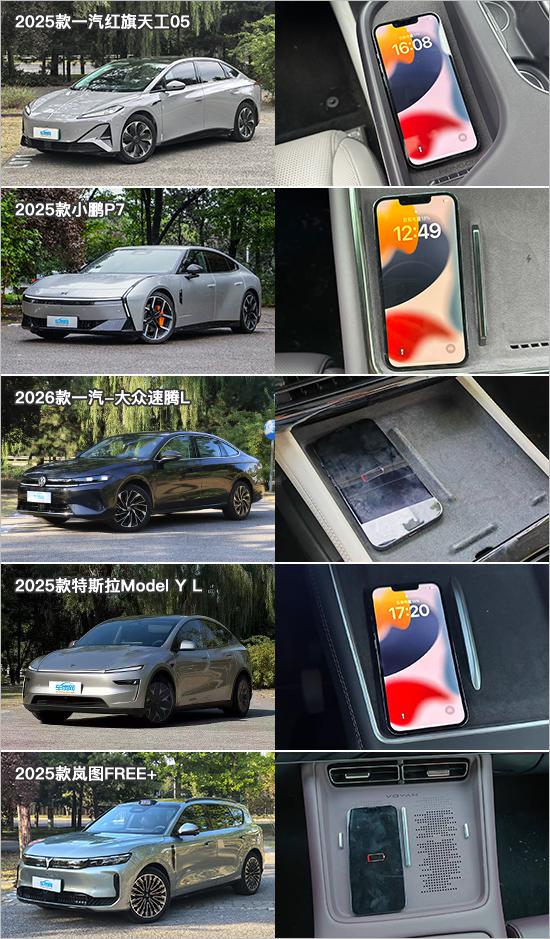

I. Testing Equipment and Process
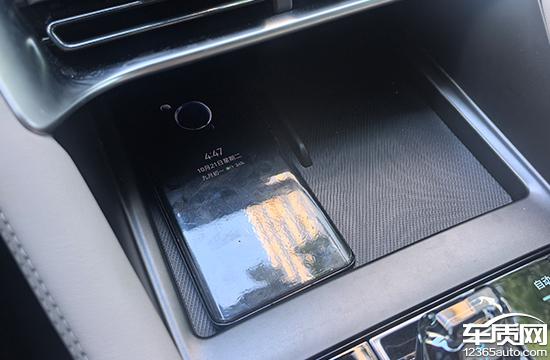
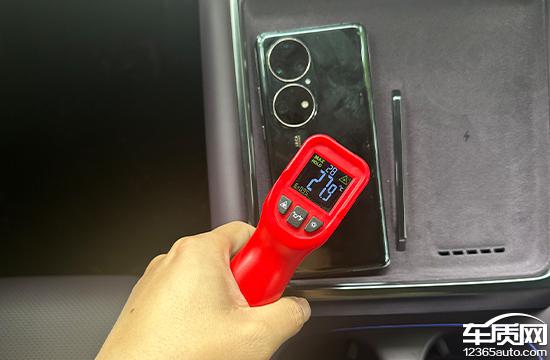
To simulate a real usage environment, we use two fixed test phones: the Apple iPhone 13 Pro and Huawei P50 Pro. The temperature inside the car is set between 25-30°C. During the test, the phones' batteries are first depleted, ensuring the initial temperature of the phones matches the ambient temperature inside the car. Then, they are placed on the vehicle's wireless charging pad for 15 minutes to test their charging efficiency. After charging, the amount of charge is checked and recorded, and an infrared thermometer is used to measure the back of the phones to test the heat generation.
2. Test Results Analysis
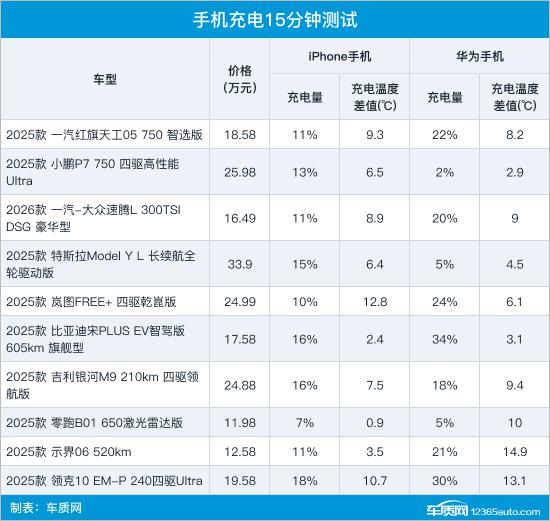
iPhone charging 15-minute test
In the charging test for the iPhone 13 Pro, except for the Leapmotor B01 and Lantu FREE+, all other models achieved more than 10% charge within 15 minutes. Among them, the Lynk & Co 10 EM-P had the highest charging efficiency, reaching 18%. In contrast, the Leapmotor B01 was not very friendly to wireless charging for iPhone phones, with only a 7% charge after 15 minutes, indicating lower charging efficiency.
After 15 minutes of charging, in terms of body heat generation, because the charging efficiency of Leapmotor B01 is relatively low, the temperature difference before and after charging is only 0.9 ℃. On the other hand, the performance of Lantu FREE+ in this test is average, with a temperature difference of 12.8 ℃ before and after charging, resulting in a hot sensation to the touch.
Overall, in the 15-minute charging test for iPhone, the BYD Song PLUS EV performed the best, ensuring efficient charging while the temperature difference was only 2.4°C. The Tesla Model Y L and Geely Galaxy M9 also performed well, with good charging efficiency and temperature differences within an acceptable range.
Huawei phone 15-minute charging test
In the charging test for the Huawei P50 Pro, the BYD Song PLUS EV stood out, achieving a charging rate of 34% within 15 minutes. Meanwhile, the Lynk & Co 10 EM-P also performed commendably with a charging rate of 30%. However, the XPeng P7 ranked last in this test, with a charging rate of only 2% in 15 minutes.
The temperature control of the Xpeng P7 during charging is excellent, with a temperature difference of only 2.9°C between before and after charging, which is closely related to its low charging efficiency. In this test, the Shijie 06 performed moderately, with a temperature difference of 14.9°C between before and after charging.
Overall, in the 15-minute charging test with Huawei phones, the BYD Song PLUS EV once again performed the best, with commendable charging efficiency and temperature control. The Voyah FREE+ also performed well, with both charging efficiency and temperature control being quite impressive.
3. Mobile phone wireless charging function
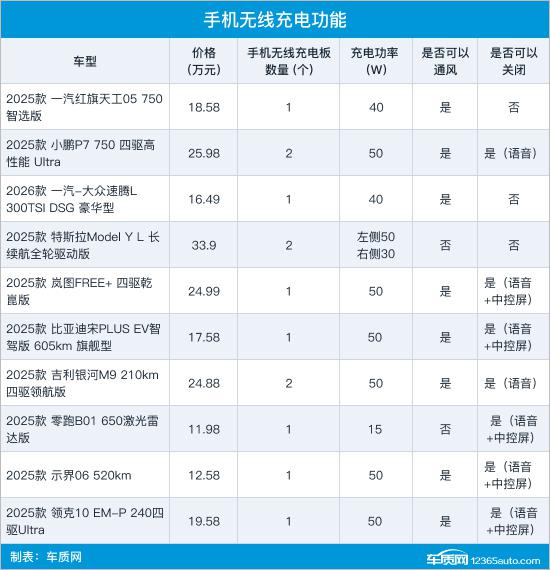
Through a comparison of wireless phone charging features across 10 car models, it can be found that the XPeng P7, Tesla Model Y L, and Geely Galaxy M9 are all equipped with two wireless charging pads. However, the Tesla Model Y L does not offer ventilation and cooling features, indicating room for improvement compared to the other two models. Additionally, the wireless phone charging function of the FAW Hongqi Tiangong 05, FAW-Volkswagen Sagitar L, and Tesla Model Y L cannot be turned off, whereas the Voyah FREE+, BYD Song PLUS EV, Leapmotor B01, Shijie 06, and Lynk & Co 10 EM-P all support two ways of turning off the function, showing better practicality.
Summary:
Among the 10 models tested this time, the BYD Song PLUS EV's overall performance is leading, with high charging efficiency for iPhone and Huawei phones, reasonable control of phone heating, and support for turning off wireless charging via the central control screen and voice commands. However, it only comes with one wireless charging pad, which is its only drawback. The performance of the Lynk & Co 10 EM-P is also commendable, but the control of phone charging heat needs to be optimized. In contrast, the Leapmotor B01's overall performance is average due to the low power of its wireless charging pad, resulting in low charging efficiency for both phones, leaving significant room for improvement.
【Copyright and Disclaimer】This article is the property of PlastMatch. For business cooperation, media interviews, article reprints, or suggestions, please call the PlastMatch customer service hotline at +86-18030158354 or via email at service@zhuansushijie.com. The information and data provided by PlastMatch are for reference only and do not constitute direct advice for client decision-making. Any decisions made by clients based on such information and data, and all resulting direct or indirect losses and legal consequences, shall be borne by the clients themselves and are unrelated to PlastMatch. Unauthorized reprinting is strictly prohibited.
Most Popular
-
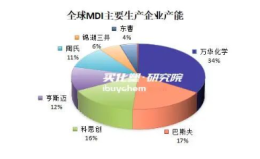
Dow, Wanhua, Huntsman Intensively Raise Prices! Who Controls the Global MDI Prices?
-

Clariant Unveils Cost-Cutting Plan Details, Plans to Shut Down Multiple Plants
-
[Today's Plastics Market] General Materials Weakly Fluctuate, Engineering Materials Steadily Rise
-
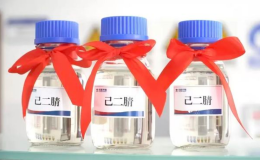
New Breakthrough in Domestic Adiponitrile! Observing the Rise of China's Nylon Industry Chain from Tianchen Qixiang's Production
-
Daily Review: Polyethylene Prices Under Weak Consolidation, Sellers Face Significant Pressure to Move Inventory