



State council tariff commission: China Adjusts Some Commodity Tariff Rates Starting January 1, 2026
Introduction: ① The Customs Tariff Commission of the State Council released the "2026 Tariff Adjustment Plan," which will be implemented starting January 1, 2026. ② The plan adjusts the provisional import tax rates, applying provisional import tax rates lower than the most-favored-nation rates to 935 items, cancels the provisional import tax rates for certain goods, and restores the implementation of the most-favored-nation rates.
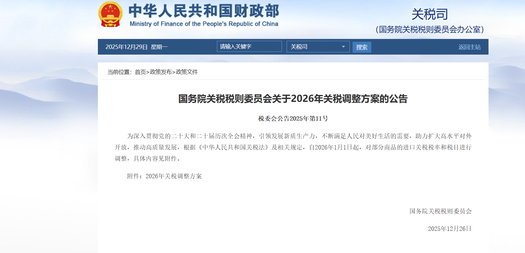
On December 29, according to the Ministry of Finance's website, the Tariff Commission of the State Council released the "2026 Tariff Adjustment Plan" (hereinafter referred to as the "Plan"), which will be implemented starting January 1, 2026. The Plan is guided by Xi Jinping's Thought on Socialism with Chinese Characteristics for a New Era, thoroughly implements the spirit of the 20th National Congress of the Communist Party of China and subsequent plenary sessions, fully and accurately embraces the new development philosophy, accelerates the construction of a new development pattern, adheres to the general principle of seeking progress while maintaining stability, scientifically adjusts the provisional import tariff rates, optimizes the tariff item settings, continues to implement preferential and special tariff rates, which is beneficial for leading the development of new productive forces, meeting the people’s growing demand for a better life, expanding high-level opening up, and promoting high-quality development.
To enhance the synergistic effects of domestic and international markets and resources, and to expand the supply of high-quality goods, a provisional import tariff lower than the Most Favored Nation (MFN) rate will be implemented for 935 items in 2026. First, this aims to promote high-level technological self-reliance and strength, facilitate the construction of a modern industrial system, and reduce import tariffs on key components such as CNC hydraulic cushions for presses and specially-shaped composite connectors. Second, it supports the comprehensive green transformation of economic and social development by lowering import tariffs on resource-based products such as regenerated black powder for lithium-ion batteries and unroasted pyrite. Third, it increases efforts to guarantee and improve people's livelihoods, aiding in the acceleration of building a Healthy China by reducing import tariffs on medical products such as artificial blood vessels and certain diagnostic kits for infectious diseases. Additionally, to enhance the endogenous momentum of the domestic circulation, provisional import tariffs on items like micro motors, printing machines, and sulfuric acid will be canceled based on changes in domestic industrial development and supply-demand conditions, reverting to the implementation of the MFN rate within the scope of commitments made upon China's accession to the World Trade Organization.
In order to serve technological development and progress, support the development of the circular economy and the under-forest economy, the addition of domestic items such as intelligent bionic robots, bio-aviation kerosene, and under-forest ginseng will be included in 2026. After the adjustments, the total number of tariff items will be 8,972.
To continuously deepen economic and trade cooperation and promote regional integration and development, in 2026, according to the 24 free trade agreements and preferential trade arrangements signed with 34 trade partners, we will continue to apply the agreed tariff rates to certain imported goods originating from these trade partners.
To promote economic and trade cooperation with the least developed countries and assist in their development, in 2026, we will continue to grant zero-tariff treatment for 100% of tariff lines to 43 least developed countries that have established diplomatic relations with us. According to the Asia-Pacific Trade Agreement and the intergovernmental exchange of letters agreements between us and relevant ASEAN member countries, we will continue to implement preferential tax rates on certain imported goods originating from Bangladesh, Laos, Cambodia, and Myanmar.
2026 Tariff Adjustment Plan
1. Temporary Import Tax Rate
Implement provisional import tariffs on 935 items (excluding tariff quota goods).
II. Tariff Quota Rates
Continue to implement tariff quota management on eight types of imported commodities, including wheat, with unchanged tax rates. Among them, the quota tax rate for three types of fertilizers—urea, compound fertilizers, and diammonium phosphate—will continue to have a provisional import tax rate of 1%. A sliding tax rate will continue to apply to a certain quantity of out-of-quota imported cotton in the form of a provisional import tax rate.
III. Export Tariff Rates
Continue to impose export tariffs on 107 items, with provisional export tax rates applied to 68 of these items.
4. Tax Items and Annotations
对部分税目、本国子目注释进行调整。调整后,本国子目8972项,本国子目注释201条。
V. Agreement Tariff
Continue to apply the agreed tariff rates to certain imports originating from the above-mentioned trade partners, based on the 24 free trade agreements and preferential trade arrangements signed and in effect with 34 trade partners. First, implement further tariff reductions according to the contents of relevant agreements. Further tariff reductions will be carried out under the free trade agreements between China and New Zealand, Peru, Switzerland, South Korea, Australia, Pakistan, Mauritius, Cambodia, Nicaragua, Ecuador, Serbia, the Maldives, and the Regional Comprehensive Economic Partnership (RCEP). Second, for imports that have already completed tariff reductions, continue to implement the corresponding agreed tariff rates. The free trade agreements between China and ASEAN, Chile, Singapore, Georgia, Iceland, and Costa Rica, the early harvest arrangement of the China-Honduras Free Trade Agreement, the Closer Economic Partnership Arrangement (CEPA) between Mainland China and Hong Kong and Macau, the Cross-Strait Economic Cooperation Framework Agreement (ECFA), and the Asia-Pacific Trade Agreement will continue to be implemented as stipulated.
VI. Preferential Tax Rate
(一)继续给予43个与我建交的最不发达国家100%税目产品零关税待遇,实施特惠税率。其中,关税配额商品仅将配额内关税税率降为零,配额外关税税率不变。
(2) According to the Asia-Pacific Trade Agreement and the exchange of letters agreements between our government and the governments of relevant ASEAN member countries, preferential tariff rates will continue to be applied to certain imported goods originating from Bangladesh, Laos, Cambodia, and Myanmar.
The above plan will be implemented starting from January 1, 2026.
【Copyright and Disclaimer】The above information is collected and organized by PlastMatch. The copyright belongs to the original author. This article is reprinted for the purpose of providing more information, and it does not imply that PlastMatch endorses the views expressed in the article or guarantees its accuracy. If there are any errors in the source attribution or if your legitimate rights have been infringed, please contact us, and we will promptly correct or remove the content. If other media, websites, or individuals use the aforementioned content, they must clearly indicate the original source and origin of the work and assume legal responsibility on their own.
Most Popular
-

Key Players: The 10 Most Critical Publicly Listed Companies in Solid-State Battery Raw Materials
-
Vioneo Abandons €1.5 Billion Antwerp Project, First Commercial Green Polyolefin Plant Relocates to China
-
EU Changes ELV Regulation Again: Recycled Plastic Content Dispute and Exclusion of Bio-Based Plastics
-
Clariant's CATOFIN™ Catalyst and CLARITY™ Platform Drive Dual-Engine Performance
-

List Released! Mexico Announces 50% Tariff On 1,371 China Product Categories