



Window of Easing in China-U.S. Trade Relations: Opportunity for Recovery in China's PVC Glove Exports
Introduction:According to the latest official news and authoritative media reports, the China-U.S. summit held on October 30, 2025, in Busan, South Korea, and the China-U.S. economic and trade consultations in Kuala Lumpur, Malaysia, achieved several substantial results in the fields of tariffs and trade, bringing positive signals for bilateral economic and trade relations.
I. Interpretation of the Latest Tariff and Trade Policies
The 24% "reciprocal tariffs" will be suspended for one year: The 24% "reciprocal tariffs" imposed by the United States on Chinese goods will continue to be suspended for one year. China will make corresponding adjustments to its countermeasures: In response to the aforementioned adjustments by the U.S., China will also make corresponding adjustments to its counter-tariff measures.
The U.S. side suspends the 301 investigation: The implementation of the "301 investigation" measures on China's maritime, logistics, and shipbuilding industries is suspended for one year. China suspends corresponding countermeasures: After the U.S. suspension, China will also suspend its countermeasures related to this matter for one year.
The U.S. side's suspension of the 24% "reciprocal tariff" has significantly reduced the cost pressure on Chinese export enterprises, helping to restore the price competitiveness of Chinese products in the international market. For example, in the PVC glove industry, the minimum export price had previously dropped to below $7.5 per box due to tariff impacts, resulting in widespread losses for companies. After the tariff reduction, prices have rebounded to a range of $7.8 to $8.5 per box, leading to a noticeable improvement in profit margins for enterprises. Meanwhile, China's suspension of the additional 24% tariff on U.S. goods has also lowered the cost of imported raw materials needed for PVC glove production, further alleviating operational pressures on companies.
In addition, the increased port charges policy poses certain challenges to the export of PVC gloves. As a commodity with relatively low value and highly sensitive to logistics costs, the increase in port charges will directly drive up export costs, squeezing corporate profits. Currently, China accounts for over 90% of the global supply of PVC gloves, and the increased port charges may indirectly transmit to product prices, putting pressure on companies to secure orders. However, in recent years, large domestic glove companies have continuously optimized cost control, significantly enhancing their risk response and negotiation capabilities, making the impact relatively manageable. In contrast, small and medium-sized enterprises, with limited ability to transfer costs and narrow profit margins, will face more severe operational challenges.
Overall, the recent talks between China and the United States have resulted in a series of reciprocal and mutually beneficial arrangements. Through adjustments to tariffs, a pause in export controls, and the suspension of trade investigations, the bilateral economic and trade tensions have significantly eased in the short term, injecting more certainty into the economies of both countries and even the global economy. It is worth noting that most trade measures have set a suspension or implementation period of one year, so the long-term stability of China-U.S. relations still requires observation of subsequent negotiations and interactions.
II. Analysis of China's Export Quantity of PVC Gloves to the United States
|
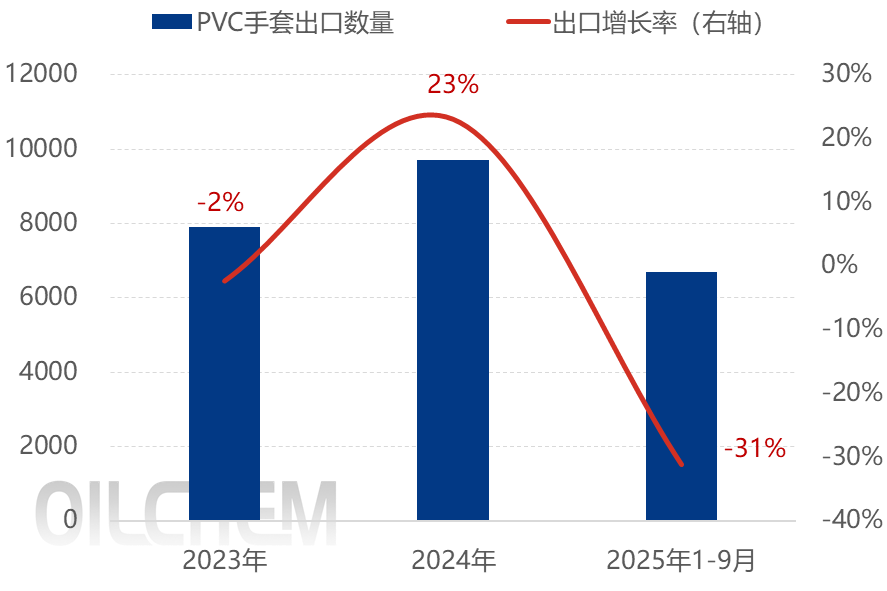
Figure 1 Annual Export Volume and Growth Trend of PVC Gloves from 2023 to 2025 (10,000 boxes) |
Figure 2 Annual Export Volume and Growth Trend of PVC Gloves to the United States (10,000 boxes) from 2023 to 2025 |
 |
 |
|
Data source: Customs data.Longzhong Information |
Data source: Customs data.Longzhong Information |
Since 2023, as the impact of the pandemic gradually subsides, the global PVC glove market has entered a stable development phase, and China's export volume to the US has also gradually returned to a rational level. Despite the cyclical decline in global demand causing China's total PVC glove exports in 2023 to decrease compared to 2022, the US market has continued to show strong resilience, accounting for 49% of China's total exports, firmly remaining China's largest export market for PVC gloves.
In 2024, China's PVC glove exports have shown a comprehensive recovery trend. On one hand, the acceleration of global industrialization and the enhanced safety awareness across various industries have led to a continued increase in demand for protective gloves in sectors like healthcare, food processing, and manufacturing. On the other hand, previous overseas inventories have been reduced to relatively low levels, creating a strong rigid replenishment demand in the market. Additionally, improvements in external conditions such as decreased ocean freight rates and enhanced shipping efficiency have lowered export costs, while adjustments in U.S. tariff policies have prompted overseas customers to increase their purchasing efforts. Driven by multiple favorable factors, China's PVC glove exports significantly grew in the second half of 2024, with annual export volumes reaching 97.15 million boxes, a year-on-year increase of 23%, approaching the peak levels during the pandemic in 2021. Exports to the U.S. accounted for 47%, demonstrating a robust recovery in market demand.
Table of PVC Glove Export Data from January to September 2025 (Unit: Ten Thousand Boxes)
|
Trade Partner Name |
Export Quantity |
Proportion |
|
United States |
2855.2 |
43% |
|
Japan |
1052.4 |
16% |
|
Saudi Arabia |
395.2 |
6% |
|
Russia |
240.7 |
4% |
|
United Kingdom |
240.2 |
4% |
|
Canada |
224.1 |
3% |
|
UAE |
194.6 |
3% |
|
Australia |
185.6 |
3% |
|
France |
141.7 |
2% |
|
Brazil |
117.7 |
2% |
|
Other |
1033.4 |
15% |
|
Total |
6680.9 |
|
|
Data Source: General Administration of Customs, Longzhong Information |
||
In 2025, influenced by changes in tariff policies and fluctuations in global demand, China's PVC glove export market presents a complex situation with distinct phases: In January and February, exports remained at a high level driven by pre-holiday concentrated shipments and overseas restocking. After March, the "Fentanyl Tariff" and "Reciprocal Tariff" policies implemented by the United States increased procurement costs, leading to more price suppression in the market, squeezing profit margins for companies, and gradually reducing the share of exports to the US. By September, the share of the US market had dropped to 43%, and the total national export volume of PVC gloves from January to September was 66.809 million boxes, showing a year-on-year decline.
3. The Impact of Tariff Negotiations on PVC Glove Exports
On October 30, 2025, the tariff adjustment agreement reached during the China-U.S. meeting in Busan had a direct and profound impact on China's PVC glove export industry. As the world's largest producer of PVC gloves, China exports approximately 90% of its production, with the United States serving as a key demand market, sourcing 47% of its PVC glove imports from China. This adjustment in tariff policy is reshaping the development landscape of this industry.
The tariff adjustments have already yielded positive effects, as seen from the market response. U.S. buyers, driven by rigid demand, have begun to resume and increase their purchasing efforts. Domestic PVC glove manufacturers have also accordingly raised their production line capacity, and current production capacity has returned to normal levels. It is expected that by the end of 2025 to the beginning of 2026, the monthly export volume will rebound to 7.8-8.2 million boxes, approaching the normal levels of 2024.
However, the suspension of tariffs this time is only for one year, and in the long term, the industry still faces uncertainties. Chinese companies are mitigating risks through diversified strategies, including actively expanding into non-U.S. markets such as Europe, Japan, and countries along the "Belt and Road," while optimizing product structures to enhance risk resistance. The stability of PVC glove exports will be determined by the subsequent negotiations and interactions in China-U.S. relations, but the current policy relaxation undoubtedly injects certainty into the industry's recovery.
【Copyright and Disclaimer】The above information is collected and organized by PlastMatch. The copyright belongs to the original author. This article is reprinted for the purpose of providing more information, and it does not imply that PlastMatch endorses the views expressed in the article or guarantees its accuracy. If there are any errors in the source attribution or if your legitimate rights have been infringed, please contact us, and we will promptly correct or remove the content. If other media, websites, or individuals use the aforementioned content, they must clearly indicate the original source and origin of the work and assume legal responsibility on their own.
Most Popular
-
Dow, Wanhua, Huntsman Intensively Raise Prices! Who Controls the Global MDI Prices?
-

Clariant Unveils Cost-Cutting Plan Details, Plans to Shut Down Multiple Plants
-
[Today's Plastics Market] General Materials Weakly Fluctuate, Engineering Materials Steadily Rise
-

New Breakthrough in Domestic Adiponitrile! Observing the Rise of China's Nylon Industry Chain from Tianchen Qixiang's Production
-

Daily Review: Polyethylene Prices Under Weak Consolidation, Sellers Face Significant Pressure to Move Inventory