



World's first 50,000-ton unit successfully put into operation! subsequent 470,000-ton capacity ready to launch
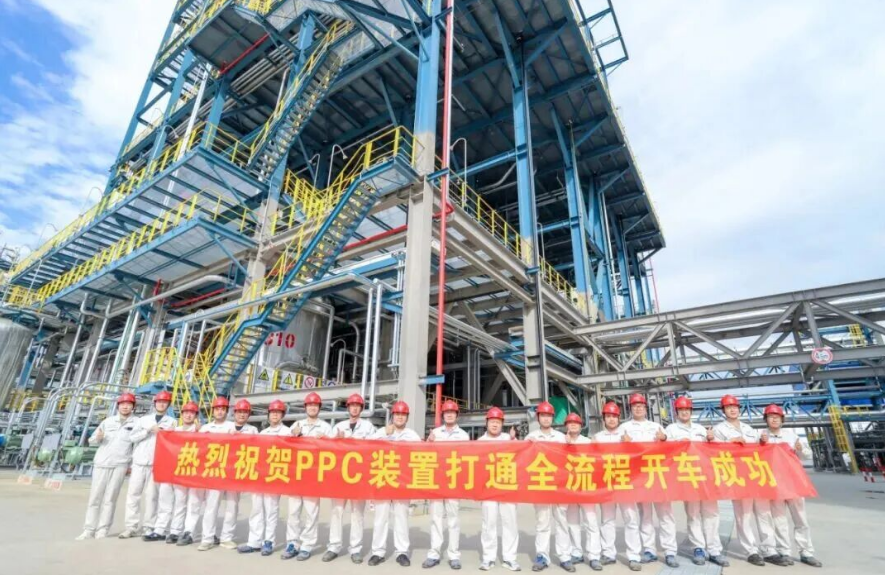
On May 29, Hui Zheng Information reported that Lianhong New Science and Technology has reached a key industrial milestone. Its integrated project for Lianhong Gelun New Energy Materials and Biodegradable Materials has achieved significant results, with the world's first 50,000-ton carbon dioxide-based polycarbonate (PPC) industrialization facility successfully completing the entire production process, starting up and producing qualified products in one go. The successful implementation of this facility fills the technological and industrial gap in the global industrialization of 50,000-ton PPC production, marking China's advancement in carbon dioxide resource utilization and the industrialization technology of biodegradable materials to the world's leading tier. This injects strong momentum into the high-quality development of the domestic green new materials industry and the realization of the "dual carbon" goals.
Turning Waste into Treasure with Multiple Advantages: New Eco-Friendly Materials Empower Diverse Applications
PPC is an innovative biodegradable polymer material that relies on carbon dioxide as a key feedstock and is hailed as a “star” environmentally friendly material in the “dual carbon” field. Its production principle is the copolymerization of carbon dioxide and propylene oxide under the action of a dedicated catalyst, enabling direct consumption of carbon dioxide from industrial exhaust gases and realizing the resource utilization of greenhouse gases, with outstanding carbon sequestration and emission reduction value. The facility commissioned by Levima New Materials this time is built on a proprietary process jointly developed by the company and its partners. Its core raw materials, propylene oxide and carbon dioxide, are both produced in-house, forming a closed-loop green production model that perfectly balances ecological and environmental benefits with industrial and economic benefits.
From the perspective of material performance, PPC has prominent comprehensive advantages and is suitable for multiple green application scenarios. The main chain of the material contains a large number of ester groups, which can be completely decomposed by microorganisms in the natural environment, ultimately generating water and carbon dioxide, achieving 100% complete biodegradation and addressing the problem of plastic "white pollution" from the source. At the same time, this material exhibits excellent balance between rigidity and toughness, strong gas barrier properties, high transparency, and outstanding moisture retention capabilities. Its flexibility is exceptional, with a breaking elongation rate of up to 600%-700%, making it an ideal material for disposable eco-friendly films, agricultural moisture-retaining films, and green food packaging. Furthermore, PPC has potential application value in the biomedical field, where it can be used as a drug release carrier and in orthopedic medical materials, offering vast opportunities for segmentation and expansion.
The industry landscape is clear, with opportunities and challenges coexisting in the sector.
From the perspective of industry technology barriers, the core competitiveness of the PPC industry lies in the catalyst system. The activity and selectivity of the catalyst directly determine the product’s molecular weight, carbon dioxide fixation rate, and production cost, making the technical threshold extremely high. At present, only a few domestic institutions, such as the Changchun Institute of Applied Chemistry of the Chinese Academy of Sciences and Guangdong University of Technology, have mastered independently patented catalyst technologies. Leveraging collaborative innovation between industry, academia, and research, Levima Advanced Materials has mastered a new-generation core catalytic process, giving it a significant technological leadership advantage.
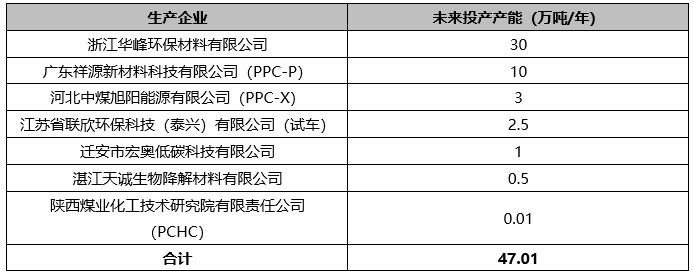
In terms of production capacity structure, following the commissioning of Union New Materials’ 50,000-ton/year PPC unit, China’s total domestic PPC capacity has reached 132,000 tons. Other major producers include Jilin Boda Dongfang (50,000 tons/year), Jiangsu Zhongke Jinlong (22,000 tons/year), and Zhejiang Huafeng (10,000 tons/year), among others. Meanwhile, the industry is expanding rapidly. According to data from the Buychem Plastics Research Institute, the domestic PPC capacity planned to come online in the future amounts to 470,100 tons, indicating a clear trend toward large-scale industrial development.
From the demand side, the current PPC industry is still in the market introduction and cultivation stage, and is a typical technology-driven niche specialty materials segment. At present, this material has not yet become a mainstream base material for finished products; instead, it is mainly used as a modifying additive to optimize the performance of biodegradable materials such as PLA and PBAT. Its core application scenario is concentrated in the biodegradable agricultural mulch film field, while large-scale adoption in high-value-added applications such as medical uses has yet to materialize, resulting in relatively limited market demand. At the same time, the material’s own performance shortcomings and relatively high production costs are also key factors constraining the industry’s rapid penetration.
Looking to the Future: Deepening Technological Iteration and Expanding New Paths in the Green Industry
Overall, PPC, with its unique carbon dioxide sequestration property and fully biodegradable advantages, has irreplaceable ecological value and broad long-term development potential. In the short term, it faces both opportunities and challenges. Going forward, improved industrial chain support, upgraded modification technologies, and the release of policy dividends under the dual-carbon agenda will become the core drivers promoting the large-scale commercialization of the PPC industry.
Based on a new industrialization starting point, Lianhong Xinke will continue to adhere to the development path of greening, high-end, differentiation, and refinement. On one hand, it will continuously optimize the operating conditions of the PPC unit, iterating and upgrading core processes and modification technologies to address material performance shortcomings. On the other hand, it will actively expand product application scenarios, deeply exploring high-value-added niche markets such as agricultural, packaging, and biomedicine. At the same time, the company will continue to deepen its focus on the green new materials sector, accelerating technological innovation and the transformation of achievements, relying on core industrial results to support the implementation of the national "dual carbon" goals, and continuously empowering the high-quality development of the domestic green low-carbon industry.
【Copyright and Disclaimer】The above information is collected and organized by PlastMatch. The copyright belongs to the original author. This article is reprinted for the purpose of providing more information, and it does not imply that PlastMatch endorses the views expressed in the article or guarantees its accuracy. If there are any errors in the source attribution or if your legitimate rights have been infringed, please contact us, and we will promptly correct or remove the content. If other media, websites, or individuals use the aforementioned content, they must clearly indicate the original source and origin of the work and assume legal responsibility on their own.
Most Popular
-

Layoffs, Divestments, Plant Closures While Pouring Billions: BASF Undergoes Major Transformation!
-
Ascend Adipic Acid Hit By Force Majeure, Market Expects Supply Resumption In Mid-September
-

Raw Material Supply Shortage! INEOS Phenol Declares Force Majeure on Phenol and Acetone Businesses
-
South Korea initiates anti-dumping investigation against Chinese PVC suspension resin! The target is Tianjin Bohua and Wanhua Chemical. How to break through?
-

Sixth national procurement set to be implemented: A “Reshuffling” Moment for the $10-Billion Medical Device Market