



Xiaomi Loses Car Lawsuit!
The People's Court of Meilan District, Haikou City, Hainan Province, recently issued a first-instance judgment on a deposit dispute case involving the purchase of a Xiaomi car. The court ruled that the standard clause in Xiaomi's "Purchase Agreement," which required payment of the balance within seven days without inspection of the car, otherwise the deposit would be forfeited, is invalid. The court ordered the relevant Xiaomi company to return double the deposit to the consumer, totaling 10,000 yuan.

The first-instance judgment of the Xiaomi Automotive unpaid final payment collection case has been pronounced.
This first nationwide judicial case regarding Xiaomi's "demand for final payment before car delivery" has established a clear legal boundary for the rapidly developing automotive sales industry, particularly the new "order before production" model.
National First Case: The Origin and Outcome of the Xiaomi Deposit Compensation Case
In July 2024, Ms. Li from Hainan ordered a Xiaomi SU7 Max through the Xiaomi Auto APP after a test drive and paid a deposit of 5,000 yuan. Due to financial arrangements, Ms. Li wishes to delay the car delivery. After consultation with Xiaomi staff, both parties confirmed that the order is valid for 360 days, during which she can apply for production scheduling at any time.
On December 4, 2024, a sudden notification from the sales department required Ms. Li to pay the outstanding balance of over 310,000 yuan within seven days. They stated that if the payment was overdue, not only would the order be canceled, but the 5,000 yuan deposit would also be non-refundable. Ms. Li objected, arguing that it was unreasonable to pay the full amount without having seen or inspected the vehicle. After failed negotiations, Xiaomi canceled the order and confiscated the deposit, citing Ms. Li's breach of contract. Ms. Li considered this an "unfair clause" by Xiaomi Auto and could not accept it. She took Xiaomi to court to demand a refund of the deposit and submitted relevant evidence of Xiaomi's breach of contract, also seeking compensation from Xiaomi. After nearly a year of legal battles, the judgment was finally delivered. This is believed to be the first nationwide ruling on a Xiaomi Auto case regarding the demand for final payment before vehicle delivery.
Since August this year, many owners of YU7, SU7, and SU7 Ultra vehicles across the country have been asked to pay the balance within 7 days even though the vehicles have not been delivered.
The reporter contacted the relevant department of Xiaomi Auto to inquire whether Xiaomi Auto would choose to continue appealing in the case of being ordered to double the refund of the deposit, or whether it would pay the consumer compensation during the execution period. Additionally, the reporter asked about Xiaomi Auto's current policy regarding the balance payment. As of the time of publication, there has been no official response from Xiaomi Auto.
The court judgment: Standard clauses are invalid, promises must be kept.
The court held that the clause relied upon by Xiaomi, which stipulates "if the vehicle is not inspected or delivered, payment must be made within a deadline, otherwise the deposit will be forfeited," essentially increases the payment obligations of consumers while indirectly restricting their primary right to inspect the quality of the vehicle. The court determined that this clause is "unfair and unreasonable," violates the principle of good faith, and should be deemed invalid.
The judgment specifically pointed out that in May 2024, Xiaomi Auto publicly responded to a netizen saying, "Of course you can! Xiaomi supports paying the final payment after vehicle inspection." This official promise constituted an important basis of trust for consumers in entering into the contract. However, the actual practices of Xiaomi's Haikou company were inconsistent with the promotional promises, violating the relevant laws and regulations on consumer rights protection.
Xiaomi Auto's official WeChat public account stated clearly in "Xiaomi SU7 Answers Questions from Netizens (Episode 34)" that "payment of the final installment is supported after vehicle inspection."
Although the amount involved in this case is not large, the judicial signal it conveys is very strong. The judgment clarified the fundamental principle in car sales contracts: the obligation to pay should match the obligation to deliver.
Hao Qingfeng, Deputy Secretary-General of the Consumer Rights Protection Law Research Association of the China Law Society, stated: "This judgment reaffirms the basic principles of a market economy—honest business practices. Regardless of how innovative their models are, automotive companies must not breach the baseline of fair trade."
Automobile Pre-sale Model and Industry Chaos
It is worth noting that Xiaomi Auto's practice of "urging full payment before delivery" is quite rare in the automotive consumer sector.
Car brands generally follow the process of "vehicle arrival at the dealership → consumer inspection → payment of the balance → completion of delivery." This convention is based on long-term market practices and effectively ensures fair transactions.
According to a report by China Automotive News, despite the significant advantages of the pre-sale model, the problems exposed in the industry in recent years also reveal multiple hidden risks. The foremost issue is the market chaos caused by data bubbles. Some car manufacturers, in order to create the illusion of a "hot-selling" product, equate refundable small order data with actual orders in their promotions, leading to distorted industry data. Secondly, delivery delays and discrepancies between the actual vehicle and what was promised are the most prominent consumer dispute points in the pre-sale model. Due to factors such as supply chain fluctuations and insufficient production capacity, some car manufacturers struggle to fulfill the delivery timelines promised during the pre-sale. More seriously, some manufacturers exaggerate product performance in pre-sale promotions, only to deliver vehicles with reduced configurations and falsely claimed driving ranges. Sales should be a natural result; in the short term, the focus should be on user satisfaction rather than blindly pursuing order numbers. The pre-sale model should be centered on user value rather than marketing gimmicks. Improving fulfillment capabilities and service quality is the foundation for the pre-sale model to be sustainable and stable in the long run.
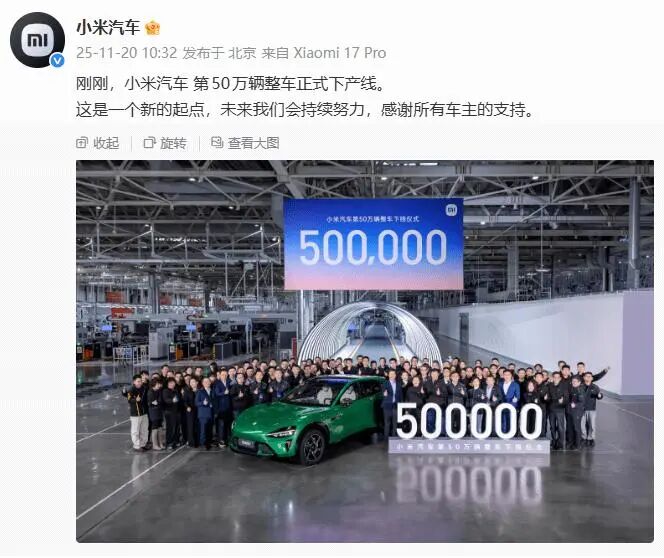
On November 20, Xiaomi Auto officially announced the rollout of its 500,000th vehicle.
For emerging brands that claim to be "user-centric enterprises," the recent verdict in the Xiaomi deposit case serves as a profound lesson in compliance. Respecting contracts, processes, and users should not just be promotional slogans, but should become guiding principles in business operations.
As competition in the new energy vehicle market becomes increasingly fierce, achieving a balance between operational efficiency and consumer rights protection has become a challenge that every car company must face. This ruling is expected to further standardize processes in the automotive sales industry, creating a fairer and more transparent car purchasing environment for consumers. Industry experts believe that this ruling will prompt car companies to re-evaluate sales contract terms and delivery processes, driving the entire industry towards a more standardized and healthy development, ultimately achieving a win-win situation for both enterprises and consumers.
【Copyright and Disclaimer】The above information is collected and organized by PlastMatch. The copyright belongs to the original author. This article is reprinted for the purpose of providing more information, and it does not imply that PlastMatch endorses the views expressed in the article or guarantees its accuracy. If there are any errors in the source attribution or if your legitimate rights have been infringed, please contact us, and we will promptly correct or remove the content. If other media, websites, or individuals use the aforementioned content, they must clearly indicate the original source and origin of the work and assume legal responsibility on their own.
Most Popular
-
Dow, Wanhua, Huntsman Intensively Raise Prices! Who Controls the Global MDI Prices?
-

Clariant Unveils Cost-Cutting Plan Details, Plans to Shut Down Multiple Plants
-
[Today's Plastics Market] General Materials Weakly Fluctuate, Engineering Materials Steadily Rise
-

New Breakthrough in Domestic Adiponitrile! Observing the Rise of China's Nylon Industry Chain from Tianchen Qixiang's Production
-

Daily Review: Polyethylene Prices Under Weak Consolidation, Sellers Face Significant Pressure to Move Inventory