



Bosses, Take Note! New Plastic Recycling "Gold Mine" Emerges as This Nation Is "Drowning" in Plastic Waste
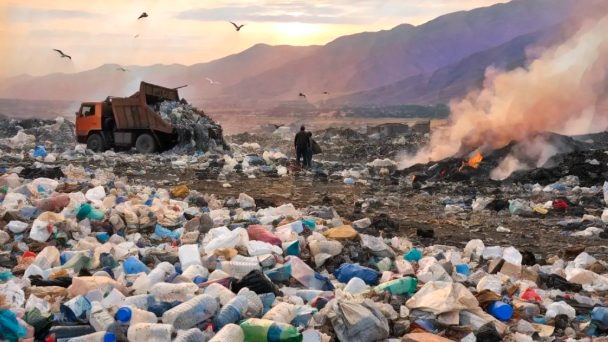
According to domestic industry sources in Tajikistan reported by CPRJ, the country generates over 9 million tons of municipal solid waste (MSW) annually, with approximately 322,000 tons of plastic waste. A key characteristic of plastic waste is its high resistance to decomposition, allowing it to persist in the natural environment for decades or even centuries, accumulating continuously in soil and water bodies.
However, estimates of Tajikistan's total waste generation vary widely across sources, with international organizations providing relatively conservative figures. For example, the United Nations Environment Programme (UNEP) reported that approximately 2 million tons of municipal waste are officially collected in Tajikistan annually.
This discrepancy is likely due to different statistical methods. Domestic statistics often include waste from unauthorized dumpsites and the informal sector, while international estimates tend to rely on data from formally collected and officially recorded waste. Even so, even by the most conservative estimates, Tajikistan's waste management system still poses a heavy burden on the environment.
Source: TCA
Tajikistan's position in international garbage rankings
Global assessments reveal that Tajikistan is grappling with issues of waste accumulation and limited recycling capacity. According to domestic reports citing the 2024 "Mismanaged Waste Index (MWI)," 87.1% of Tajikistan's waste is either not collected through formal systems or is disposed of in ways that violate environmental standards. This makes the country one of the most vulnerable in terms of waste management systems.
In practice, this means that waste is often dumped in unauthorized locations, openly burned, or scattered indiscriminately into the environment. These practices put pressure on soil, water resources, and air quality, while also posing a long-term threat to public health.
Currently, the world is facing a plastic waste crisis. Even in countries with advanced recycling systems, the plastic recycling rate remains very low. The United Nations Environment Programme estimates that only about 9% of all plastics ever produced by humans have been recycled, with the rest remaining in the environment.
Regional Differences: Urban vs. Rural
According to domestic statistics on waste generation, Tajikistan is divided into three groups. The "large" group, including the largest cities and surrounding areas (such as Dushanbe and Khujand), comprises approximately 4.2 million people. The per capita daily waste generation here is 1.013 kg, which estimates up to 148,000 tons of plastic waste generated annually.
The "Medium" group consists of 10 medium-sized cities (such as Bokhtar, Kulob, Kanibadam) with a total population of 1.99 million. The group has an average per capita daily waste generation of 0.902 kg and an estimated annual plastic waste generation of 62,000 tonnes.
Rural and small areas, home to over 4 million people, generate an average of 0.79 kg of waste per person per day. Although the proportion of plastic waste in these areas is not clearly defined, an estimated 100,000 tons of plastic waste are still generated annually.
Waste management infrastructure is most lacking in these small settlements. Cities have basic municipal services and landfills, while many rural areas don't even have waste collection containers. As a result, waste is often dumped in gullies, rivers, or burned in backyards, meaning a large amount of waste goes unrecorded, and the actual amount may be far greater than recorded levels.
The Fate of Plastic Waste: Disposal, Leakage, and Recycling
Most of Tajikistan's plastic waste is either buried or left in landfills. It is estimated that only about 2.6% (approximately 8,500 tons) of plastic waste is recycled annually. Approximately 267,000 tons (83% of the total) are transported to landfills, where they are left untreated. Another approximately 46,000 tons are lost during transport, blown out of containers, falling from collection vehicles, or abandoned in informal dumpsites.
This means that only a small fraction of the over 320,000 tons of plastic waste discarded annually is recycled back into the economy. The rest contributes to the growing environmental degradation.
Environmental experts warn that immediate action is necessary. Proposed measures include banning the production and import of single-use plastic products, such as cutlery and packaging materials less than 15 microns thick, which are almost impossible to recycle. Similar bans in other countries have successfully reduced difficult-to-recycle waste.
Executive Summary: Current Status of the Recycling Industry and Infrastructure
Despite Tajikistan's formal commitment to green principles, a robust recycling industry is lacking. Currently, only 42 small enterprises are engaged in waste processing of plastics, paper, and metals. As of 2024, only 19 enterprises are specifically involved in plastic recycling, which is insufficient to handle the national volume of plastic waste.
The country lacks a systematic waste sorting mechanism, and plastics are typically discarded together with organic waste and other refuse, making sorting efforts difficult. Large-scale recycling facilities have not been built, and recycling efforts are fragmented, mainly driven by individual initiatives.
Epilogue:
However, recent data shows some positive trends. Between 2020 and 2023, the production of goods using recycled plastics increased significantly. The output of plastic profiles for construction grew by 250%, reaching 19,300 tons in 2023. The production of metal-plastic building materials (such as doors and windows) increased by 200%, reaching 596,000 square meters. The output of plastic pipes grew by 132%, reaching 10,600 meters. The production of small products like bottle caps increased by 439%, exceeding 193,000 units annually.
Waste management issues have also begun to attract attention at the political level. In November 2024, Dushanbe hosted an international workshop on the problem of plastic waste in mountainous areas. Tajik officials presented strategies for reducing plastic use and proposed investment initiatives for recycling.
Despite these positive developments, significant challenges remain. Plastic waste stems not only from domestic consumption, but also from imported plastics, which exacerbate the strain on waste management systems. This underscores the urgency of establishing a circular plastic economy – scaling up recycling, promoting reuse, and reducing the use of unnecessary single-use plastics.
Without such systemic reforms, Tajikistan's plastic footprint will continue to expand, and the garbage crisis will deepen further.
【Copyright and Disclaimer】This article is the property of PlastMatch. For business cooperation, media interviews, article reprints, or suggestions, please call the PlastMatch customer service hotline at +86-18030158354 or via email at service@zhuansushijie.com. The information and data provided by PlastMatch are for reference only and do not constitute direct advice for client decision-making. Any decisions made by clients based on such information and data, and all resulting direct or indirect losses and legal consequences, shall be borne by the clients themselves and are unrelated to PlastMatch. Unauthorized reprinting is strictly prohibited.
Most Popular
-

Layoffs, Divestments, Plant Closures While Pouring Billions: BASF Undergoes Major Transformation!
-
Ascend Adipic Acid Hit By Force Majeure, Market Expects Supply Resumption In Mid-September
-

Raw Material Supply Shortage! INEOS Phenol Declares Force Majeure on Phenol and Acetone Businesses
-
South Korea initiates anti-dumping investigation against Chinese PVC suspension resin! The target is Tianjin Bohua and Wanhua Chemical. How to break through?
-

Sixth national procurement set to be implemented: A “Reshuffling” Moment for the $10-Billion Medical Device Market