



Break Monopoly! Domestic T1200 Carbon Fiber Mass Production Rewrites Plasticization Chain to Empower Industrial Upgrade
Recently, Zhuan Su Shi Jie learned that SYT80 (T1200-grade) ultra-high-strength carbon fiber, developed by Zhongfu Shenying—a subsidiary of China National Building Material Group—has been officially launched globally. China has thus become the world’s first country to achieve mass production of T1200-grade carbon fiber at a scale of over 100 tons.
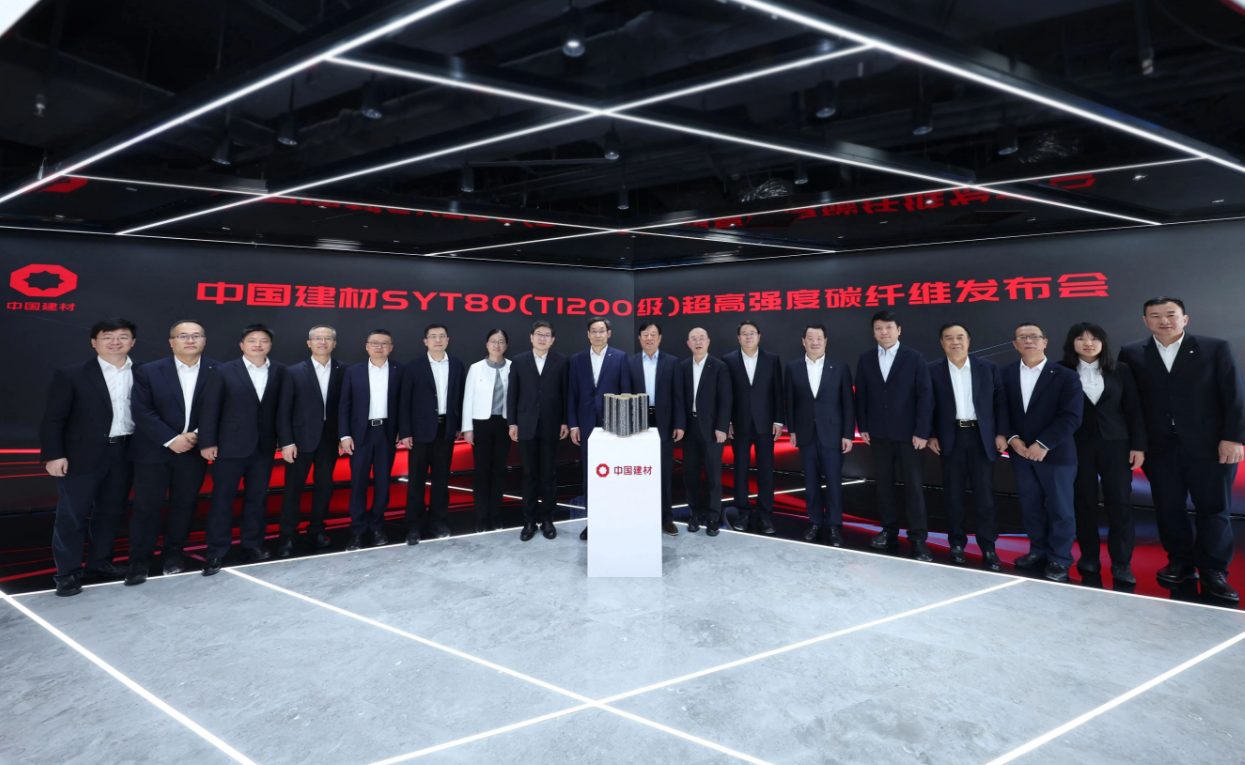
Image Source: New Quality Industrial Chain
The product's engineering tensile strength has surpassed 8000 MPa, breaking the long-term technological monopoly of the US and Japan, and filling the gap in the global high-end carbon fiber industrial production. As a core reinforcing material deeply coupled with thermosetting resins and engineering plastics, the breakthrough of T1200 grade carbon fiber is not only a milestone in the field of new materials, but also drives the structural upgrade of the plastics and chemicals industry, providing key material support for industries such as new energy vehicles, humanoid robots, and low-altitude economy.
I. T1200-Grade Carbon Fiber: The World's Strongest "Black Gold"—Why Is It the Ultimate Partner for the Plastics Industry?
SYT80 (T1200 grade) carbon fiber has a diameter less than one-tenth of a human hair, with a single filament diameter below 4.5 micrometers. Its density is only one-quarter of steel, and its tensile strength reaches 10 times that of ordinary steel. A carbon fiber rope made of 120,000 filaments has a theoretical diameter of less than 2 millimeters and can pull a fully loaded bus carrying 54 people. Meanwhile, this material is produced through carbonization at nearly 2000°C, and it has excellent chemical stability, as well as outstanding corrosion resistance, flame retardancy, and fatigue resistance. It is currently the strongest industrially mass-produced carbon fiber in the world.
From a production process perspective, T1200-grade carbon fiber traverses a high-temperature production line exceeding 1,000 meters in length, undergoing pre-oxidation at 200–300°C and oxygen-free carbonization at 600–2000°C. The process requires real-time control of over 3,000 precise parameters and has overcome sub-nanometer-scale molecular structural defect control technology, achieving the leap from laboratory-scale samples to industrial mass production. Within the polymer composites application system, carbon fiber reinforced plastics (CFRP), formed by combining carbon fiber with matrix resins such as epoxy, PA, and PEEK, offer 3–5 times higher strength and 40–60% greater weight reduction compared to traditional glass fiber reinforced plastics, making CFRP a core solution for lightweighting in high-end equipment.
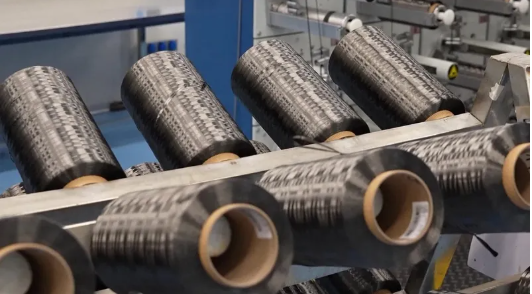
Image source: CCTV News
2. Full-Chain Restructuring: Simultaneous Upgrading of Three Key Segments—Upstream Raw Materials, Midstream Modification, and Downstream Applications
China's carbon fiber industry has established a complete ecosystem, with an average annual growth rate exceeding 30% during the 14th Five-Year Plan period. By 2025, China's carbon fiber production is expected to reach approximately 90,000 metric tons, with exports amounting to 2,092.7 metric tons. The domestic localization rate has surpassed 92%, marking a dramatic leap from 13.4% a decade ago. China now accounts for roughly 50% of global production capacity, solidifying its position as the world's largest producer. The mass production of T1200-grade carbon fiber will reshape the plastics industry by transforming raw materials, modification processes, and applications.
In the upstream raw material sector, the main raw material for carbon fiber is polyacrylonitrile (PAN). China has a complete PAN supply system that can support the large-scale production of high-end carbon fibers. Meanwhile, it drives the growth in demand for high-end epoxy resins and thermoplastic engineering plastics, accelerating the domesticization of high-end resin products from companies such as Wanhua Chemical and Sinopec, and solving the problem of reliance on imported matrix resins in composite materials.
Stabilized supply of high-end carbon fiber from midstream modification players will accelerate domestic modified plastics companies’ R&D and mass production of carbon fiber-reinforced composites. Companies such as Kingfa Sci. & Tech., WOTE Advanced Materials, and Qide New Materials have already developed carbon fiber-reinforced PP, PA, and PC products, which are used in automotive structural components and electronic appliance housings. FH New Materials focuses on carbon fiber-reinforced PEEK, entering the supply chain for robotic joint modules. The mass production of T1200-grade carbon fiber will reduce raw material costs for high-end composites, driving carbon fiber-modified plastics from customized niche products toward scalable, standardized, high-value-added products.
Downstream application sectors are accelerating the substitution of carbon fiber reinforced plastics for metals and traditional plastics. The product structure of the plastic industry is shifting from general plastics and low-to-mid-end modified plastics toward high-performance composites, enhancing the overall profit margin and technical barriers of the industry.
III. Industrial Breakthrough Points: Automotive Weight Reduction and Robot Skeletons—Two Major Sectors to Benefit First
1. New Energy Vehicles: Solving the Dual Challenges of Range and Safety
The core components of new energy vehicles, such as the body, battery pack, and chassis, have extremely high requirements for lightweight and structural strength. T1200-grade carbon fiber reinforced plastics can reduce the body weight by 40%-50% and the battery pack casing weight by over 50%. This not only improves collision safety but also effectively extends the vehicle's range by 15%-20%. Previously, the application of high-end carbon fiber was limited to luxury models due to capacity and price constraints. With the mass production of SYT80 at the hundred-ton level, the cost is gradually decreasing, and carbon fiber composite materials will quickly be adopted in mainstream new energy vehicle models, becoming the main upgrade direction for automotive plastic components.
2. Humanoid Robots: Developing Lightweight, High-Performance Mechanical Skeletons
The joints, skeleton, and robotic arms of humanoid robots need to balance lightweight design, high rigidity, and motion accuracy. T1200-grade carbon fiber can reduce the weight of robot structural components by more than 40%, improve load capacity and motion accuracy, reduce equipment energy consumption, and address the drawbacks of traditional metal parts such as being heavy and energy-intensive. Relying on domestic high-end carbon fiber supply, domestic plastic processing companies can quickly develop customized composite parts, enter the core supply chain of embodied intelligence, and seize the development opportunities in the robotics industry.
In addition, in fields such as low-altitude economy, commercial aerospace, and high-end medical devices, T1200-grade carbon fiber reinforced plastics can replace aluminum and titanium alloys, significantly reducing the weight of structural components. This promotes the transition of plastic composite materials from civilian applications to core scenarios in high-end equipment, expanding the boundaries of industry applications.
IV. Domestic Enterprises Accelerate Positioning: Carbon Fiber + Plastics, Opening the Golden Track of New Materials
This breakthrough in T1200 carbon fiber has driven domestic companies to form a graded, full-chain layout: Zhongfu Shenying, as the main body for R&D and mass production, has established a complete product matrix from T300 to T1200, ensuring a stable supply of high-end carbon fiber; Guangwei Fucai and Zhongjian Technology focus on small-tow carbon fiber for aerospace applications, collaborating with plasticization companies to develop customized composite solutions; Shanghai Petrochemical is advancing its large-tow carbon fiber project, focusing on industrial fields such as wind power and energy storage, to reduce the cost of large-scale application.
For a long time, the global high-end carbon fiber market has been monopolized by companies such as Toray of Japan and Hexcel of the United States. In 2023, Toray announced the development of T1200 grade carbon fiber, but it has not yet achieved mass production. Our country has taken the lead in completing the industrial-scale production of hundreds of tons, marking a lead over the US and Japan in the field of ultra-high-strength carbon fiber, achieving full-chain independence in technology, equipment, and production capacity, and completely breaking free from the "chokehold" situation in high-end carbon fiber.
The mass production of SYT80 (T1200 grade) ultra-high-strength carbon fiber at the hundred-ton level is a landmark achievement in China's independent innovation in new materials, and a key opportunity for the plastic and chemical industry to move towards high-end and independent development. The deep integration of "black gold" with plastic materials will continue to promote the large-scale popularization of carbon fiber reinforced plastics, reconstruct the global high-end composite material supply chain, and lay a solid material foundation for strategic emerging industries such as new energy vehicles, humanoid robots, and low-altitude economy.
For domestic polymer enterprises, grasping the development trend of carbon fiber composites, accelerating technological R&D, and enhancing industrial chain collaboration will effectively boost global competitiveness, enabling them to share in the trillion-yuan market opportunities brought by the lightweighting revolution and steadily advance China’s transformation from a polymer powerhouse to a polymer leader.
【Copyright and Disclaimer】This article is the property of PlastMatch. For business cooperation, media interviews, article reprints, or suggestions, please call the PlastMatch customer service hotline at +86-18030158354 or via email at service@zhuansushijie.com. The information and data provided by PlastMatch are for reference only and do not constitute direct advice for client decision-making. Any decisions made by clients based on such information and data, and all resulting direct or indirect losses and legal consequences, shall be borne by the clients themselves and are unrelated to PlastMatch. Unauthorized reprinting is strictly prohibited.
Most Popular
-
Supply Extremely Tight! LG Chem Declares Force Majeure on Export Contracts for Di-Octyl Terephthalate (DOTP)
-

Deadly Impact: Hormuz Strait Blockade Sparks Shortage of Plastic Raw Materials, Threatening Shutdowns at Japanese and Korean Chemical Plants
-
Huntsman Introduces “War Surcharge” Amid Shipping Disruption and Soaring Energy Costs, Global MDI Prices Continue to Rise
-
Catl “wins big”: Beyond Batteries, What Else Can It Sell?
-

Tao Lin: Tesla’s Supercharger Stations in China Surpass 2,500