



Huawei Controls, Yu Chengdong Brings 78 Billion to the Table
On March 4, Huawei Harmony Intelligence Mobility held its first Spring Festival press conference.
The stars of this launch event are the technologically upgraded Wenjie M9 and Zunjie S800, both of which are equipped with the world's highest-spec 896-line LiDAR in mass production.
Yu Chengdong has laid his cards on the table—aiming for the high-end market right from the start of the year.
As Huawei’s Executive Director, Chair of the Product Investment Review Committee, and Chairman of the Terminal BG, Yu Chengdong proudly mentioned the “Five Realms” assembled by Harmony Intelligence Mobility.
He revealed that the cumulative delivery volume of AITO Wenjie, LUXEED Zhijie, STELATO Xiangjie, MAEXTRO Zunjie, and SAIC Shangjie has exceeded 1.28 million units, and for 14 consecutive months, it has maintained the top position in China's auto brand average transaction price.
From the perspective of average transaction prices, the five sectors under Yu Chengdong’s leadership are indeed playing in the high-end market.
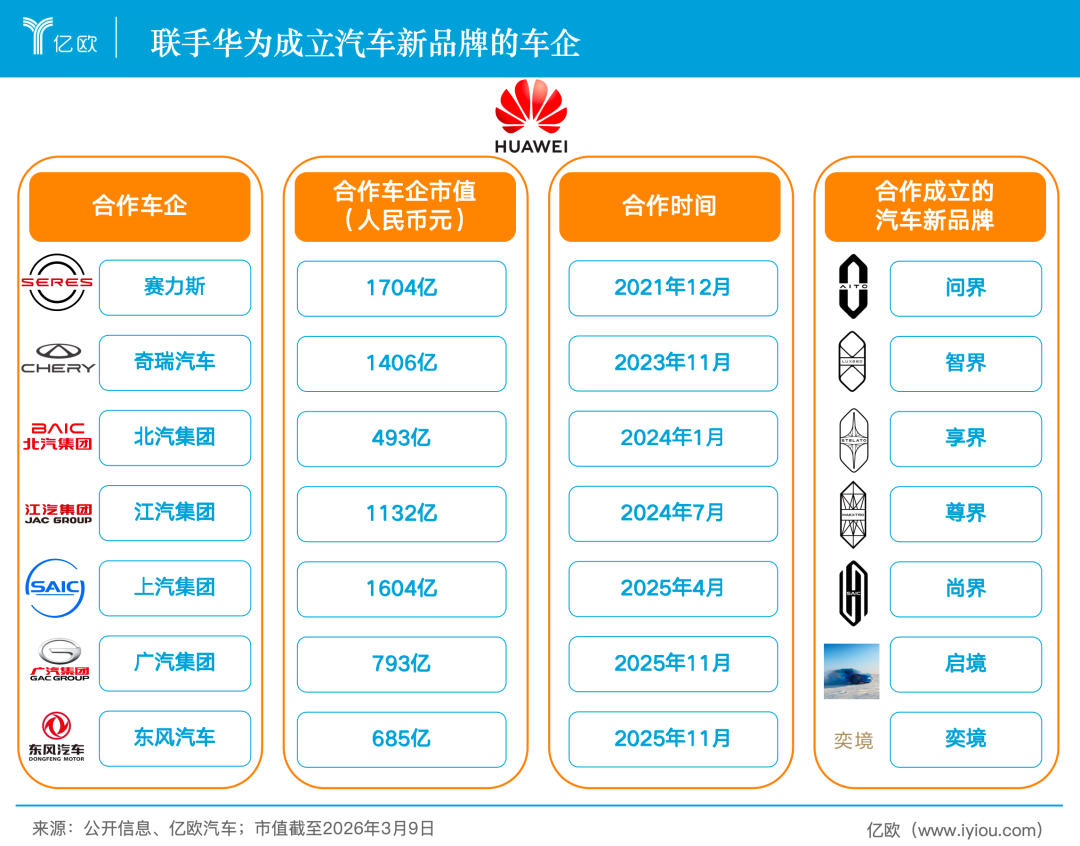
Especially the Avatr brand, which Yu Chengdong personally nurtured from its inception, has become Huawei’s hallmark, attracting numerous automakers to collaborate with Huawei—thus giving rise to today’s “Seven Major Sects,” all state-owned enterprises with a combined market capitalization of RMB 780 billion. The launch of the “Five Realms + Two Realities” further cements Huawei’s position as the “Supreme Patriarch of the Martial World.”
At the press conference, when mentioning the Aito M9, Richard Yu couldn't help but smile with pride.
He stated that the Avatr M9 has “taken on four rivals at once,” successfully surpassing the BMW X5 and X7, as well as the Mercedes-Benz GLE and GLS in sales over the past two years, and has become the best-selling luxury SUV in the RMB 500,000 price segment for 2025.
According to Seres data, from 2022 to the first half of 2025, Seres paid Huawei, its largest supplier, RMB 75 billion in procurement fees. In the first half of 2025 alone, Seres paid Huawei RMB 20 billion in procurement fees—equivalent to RMB 140,000 per delivered AITO vehicle.
For the company that changed the fate of Seres, this money is well-deserved.
It also means that in the automotive industry, Huawei is no longer just "a dominant supplier."
Now, Huawei is more like a variable that redistributes industrial power.
For many traditional Chinese automakers, Huawei is not just a regular partner, but a technological lifeboat and a disruptor of the order.
While helping traditional automakers address their intelligentization shortcomings, Huawei is also quietly reshaping the value distribution model of the automotive industry.
While Huawei helps automobile manufacturers sell cars, it also increasingly worries them that, in the end, customers will remember “Huawei” rather than the automakers’ own brands.
Traditional automakers both need Huawei and fear Huawei.
Currently, traditional automakers are in a situation where they both need Huawei, rushing to cooperate with it, yet also fear Huawei, harboring suspicion and caution.
Because Huawei provides a complete set of the most scarce capabilities in the intelligent vehicle era, including product definition, intelligent driving, intelligent cockpit, electronic and electrical architecture, terminal channels, brand momentum, and even user mindset.
Putting these together is simply a fatal temptation for traditional automakers.
The strengths of traditional automotive companies have traditionally been in manufacturing, including factories, supply chains, cost control, quality systems, and organizational efficiency.
However, the electric era has lowered the mechanical threshold, while the intelligent era has raised the software threshold.
In other words, the factors that determined a car manufacturer's upper limit in the past were engines, transmissions, and chassis; now, what determines a car manufacturer's upper limit are advanced driver assistance systems, intelligent cabins, software update speed, and the underlying data loop capability.
Who controls the software, controls the soul of the car.
This is precisely where most traditional automakers are weakest.
Therefore, traditional automakers need Huawei.
After all, Huawei can bundle its technological capabilities, product experience, brand appeal, and sales channels and offer them to automakers all at once—like a legendary hero descending on a rainbow cloud.
While being "saved" by the "hero," traditional automakers are also ceding control, having to allow Huawei deep involvement in product definition, core technology R&D, brand marketing, and retail channels, enabling Huawei to fully unleash its potential.
Traditional automakers are accelerating their transformation and increasing sales, but they are increasingly dependent on Huawei.
Traditional automakers, losing their autonomy, inevitably fear Huawei.
The most“”…… The most“”…… The most direct change is that more and more consumers, when talking about Wanjie (), Zhijie (), and Xiangjie (), are essentially referring to "Huawei cars" rather than to Seres, Chery, or BAIC...
This means the anchor point of user perception is shifting from manufacturers to technology brands.
For traditional automakers, this is a very dangerous signal.
For a century, the automotive industry has seen brands firmly held by OEMs; consumers buy Mercedes-Benz because of the Mercedes-Benz brand, and BMW because of the BMW brand—regardless of how strong a technology supplier may be, it rarely surpasses the vehicle brand itself.
But at Huawei, the logic begins to change.
Users' judgment of cars is increasingly focused on Huawei's intelligent driving, HarmonyOS cockpit, Huawei ecosystem, and Huawei stores, rather than first considering which factory produced the car.
Once this perception solidifies, the worst fear of traditional automakers comes true: they will be forced to retreat to the "manufacturing end," while Huawei remains at the "value end."
This is also why the better Huawei's cars sell, the more anxious some car manufacturers become. Because the higher the sales, the stronger Huawei's interpretative power, voice, and dominance in the market.
AITO's success is not only benefiting Seres, but also means consumers have further confirmed that Huawei is not only capable of making phones, operating systems, and channels, but can also define high-end cars.
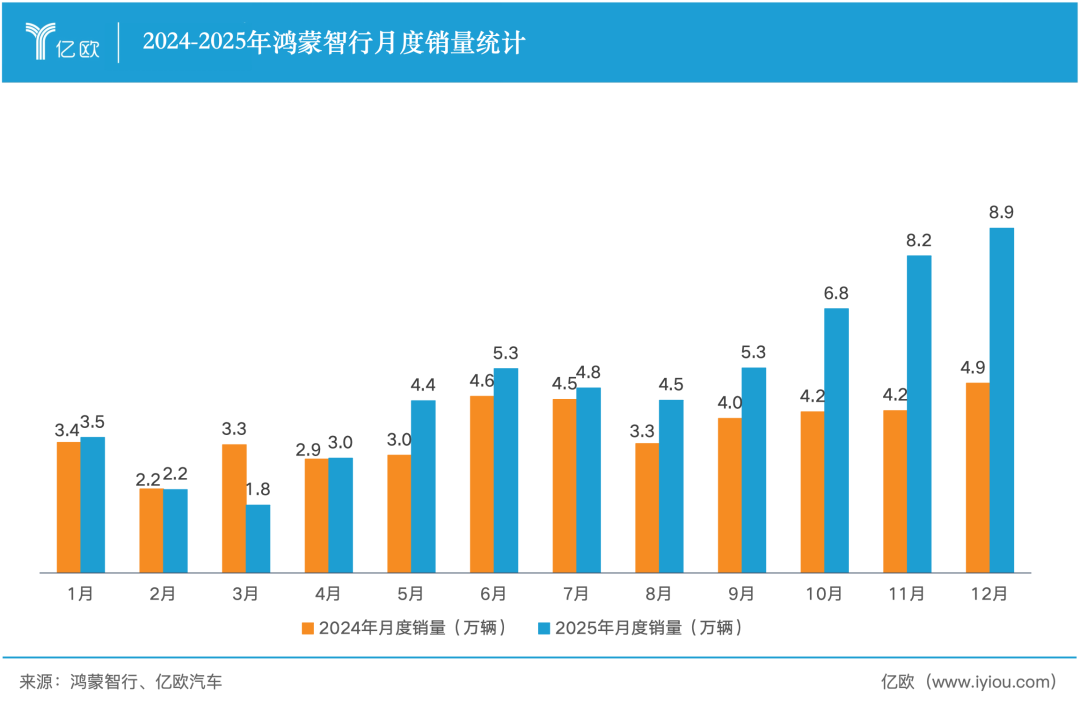
In February 2026, the total delivery of Harmony Intelligent Drive reached 28,212 units, an increase of 31% year-on-year, with the M5 model still being the core sales driver.
The more sales concentrate toward the top, the stronger this “Huawei-as-a-brand” suction effect becomes.
For partner automakers, Huawei's assertiveness isn't always good news. In the short term, Huawei brings orders; in the medium term, it drives organizational reassessment; and in the long term, it could redefine brand ownership.
In other words, many traditional automakers cannot fully trust Huawei, yet they have no choice but to engage in deep collaboration while trying their best to keep backup options.
Traditional car manufacturers need Huawei to bring their products to market, but they are unwilling to completely outsource their intelligent capabilities. They want to use Huawei's help to break out of the transformation trough, but they are also afraid that in the end, they will be left with nothing but a production license and a few manufacturing plants.
This is the most genuine conflict that traditional car manufacturers face when dealing with Huawei.
They’re not unaware of the risks of collaborating with Huawei—in fact, they understand them all too well—but compared to the immediate pressure of survival, long-term concerns have to take a back seat.
Why can it only be Huawei?
Are Chinese automakers willing to entrust intelligence initiatives to external parties?
The answer is usually negative.
However, if it were entrusted to Huawei, things would be different.
Because, across the Chinese market, companies that genuinely possess all four of these capabilities simultaneously are, in fact, extremely rare.
First, it is the foundational technical capability.
Second, engineering implementation capability.
Third, consumer brand capability.
Fourth, terminal sales capability.
Huawei is nearly the only company that holds all four of these things in its hands.
Huawei has built its foundation by advancing through communications, chips, operating systems, terminals, cloud computing, and AI. Nearly every critical component required for intelligent vehicles already has a corresponding capability within Huawei's ecosystem. In its Harmony Intelligent Mobility initiative, Huawei showcases core technologies such as advanced driver assistance and intelligent cockpit systems as integrated selling points. For automakers, this isn't just isolated superiority in specific areas—it's a comprehensive system-level upgrade.
More importantly, Huawei is not only good at technology. It also makes products, does marketing, and runs retail.
This point is extremely crucial.
Many traditional Chinese car manufacturers have attempted to implement intelligent features; the issue is not about "whether to do it," but rather "nobody perceives it when it's done."
The cruelest thing in the automotive industry is that technology does not equal a product.
Automakers can invest billions of yuan in intelligent driving, smart cockpits, and platforms; however, if these technologies fail to be recognized by users and cannot translate into compelling purchase reasons at the point of sale, such technological investments will struggle to convert into sales volume.
Huawei’s advantage lies precisely in its ability to directly translate technical capabilities into consumer-friendly language—knowing how to package complex capabilities into a single, easily understandable statement for users. This is a technical communication capability, as well as a product methodology honed in the consumer electronics era.
There is also a more realistic reason: Huawei already has established physical stores and brand recognition among users.
One of the most challenging aspects for traditional automakers launching new brands is building a sales network—opening stores, staffing, training, marketing, test drives, and after-sales services—all of which require substantial investment. Huawei, however, inherently possesses a vast consumer electronics retail system, meaning it does not start from scratch when selling vehicles.
When traditional car companies first embarked on the transformation and upgrading to intelligence, they lacked both technology and channels. Huawei, on the other hand, not only brings intelligent capabilities but also an existing retail touchpoint network. For those traditional car companies that lack brand power, channel strength, and intelligence, this kind of support is like a life-saving grace.
So it can only be Huawei.
It's not that other companies are entirely incapable of achieving a particular capability; rather, only Huawei can create a complete commercial closed loop for intelligence.
It solves R&D issues as well as sales issues; it solves experience issues as well as brand issues; it can handle hardcore technology as well as mass communication.
In this sense, automakers’ choice of Huawei is not merely a technological decision, but a pragmatic one—selecting the partner most likely to deliver rapid, tangible results, boost sales, and shorten the transition timeline amid fierce industry competition and consolidation.
Huawei thus becomes a special existence.
It is not a traditional vehicle manufacturer, nor a traditional supplier, but more like a "smart car platform company." This is precisely why many traditional car companies are willing to get closer to it.
In addition to the seven state-owned automakers partnering with Huawei to launch new car brands, more traditional automakers are also actively collaborating with Huawei—for example, Changan and Huawei co-developed Avatr, Huawei and SAIC-GM-Wuling launched the HuaJing S, and Dongfeng Group has fully embraced Huawei's technologies across the board.
All of these have become the foundation of Yu Chengdong's pride.
The Hongmeng Smart Driving ecosystem he leads is a red-hot entity in China’s automobile industry, successfully carving out an entry point for Huawei in the automotive sector and accelerating the transformation and upgrading of traditional automakers.
It is foreseeable that Huawei's position as the "bookmaker" will become increasingly solid, with car manufacturers joining the table far beyond the current 780 billion in assets.
【Copyright and Disclaimer】The above information is collected and organized by PlastMatch. The copyright belongs to the original author. This article is reprinted for the purpose of providing more information, and it does not imply that PlastMatch endorses the views expressed in the article or guarantees its accuracy. If there are any errors in the source attribution or if your legitimate rights have been infringed, please contact us, and we will promptly correct or remove the content. If other media, websites, or individuals use the aforementioned content, they must clearly indicate the original source and origin of the work and assume legal responsibility on their own.
Most Popular
-
Supply Extremely Tight! LG Chem Declares Force Majeure on Export Contracts for Di-Octyl Terephthalate (DOTP)
-
Deadly Impact: Hormuz Strait Blockade Sparks Shortage of Plastic Raw Materials, Threatening Shutdowns at Japanese and Korean Chemical Plants
-
Huntsman Introduces “War Surcharge” Amid Shipping Disruption and Soaring Energy Costs, Global MDI Prices Continue to Rise
-
Catl “wins big”: Beyond Batteries, What Else Can It Sell?
-
Tao Lin: Tesla’s Supercharger Stations in China Surpass 2,500