



Latest Interpretation! The Sixth Batch Of High-Value Medical Consumables National Procurement Opens Bids
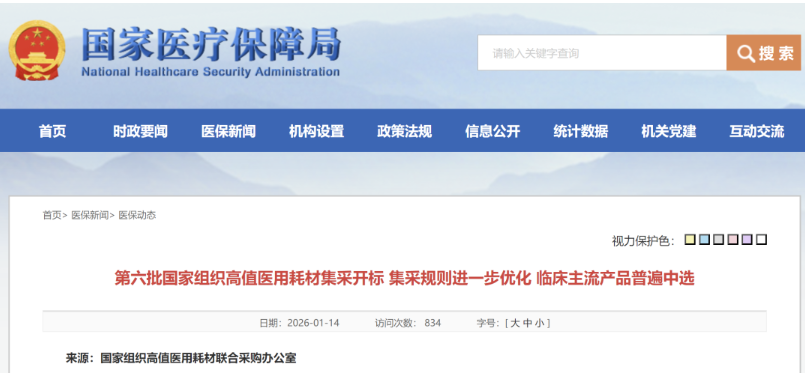
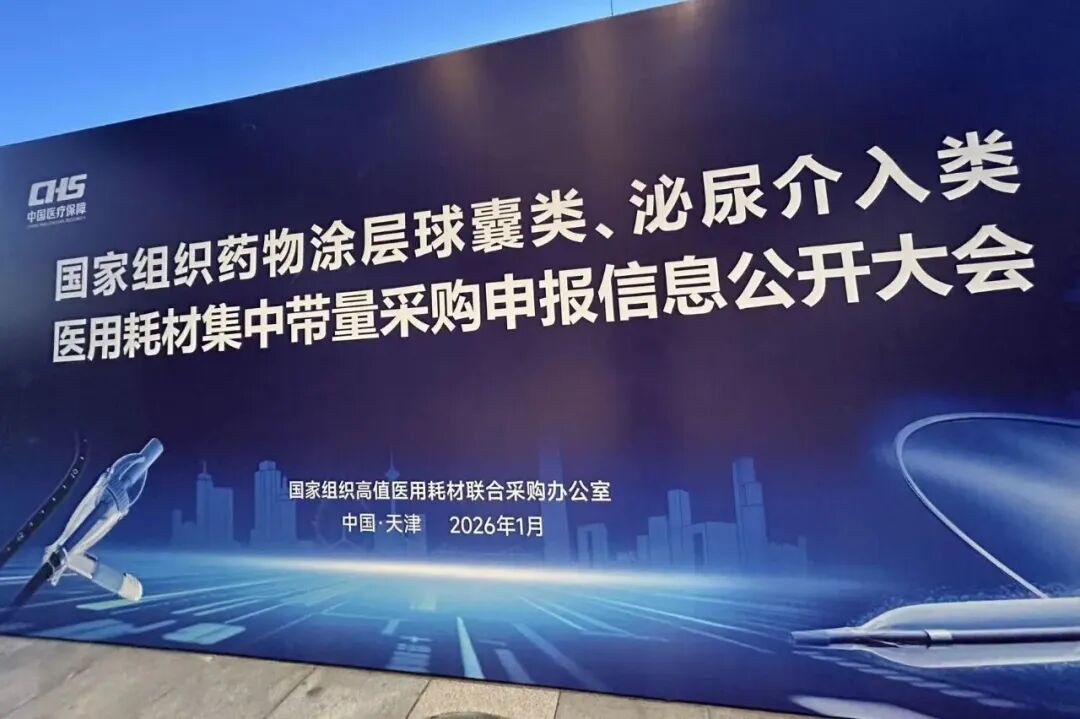
On January 13, 2025, the sixth batch of centralized volume-based procurement of high-value medical consumables organized by the state was completed in Tianjin, resulting in the selection of winners.
This round of centralized procurement includesDrug-coated balloon Urological Interventional ConsumablesTwo categories, 12 types of products, 227 companies, and 496 products participated in the application process, with a final selection of 202 companies and 440 products.
From the perspective of the selected proportion and product coverage, this is more like a."Systematic governance" after a significant adjustment of the rule structure.Regardless of the grouping method, price comparison mechanism, or the handling of differentiated functions, all signal a policy shift distinct from early centralized procurement.
I. First Inclusion of Drug-Coated Balloons: A Step Towards the "Coordination" Logic of Centralized Procurement
Drug-coated balloons (DCB) have been officially included in the national centralized procurement, which has clear policy logic.
From a technical and clinical pathway perspective, DCB is inherently related to the previously centralized procurement.Coronary stents, peripheral vascular stentsHighly collaborative; from the perspective of cost structure, its frequency of use and total cost proportion in interventional therapy have already established a realistic basis for being included in the centralized procurement framework.
It is worth noting that this time...32 enterprises submitted applications for 42 drug-coated balloon products, all of which were selected.。
This means that the centralized procurement did not attempt to reshape the market structure through "extreme compression," but rather emphasized.Maintain the integrity of the clinical options and technical pathways while reducing costs.。
This is also highly consistent with the repeatedly emphasized "higher compatibility with clinical use" in the official statement.
2. Urological Intervention Breakthrough: Centralized Procurement Begins to Enter the "Complex Consumables Area"
Compared to DCB, urological interventional consumables hold a more special significance.
This field has long been regarded as a "blank area" for centralized procurement.
Product types are numerous and specifications are complex.
Different surgical procedures have a high dependency on the combination of consumables.
Clinicians are sensitive to differences in the feel and functionality of instruments.
In this round of centralized procurement,There are a total of 195 companies and 454 products submitted in the urological intervention category, with 398 products ultimately selected.Covering multiple key instrument components such as guidewires, interventional sheaths, dilation catheters, stone retrieval baskets, and disposable ureteroscope catheters.
From the results, the policy did not avoid complexity, but choseBy implementing more granular bidding units and rule designs, "complex consumables" will be included within the scope of governance.This is an important turning point in itself.
Three major changes at the regulatory level that are more worthy of attention than "price reductions."
If we focus solely on selection quantity or price itself, it is easy to underestimate the policy value of this round of centralized procurement. What the industry should truly study repeatedly are the key adjustments in the rules.
1. Group bidding: stabilizing the clinic, rather than creating gaps.
This centralized procurement is clearly based onDemand size of medical institutions, whether they have nationwide supply capabilityConduct grouped bidding.
The core logic is not "unified standards," but ratherEnsure continuity of clinical use。
This means:
Mature products that are highly relied upon in clinical practice will not be forced to withdraw due to rule design.
Enterprises with stable production capacity and quality systems are more likely to achieve certainty in centralized procurement.
Introducing a price comparison coefficient due to differences in functionality, acknowledging the existence of "micro-innovation".
In the field of consumables, innovation is often not disruptive but is reflected in "micro-innovations" such as coating methods, material treatments, and structural designs.
The current round of centralized procurement clearly specifies at the regulatory level for the first time:For differentiated products with certain functional innovations, establish a price comparison coefficient to reasonably reflect the price differences.。
This sends a clear signal:
Centralized procurement no longer simply compresses "all similar products" into a single price line, but starts to attempt within the rules.Classification of Clinical Value Levels。
3. "Anti-involution" is embedded into algorithms, rather than remaining at the level of statements.
The most iconic change is the approach to extremely low prices.
When the lowest bid price deviates significantly from a reasonable range, the current round of centralized procurement will no longer directly use the lowest price as the basis for calculating price differences.Use 65% of the average price of shortlisted items as the control benchmark.。
Among the 20 competitive groups, 8 groups triggered the rule.
This is not simply "protecting the price," but a clear statement:
The policy discourages the use of unusually low prices to undermine the overall pricing structure of product groups.。
4. From "Cost Control Tool" to "Regulatory Governance": The Changing Role of Centralized Procurement
Since 2020, the national level has completed6 batches of high-value medical consumables centralized procurementCovering 9 major categories and 142 types of consumables, it virtually encompasses the main clinical areas of high-value consumables.
If the core goal of early procurement was "rapid cost control and breaking the rigidity of high prices," then starting from this round, the policy objectives are undergoing a more subtle but clear shift:
From a single price target toBalance of Price, Quality, Supply, and Clinical Continuity
From results-oriented toRegulatory Governance and Behavioral Constraints
From "preventing election loss" to "preventing excessive involution"
According to the official arrangement, the final results of this election will be officially announced after the public notice. It is expectedAround May 2026Implementation.
For patients, this means more accessible and sustainable use of high-value consumables.
For hospitals, this means that under the premise of cost control, there is still room for choice in clinical pathways.
For enterprises, the more important change lies in—
Centralized procurement is shifting from a "price competition" arena to a more complex rules-based arena.
In this arena, the sole ability to offer low prices no longer constitutes a long-term advantage.
Stable supply, quality systems, product structure, and clinical adaptation capabilities are being systematically incorporated into the rules.
This may perhaps be the aspect of the sixth batch of centralized procurement that deserves to be repeatedly interpreted by the industry.
【Copyright and Disclaimer】The above information is collected and organized by PlastMatch. The copyright belongs to the original author. This article is reprinted for the purpose of providing more information, and it does not imply that PlastMatch endorses the views expressed in the article or guarantees its accuracy. If there are any errors in the source attribution or if your legitimate rights have been infringed, please contact us, and we will promptly correct or remove the content. If other media, websites, or individuals use the aforementioned content, they must clearly indicate the original source and origin of the work and assume legal responsibility on their own.
Most Popular
-

Layoffs, Divestments, Plant Closures While Pouring Billions: BASF Undergoes Major Transformation!
-

Ascend Adipic Acid Hit By Force Majeure, Market Expects Supply Resumption In Mid-September
-

Raw Material Supply Shortage! INEOS Phenol Declares Force Majeure on Phenol and Acetone Businesses
-
South Korea initiates anti-dumping investigation against Chinese PVC suspension resin! The target is Tianjin Bohua and Wanhua Chemical. How to break through?
-

Sixth national procurement set to be implemented: A “Reshuffling” Moment for the $10-Billion Medical Device Market