



Middle East Conflict Escalates, PP Market Faces New Round of Volatility
Geopolitical conflicts have driven up international oil prices and raw material costs, impacting the petrochemical industry. Compounded by disruptions to shipping through the Strait of Hormuz and rising logistics costs, this has led to tight supply and significant price volatility in the global—particularly Asian—polypropylene market.
The escalation of the US-Iran situation has imposed a triple shock of "cost increase + supply disruption + logistics obstruction" on the polypropylene market, leading to significant price volatility in the short term. This is mainly due to the surge in crude oil prices, which directly raises the production costs of oil-based polypropylene. Moreover, as a key global exporter of polypropylene and upstream raw materials, the disruption of supplies from Iran and the anticipated blockade of the Strait of Hormuz have further exacerbated the supply tightness in the global, especially the Asian, market.
I. Specific analysis shows
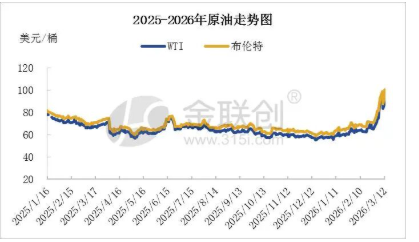
Data source: JLC Intelligence
From a cost perspective, geopolitical tensions have directly driven up oil prices, with Brent crude rising to $100.46 per barrel and WTI reaching $95.73 per barrel as of March 12, hitting multi-month highs. Polypropylene, as a downstream derivative of crude oil, has seen its production costs rise in tandem with oil prices. For PDH (propane dehydrogenation) units reliant on imported propane, tight supplies from Middle Eastern sources have pushed feedstock costs to historic highs, leading some units into negative margins and forcing them to reduce operating rates.
From the supply side, Iran is a significant player in the global polypropylene market, holding an even larger share in polyethylene, yet it also commands a non-negligible portion of the polypropylene market. The conflict has exposed Iran's petrochemical facilities to direct strike risks, and its export offers have been fully suspended or withdrawn. Although China's direct imports of Iranian polypropylene account for a relatively small proportion, the disruption in Iranian polyethylene supply will trigger a substitution effect, indirectly boosting polypropylene demand. Additionally, the disruption to Iran's methanol exports will affect the operation of methanol-to-olefins (MTO) units, further tightening supply.
Logistics situation: The Strait of Hormuz is the “chokepoint” for global energy and chemical product transportation, with approximately 20% of polyolefin raw material shipments passing through this route. Iran’s announcement threatening to blockade the Strait and attack tankers has prompted major shipping companies—including Maersk—to suspend navigation, caused war-risk insurance premiums to surge, and sharply increased logistics costs. This “supply-chain disruption” panic has triggered market-driven hoarding behavior, while traders have halted sales and adopted a cautious, supply-constrained approach—further amplifying price increases.
II. Specific Market Performance
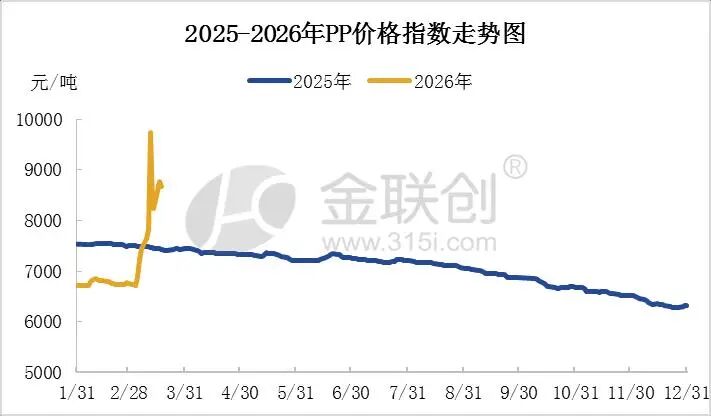
Data source: Jinlianhai
• Price Surge: Affected by this, the PP2605 futures contract hit consecutive daily limits, and the spot market surged rapidly in tandem. Market prices climbed sharply and continuously, with daily gains exceeding RMB 1,000 per ton. • Trade Standstill: Polymer trade in the Middle East has effectively ground to a halt—sellers have withdrawn their quotations, buyers struggle to reach agreements, and shipments to Turkey, Africa, and Europe have nearly ceased. • Regional Divergence: Asian markets were hit most directly, as the region is highly dependent on Middle Eastern raw materials. In contrast, although the Americas market was also lifted by rising oil prices, its supply chain remains relatively independent, resulting in a more moderate price increase.
III. Industrial Chain Transmission and Differential Impacts
Not all chemical products are affected to the same extent, polypropylene is in the position of "following the price increase but not the most scarce".
Methanol and LPG are more sensitive: Iran is the world's second-largest methanol producer, and a supply disruption would have a much greater impact on the methanol market than polypropylene, leading to higher price elasticity for methanol. LPG, as a feedstock for PDH, sees its price surge directly squeezing the profit margin of polypropylene produced via PDH, making it a typical example of cost-driven price increases.
Coal-to-olefins (CTO/MTO) advantages become prominent: In China, due to relatively stable coal prices, the cost advantage of coal-based polypropylene has been significantly amplified amid high oil prices, substantially improving profit margins for such facilities and making them a crucial force in balancing market supply.
Downstream pressure: Rapid price increases have quickly passed through to downstream sectors such as textiles and automotive materials, but high prices have dampened purchasing enthusiasm. Downstream enterprises now face dual pressures of soaring costs and slowing orders, prompting them to actively reduce inventories or seek alternative materials.
IV. Forecast of Future Trends and Response Strategies
In the short term, as long as navigation in the Strait of Hormuz is not restored and Iran's exports are not restarted, the price of polypropylene will remain in a high and volatile state, and there is even a possibility of further increases. The market is currently trading on the expectation of "supply disruption" rather than an actual shortage.
Strait navigation status: If U.S. naval escort becomes effective or Iran reopens the Strait, the logistics premium will rapidly reverse.
Conflict intensity: If the fighting spreads to major oil-producing countries like Saudi Arabia and the UAE, damaging their petrochemical facilities, the supply shortfall would expand exponentially.
On the macro front: Excessively high oil prices may trigger expectations of a global economic recession, leading to a decrease in demand and a subsequent drop in prices. For buyers: It is recommended to purchase as needed, avoiding blind stockpiling at high prices, and to pay attention to the substitution opportunities offered by coal-based sources. For investors: It is necessary to closely follow geopolitical news and the trend of crude oil, being wary of the risk of a rapid price correction due to easing of the situation, and to use hedging to lock in profits.
【Copyright and Disclaimer】The above information is collected and organized by PlastMatch. The copyright belongs to the original author. This article is reprinted for the purpose of providing more information, and it does not imply that PlastMatch endorses the views expressed in the article or guarantees its accuracy. If there are any errors in the source attribution or if your legitimate rights have been infringed, please contact us, and we will promptly correct or remove the content. If other media, websites, or individuals use the aforementioned content, they must clearly indicate the original source and origin of the work and assume legal responsibility on their own.
Most Popular
-
Supply Extremely Tight! LG Chem Declares Force Majeure on Export Contracts for Di-Octyl Terephthalate (DOTP)
-
Deadly Impact: Hormuz Strait Blockade Sparks Shortage of Plastic Raw Materials, Threatening Shutdowns at Japanese and Korean Chemical Plants
-
Huntsman Introduces “War Surcharge” Amid Shipping Disruption and Soaring Energy Costs, Global MDI Prices Continue to Rise
-
Catl “wins big”: Beyond Batteries, What Else Can It Sell?
-
Tao Lin: Tesla’s Supercharger Stations in China Surpass 2,500