



Wacker Expects Slight Growth in 2026
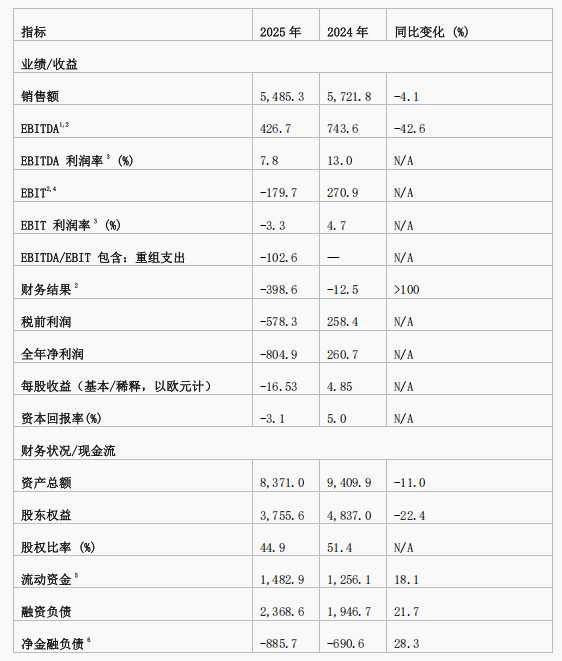
• Wacker Chemie AG confirms preliminary figures for fiscal year 2025: In a challenging market environment, group sales declined by 4% to €5.49 billion; adjusted EBITDA, excluding special items, amounted to €529 million.
Special charges related to restructuring and valuation adjustments resulted in a net loss of approximately €805 million for the full fiscal year 2025, and the company intends not to pay a dividend for the 2025 fiscal year.
"PACE" is progressing as planned, delivering annual cost savings of more than €300 million.
• 2026 Outlook: Sales are expected to achieve low-single-digit percentage growth, and EBITDA is projected to be between €550 million and €700 million.
Munich – Wacker Chemie AG announced its 2025 annual report, confirming that sales and profits for 2025 declined compared to 2024 due to a challenging market environment. The group's total sales for 2025 amounted to 5.49 billion euros, a 4% decrease from 5.72 billion euros in 2024. The group reported an EBITDA of 427 million euros (2024).
Year: €744 million), down by 43%. The profit decline was driven not only by lower sales volumes and selling prices but also by lower capacity utilization and persistently high energy costs in Germany. Additionally, the company recorded approximately €103 million in special restructuring expenses under its ongoing "PACE" program, which further negatively impacted earnings. Excluding special items, EBITDA for 2025 was approximately €529 million, a 29% decrease compared to the previous year.
Under the influence of the above factors, the sales and EBITDA excluding special items for 2025 are largely in line with market consensus expectations - according to data released by Vara Research on February 11, 2026, the average market forecast for Wacker's group sales is 5.48 billion euros and EBITDA is 523 million euros.
Affected by the above factors, the EBIT in 2025 is -180 million euros (2024: 271 million euros). Depreciation and amortization expenses reached 606 million euros, a significant increase from 473 million euros in the previous year. This is mainly due to the impairment of goodwill and other factors resulting from the company's acquisition of Spanish ADLBiopharma.
Due to a full-year net loss, the company proposes not to distribute dividends.
Due to special items and valuation adjustments, the company’s net profit for fiscal year 2025 amounted to –€805 million (2024: €261 million). Valuation adjustments recognized at year-end 2025 totaled approximately €600 million. Of this amount, approximately €308 million stemmed from the write-down of the company’s stake in Siltronic AG (due to the company’s share price persistently trading below its book value), approximately €194 million resulted from the write-off of deferred tax assets in Germany (due to their non-recoverability), and approximately €89 million arose from goodwill impairment related to the aforementioned acquisition of a Spanish company. Owing to the full-year net loss, the Board of Directors and the Supervisory Board will propose, at the Annual General Meeting held on May 6, 2026, that no dividend be distributed to shareholders for fiscal year 2025.
The chemical industry continued to face pressure in 2025.
"In 2025, the chemical industry is under immense pressure. Demand remains weak in many sectors where our customers operate. Market uncertainty caused by trade conflicts and geopolitical crises has made customers cautious about placing orders, and many companies have postponed investments," said Dr. Christian Hartel, President and CEO of Wacker Chemie AG, at the company's annual press conference in Munich on Wednesday. "Moreover, new competitors continue to enter the market," he added, noting that overcapacity is evident across multiple segments and the market is undergoing fundamental changes.
In this challenging market environment, Wacker, like many other chemical companies, has had to revise downward its original 2025 financial targets during the year. "Annual sales of €5.49 billion and an adjusted EBITDA of approximately €529 million, excluding special items, are in line with market expectations, but this does not satisfy us," added Dr. Hädelt.
The “PACE” cost-reduction project is progressing smoothly.
To enhance its competitiveness, WACKER launched the “PACE” project in October 2025—the largest cost-reduction initiative in the company’s history—with the goal of cutting over €300 million annually in production and administrative costs. “This will bring our costs down to a competitive level and put WACKER back on a successful growth trajectory,” emphasized Dr. Christian Hahn. To achieve this objective, WACKER will eliminate more than 1,500 positions globally, most of which are located in Germany. This measure has already been publicly announced by WACKER for 2025. The timing for releasing specific details regarding the workforce reductions in Germany depends on the progress of ongoing consultations with employee representatives.
2026 is expected to see a small increase.
The company expects sales in the first quarter of 2026 to be approximately €13.5 billion, lower than in the same period of 2025, primarily due to negative currency effects. However, EBITDA is expected to reach €1.4 billion to €1.6 billion, higher than in the prior-year period, as cost-reduction measures begin to take positive effect. For the full year, Wacker anticipates low single-digit percentage sales growth and EBITDA in the range of €5.5 billion to €7.0 billion. The potential impact of the current situation in the Middle East has not been included in these forecasts.
"We still haven't seen any signs of improvement in the market, which makes the measures we can control even more important. We will continue to implement these measures in 2026," said Dr. Hertel. He added that Wacker will regain profitable growth in the medium to long term: "The PACE program will make us competitive again. At the same time, we are enhancing our business model and value proposition. In the chemical business segment, we focus on specialty products; in the polysilicon business segment, we focus on the semiconductor market; in the biotechnology business segment, we are committed to biotechnology solutions. This strategy will help us better serve our customers in the future."
Business Development in 2025
Sales of Wacker in the 2025 fiscal year amounted to 83% outside Germany and 17% within Germany. Sales in the Asian and American markets decreased year-on-year, while the European market remained basically stable. Wacker's sales in Asia were 1.92 billion euros (2024: 2.11 billion euros), a decrease of 9%; sales in Europe were 2.22 billion euros (2024: 2.21 billion euros), remaining flat compared to the previous year; sales in America decreased by 5% to 1.02 billion euros (2024: 1.07 billion euros).
Capital Expenditure
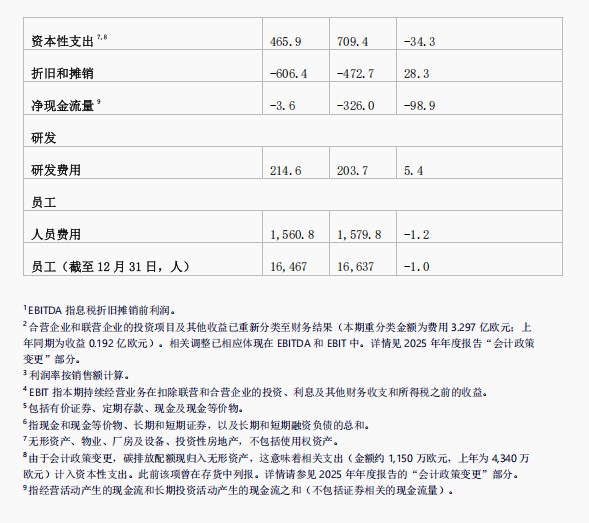
Wacker's capital expenditure for 2025 totals 466 million euros, a 34% decrease year-on-year (2024: 709 million euros). The global investment activities cover four major business segments. In the chemicals business segment, the company has built a new production plant in Karlovy Vary, Czech Republic, planning to produce high-performance, room-temperature curing silicone materials from 2026. The company has also expanded the production capacity for specialty silicones in Zhangjiagang, China, Tsukuba, Japan, and Jincheon, South Korea. Wacker has expanded the capacity for vinyl acetate-ethylene (VAE) emulsions in Calvert City, Kentucky, US. Wacker has increased the production capacity for semiconductor-grade polysilicon at its Burghausen plant in Germany: after the new cleaning line went into operation, the ultra-high purity semiconductor-grade polysilicon capacity has increased by over 50%, with further enhanced purity levels. In the biotechnology business segment, the company has invested in a new R&D center for innovative biotechnology solutions — the Wacker Biotech Center, which was officially inaugurated in Munich in mid-2025.
In 2025, the number of employees at Wacker decreased by 170. As of December 31, 2025, the group had a total of 16,467 employees worldwide (December 31, 2024: 16,637 employees). Of these, 10,749 employees were based in Germany (2024: 10,657 employees), and 5,718 employees were based outside Germany (2024: 5,980 employees).
Net cash flow, net financial debt, and shareholder equity ratio
Business Department
Organosilicon
In 2025, sales and EBITDA of the silicones business declined slightly. Sales fell to €2.73 billion, down approximately 3% year-on-year (2024: €2.81 billion). EBITDA amounted to €336 million, nearly unchanged from the prior year (2024: €341 million). The EBITDA was negatively impacted by an unfavorable product mix/volume composition, foreign exchange effects, and lower capacity utilization.
Polymer
In 2025, sales and EBITDA for the both declined. Sales fell by 6% to 1.38 billion euros (2024: 1.46 billion euros). Weak demand in the construction industry, particularly in China and Western Europe, negatively impacted the business. EBITDA decreased by 19% to 158 million euros (2024: 194 million euros), primarily due to lower sales volumes, unfavorable exchange rates, and lower selling prices, along with rising costs.
Biotechnology
In 2025, the sales and EBITDA of the biotechnology business were both lower than the previous year. Sales decreased by 4% to 360 million euros (2024: 375 million euros). EBITDA was 21 million euros, a significant decrease from the previous year (2024: 35 million euros), due to a reduction in the sales of mature products, a decrease in customer purchase volumes, and the impact of exchange rates.
Polysilicon
In 2025, both sales and EBITDA of the polysilicon business declined. Sales decreased by 7% to €883 million (2024: €949 million). EBITDA contracted sharply by 50% to €96 million (2024: €193 million), primarily due to lower sales volumes of solar-grade polysilicon. Lower capacity utilization also had a negative impact. In contrast, the ultra-high-purity semiconductor-grade polysilicon business performed well.
Outlook for 2026
Wacker expects overall sales prices to remain largely stable in 2026, with an increase in volumes. The foreign exchange rate is expected to have a negative impact on sales. Overall, a low single-digit percentage growth in sales is anticipated for 2026 (2025 sales: 5.49 billion euros), with EBITDA ranging between 550 and 700 million euros, and an EBITDA margin expected to be in the lower double-digit percentage range. The company anticipates investments of around 300 million euros for 2026. Net financial debt at the end of 2026 is expected to decrease by a low double-digit percentage compared to the end of the previous year, with significantly positive net cash flow in 2026, far exceeding the 2025 level. In the silicone business segment, sales in 2026 are expected to be on par with the previous year. Higher volumes and sales prices are expected to be offset by unfavorable exchange rate impacts, with the EBITDA margin expected to be slightly higher than the previous year.
Aggregated Polyolefins business segment sales are also expected to be in line with the prior year. Similarly, higher volumes and price increases for certain products will be offset by adverse foreign exchange effects, resulting in an EBITDA margin slightly above the prior year level.
In the biotechnology business sector, despite the market environment remaining challenging, it is expected that sales in 2026 will achieve a high single-digit percentage growth, with EBITDA projected to be around 30 million euros.
The sales of the polysilicon business segment are expected to grow, with an estimated increase in the low double-digit percentage range. The company expects a significant increase in the sales of semiconductor-grade polysilicon, while the solar-grade polysilicon business is still expected to face challenges. EBITDA is expected to remain flat compared to 2025. Higher sales and gains from efficiency improvements will be offset by higher energy costs. This forecast does not consider the potential significant impact of possible trade policy measures.
【Copyright and Disclaimer】The above information is collected and organized by PlastMatch. The copyright belongs to the original author. This article is reprinted for the purpose of providing more information, and it does not imply that PlastMatch endorses the views expressed in the article or guarantees its accuracy. If there are any errors in the source attribution or if your legitimate rights have been infringed, please contact us, and we will promptly correct or remove the content. If other media, websites, or individuals use the aforementioned content, they must clearly indicate the original source and origin of the work and assume legal responsibility on their own.
Most Popular
-
Supply Extremely Tight! LG Chem Declares Force Majeure on Export Contracts for Di-Octyl Terephthalate (DOTP)
-

Deadly Impact: Hormuz Strait Blockade Sparks Shortage of Plastic Raw Materials, Threatening Shutdowns at Japanese and Korean Chemical Plants
-
Huntsman Introduces “War Surcharge” Amid Shipping Disruption and Soaring Energy Costs, Global MDI Prices Continue to Rise
-
Catl “wins big”: Beyond Batteries, What Else Can It Sell?
-
Tao Lin: Tesla’s Supercharger Stations in China Surpass 2,500